
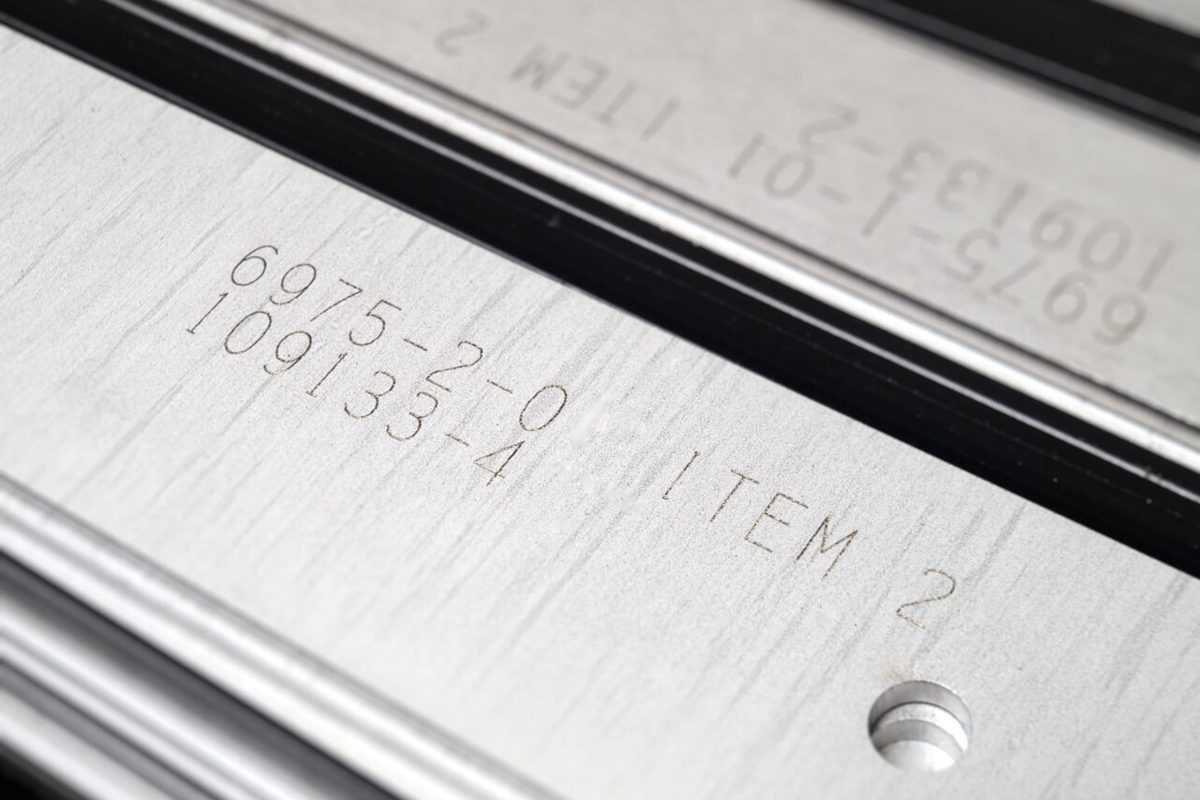
The Big Picture: Three Names, Different Mechanisms
Understanding the Laser–Material Interaction
The material’s response generally follows three energy thresholds:
- Sub-Melting Threshold: The material heats but does not melt; chemical or structural changes occur.
- Melting Threshold: The material liquefies at the surface and re-solidifies upon cooling.
- Vaporization Threshold: The material transitions directly from solid to vapor, causing material removal (ablation).
Laser Marking
Key characteristics of laser marking include:
- No material removal
- No measurable depth
- Minimal thermal stress
- High processing speed
- Preservation of corrosion resistance and mechanical integrity
Laser Etching
Mechanically and visually, laser etching provides:
- Enhanced contrast and visibility
- Slight tactile feedback
- Improved abrasion resistance compared to marking
- Faster cycle times compared to engraving
Laser Engraving
The defining features of laser engraving are:
- Clear, measurable depth
- High resistance to wear and chemicals
- Long-term legibility in harsh environments
- Strong tactile definition
A Functional Hierarchy of Permanence
Viewed collectively, these three technologies form a hierarchy of permanence and surface transformation:
- Laser marking alters appearance without altering structure.
- Laser etching reshapes the surface through controlled melting.
- Laser engraving removes material to create depth and maximum durability.
Why the Confusion Exists
Shared Technology, Different Energy Levels
Visual Similarity Masks Physical Differences
Marketing Language VS Engineering Definitions
Blurred Boundaries Due to Technological Advancement
How to Speak Clearly and Avoid Ambiguity
To reduce confusion, communication must shift from label-based language to mechanism-based specifications. Instead of asking for “laser engraving,” it is more precise to define requirements such as:
- Is material removal permitted?
- What depth is required?
- Must corrosion resistance remain unchanged?
- What environmental exposure will the part face?
- Is the mark decorative or regulatory?
Clear terminology might include phrases such as:
- “Non-removal annealed marking.”
- “Surface melt etching with shallow texture.”
- “Deep ablation engraving to 0.5 mm.”
Laser Marking Explained in Depth
What "Laser Marking" Usually Includes
Annealing
Oxidation/Discoloration
Foaming
Carbonization
Bleaching/Pigment Change
Coating Removal
Advantages of Laser Marking
Laser marking offers significant operational and engineering advantages:
- Non-contact and tool-free process
- No inks, solvents, or consumables
- High precision for fine text and 2D codes
- Fast cycle times suitable for automation
- Minimal mechanical stress
- Strong compatibility with Industry 4.0 traceability systems
- Clean and environmentally friendly operation
Limitations and Engineering Considerations
Despite its versatility, laser marking has constraints:
- Surface-level marks may degrade under heavy abrasion
- Material composition strongly affects consistency
- Some plastics require additives for optimal response
- Excessive heat may influence corrosion resistance or microstructure
- Not ideal for applications requiring deep tactile depth
Laser Engraving Explained in Depth
What Engraving Really Is
Two points are worth making crystal clear:
- Engraving is defined by depth, not by darkness. A dark mark could be annealed marking, etching, or a shallow engraving. Engraving is the one you can measure with a depth gauge—or feel with a fingernail.
- Engraving is about shape change. The surface geometry is altered on purpose. That is why it survives wear better than surface-only methods.
Engraving Physics in Simple Terms
You don’t need a physics degree to understand what’s happening. Picture the laser as a super-precise heat source concentrated into a tiny spot.
- Energy is focused into a very small area (the focal spot).
- The surface heats extremely fast—often faster than the heat can spread away.
- If the energy crosses the material’s “removal” threshold, the surface doesn’t just melt—it vaporizes and ejects tiny particles.
- Those ejected particles leave behind a pit. Millions of pits, traced in a pattern, become letters, codes, or artwork.
A few everyday factors control how engraving behaves:
- Material Absorption: Some metals reflect laser light more than others, so they may need different wavelengths or higher peak power.
- Thermal Conductivity: Materials that spread heat quickly can require more concentrated pulses to remove material efficiently.
- Pulse Duration: Shorter pulses tend to reduce excess heating around the mark, improving edge sharpness and limiting discoloration.
- Pass Strategy: One slow, high-energy pass can behave differently from several lighter passes. Multi-pass engraving often produces cleaner walls and more consistent depth.
Advantages of Laser Engraving
Laser engraving is chosen when you need markings that keep their function long after the part has been used, cleaned, rubbed, and exposed to real-world abuse.
- Exceptional Wear Resistance: Because information is recessed into the surface, it stays readable even if the top surface gets scuffed. This is why engraving is common on tools, industrial components, and equipment tags.
- True Permanence for Traceability: When regulations or quality systems require identification to last for the life of the part, engraving is often the safest bet. It supports durable serial numbers, lot codes, and 2D codes for long-term tracking.
- High Tolerance to Harsh Environments: Engraved marks generally perform better under oil, solvents, fuels, salt spray, heat, and outdoor exposure compared with surface-only contrast marks.
- Tactile Readability: Depth is not only visible; it is physical. That helps when labels must remain identifiable after paint overspray, dirt buildup, or glare. It can also support human inspection when optical contrast is poor.
- Repeatable Precision without Tool Wear: Because it is non-contact, lasers don’t dull like mechanical cutters. Once a process is dialed in, it can produce consistent results across thousands of parts with minimal variation.
- Broad Application Range: Engraving can be applied to many materials—metals, plastics, ceramics, glass, composites—though settings and laser type must be matched carefully.
Engraving Trade-Offs
Laser engraving is powerful, but it is not “better” in every case. It has real trade-offs that should be understood up front.
- Slower Cycle Time Than Marking or Etching: Depth usually requires time. Many engravings need multiple passes, especially on hard metals or when a specific depth is required for durability.
- Higher Energy Demand: Removing material typically consumes more power than changing color. This can affect operating cost and may require more robust fume extraction.
- Heat Effects and Edge Quality: Engraving can create a heat-affected zone, especially on thin parts or heat-sensitive materials. Poorly tuned parameters can cause burr-like ridges, discoloration, or micro-melting at edges.
- Surface Roughness and Debris: Material removal creates texture and can produce debris or redeposited particles around the mark. Post-cleaning may be needed for some applications (for example, medical or optical parts).
- Potential Design Constraints: Because engraving removes material, extremely deep marks on thin walls or stressed components should be evaluated to avoid weakening the part or creating stress concentrators.
Laser Etching Explained in Depth
What People Mean by "Etching"
When a laser beam delivers enough energy to reach the material’s melting threshold—but not enough to cause full vaporization—the surface briefly liquefies. As it cools, it re-solidifies in a slightly altered shape. The molten material may expand and then contract, producing:
- Subtle raised areas
- Slight depressions
- Micro-roughened texture
How Laser Etching Works in Practical Terms
Here is the process in simplified terms:
- The laser beam focuses energy into a small spot.
- The surface temperature rises rapidly.
- The material reaches its melting point.
- A thin layer liquefies.
- The laser moves away.
- The material cools and solidifies in a slightly modified form.
The outcome depends on factors such as:
- Laser wavelength and absorption efficiency
- Power density and pulse duration
- Material composition
- Surface finish
- Scanning speed
Etching VS Engraving: The Practical Difference
Etching, on the other hand, melts and re-solidifies the surface without creating a deep cavity. While there may be slight texture or micro-depth, it is significantly shallower than engraving.
- From a durability perspective:
- Engraving provides maximum wear resistance because the information is recessed into the substrate.
- Etching provides moderate wear resistance suitable for most industrial labeling needs.
- From a production standpoint:
- Engraving typically requires more energy and longer cycle times.
- Etching is faster and more energy-efficient.
Etching VS Marking: The Practical Difference
In practical terms:
- Marking affects color or reflectivity.
- Etching affects both color and surface structure.
Where Laser Etching Is Most Commonly Used
Laser etching is frequently selected for:
- Industrial equipment panels
- Automotive components
- Appliance nameplates
- Consumer product branding
- Identification tags
Advantages of Laser Etching
Laser etching offers a balanced set of benefits:
- Improved durability compared to marking
- Faster processing than engraving
- Lower energy requirements than deep ablation
- Minimal structural compromise
- Clear visual and tactile contrast
- Strong compatibility with automated production systems
Limitations of Laser Etching
Laser etching also has limitations:
- Shallower depth than engraving
- Less resistance to extreme abrasion
- Requires precise parameter control
- Material-dependent results
Laser Marking VS Laser Engraving VS Laser Etching
Depth and Geometry
Contrast and Readability
Durability
Speed and Throughput
Cleanliness and Contamination
Cosmetic Requirements
Laser marking, laser engraving, and laser etching differ primarily in how much they physically transform the material.
- Laser marking changes appearance while preserving geometry, offering speed and cleanliness.
- Laser etching reshapes the surface slightly, providing balanced durability and enhanced visibility.
- Laser engraving removes material to create depth, delivering maximum permanence at the cost of slower processing.
Materials
A practical way to think about this is:
- If the material can create contrast through oxidation or pigment change, laser marking is often the cleanest and fastest option.
- If the material benefits from a slight texture change to reduce glare, etching becomes attractive.
- If the environment is harsh (abrasion, chemicals, outdoor exposure) and the mark must survive, the engraving’s depth becomes valuable.
Metals
Stainless Steel
Stainless steel is one of the most forgiving and consistent metals for laser processing. It absorbs laser energy reasonably well and forms stable oxides when heated, which is why it supports all three processes.
- Best for Laser Marking (annealing): Annealing produces dark, high-contrast marks by creating an oxide layer without removing base material. That matters because stainless steel relies on its passive surface layer for corrosion resistance. Annealed marking is popular for medical tools, implants (where permitted), food-grade components, and cleanroom equipment because the surface remains smooth and easy to clean.
- Best for Laser Etching: When glare is an issue (brushed stainless panels, outdoor plates, angled viewing), a shallow etched texture improves readability under changing light.
- Best for Laser Engraving: For parts exposed to abrasion, frequent scrubbing, or harsh service (industrial tags, fixtures, tools), engraving provides the most long-term legibility.
Carbon Steel
Carbon steel generally absorbs laser energy efficiently and engraves cleanly, which makes it a common choice for industrial identification.
- Laser Marking: Possible, but it doesn’t offer the same corrosion-preserving benefits as stainless.
- Laser Etching: Useful for improved readability without deep material loss.
- Laser Engraving: Often the best match, especially for tooling, dies, molds, and machinery components where the mark must survive wear.
Aluminum
Aluminum’s behavior depends heavily on whether it is bare or anodized. Bare aluminum reflects a lot of laser energy and conducts heat quickly, which can reduce contrast and increase the risk of melting artifacts.
- Bare Aluminum:
- Laser Marking/Etching: Possible, but contrast may be subtle. Etching can help by creating texture that reduces glare.
- Laser Engraving: Works, but edge quality needs careful tuning because aluminum can melt and smear if the process runs too “”
- Anodized Aluminum:
- Laser Marking (Coating Removal): Often the best option. The laser selectively removes or modifies the dyed anodized layer, revealing crisp contrast beneath. This is why anodized aluminum is common for control panels, branded plates, and consumer electronics.
- Laser Etching: Used when a softer matte look is desired rather than hard contrast blocks.
Titanium
Titanium is highly responsive to controlled oxidation and is famous for producing attractive, stable marks.
- Laser Marking (Oxidation/Annealing-Style): Often the best match. With precise thermal control, titanium can produce dark marks or even “color marking”effects via oxide thickness changes. This is valuable in aerospace components, premium consumer goods, and some medical applications where minimal material removal is preferred.
- Laser Etching: Used when added glare reduction or slight texture helps readability.
- Laser Engraving: Chosen mainly for extreme wear situations, not because titanium requires it.
Copper
Copper is one of the trickier metals because it is both highly reflective and extremely thermally conductive. It tends to “reject” laser energy and then spreads whatever heat it does absorb quickly.
- Laser Marking: Can be difficult to achieve with strong contrast unless the laser setup is optimized.
- Laser Etching: Improves readability by changing reflectivity through texture.
- Laser Engraving: Often the most reliable option for permanent identification because depth remains readable even if color contrast is limited.
Brass
Brass behaves similarly to copper (reflective and conductive), though many brasses engrave reasonably well when parameters are dialed in.
- Laser Marking: Contrast can be limited depending on alloy and finish.
- Laser Etching: Helpful for glare control and “matte” branding effects.
- Laser Engraving: Frequently chosen for long-term readability (instrument plates, tags, decorative nameplates) because the recessed geometry provides clear definition.
Plastics
ABS
ABS is typically a strong performer.
- Best: Laser marking via foaming or carbonization, producing crisp contrast for housings and interior components.
- Laser Etching: Used when you want slightly more texture or a matte appearance.
- Laser Engraving: Possible, but usually shallow for cosmetic and structural reasons.
PC (Polycarbonate)
PC can mark well, but is more sensitive to heat.
- Best: Controlled marking or light etching.
- Risk: Overheating can create stress cracking, haze, or edge distortion.
- Use Case: Electronics, lenses/housings, safety components where clarity and surface integrity matter.
PA (Nylon)
Nylons often mark effectively, especially with additives.
- Best: Laser marking (pigment change/foaming-like behavior depending on formulation).
- Note: Moisture content and fillers can shift results; consistency improves when material conditioning is controlled.
PP and PE
These are often the hardest common plastics to mark well because they absorb less laser energy and melt easily.
- Best: Laser marking with laser-sensitive additives; otherwise, contrast may be weak.
- Laser Engraving: Generally not ideal for thin parts because melting and warping can occur quickly.
- Common Reality: Many industrial PP/PE parts are formulated specifically to be laser-markable.
POM (Acetal)
POM can produce good marks but needs careful control.
- Best: Carbonization-based marking in many cases.
- Risk: Too much heat can create glossy melt zones or rough edges.
High-Performance Plastics (PEEK, PSU, etc.)
These are often used where heat resistance and chemical resistance matter.
- Best: Precise marking and shallow etching; they tend to be more thermally stable and process consistently when tuned well.
- Laser Engraving: Usually shallow, especially on load-bearing or thin-walled components, to avoid weakening.
Coated and Painted Parts
Coated surfaces are often “easy wins” for readability because contrast can come from layer-to-layer difference rather than from the base material itself.
- Painted and Powder-Coated Metals: Laser marking via selective coating removal is a common best practice. Done correctly, the laser removes only the coating and exposes the substrate cleanly, producing sharp lettering and icons. This is widely used for appliance panels, industrial control boxes, and durable labeling.
- Anodized Surfaces: Similarly, removing or modifying the anodized dye layer can create crisp, high-contrast results without affecting the underlying aluminum structure.
Glass, Ceramics, and Stone
Glass
- Best: Laser etching that creates controlled micro-fractures, producing a frosted appearance.
- Laser Engraving: Possible, but higher energy increases crack risk, so control is essential.
- Laser Marking: Pure “color change marking” is generally limited unless the glass is coated or treated.
Ceramics
Ceramics vary widely by composition.
- Some ceramics darken or change color under laser exposure, enabling marking.
- Others require surface removal (etching/engraving) to create contrast.
Stone
- Best: Laser engraving (or heavy etching) that fractures or removes the surface to create contrast.
- Common for architectural features, decorative tiles, and memorial products.
Laser Types and Why They Matter
A useful way to frame it is this:
- Wavelength controls absorption (does the material take in the energy or reflect it?).
- Pulse duration and peak power control thermal behavior (does heat stay localized or spread?).
- Beam quality controls precision (how small and intense is the focal spot?).
Fiber Lasers (Near-Infrared ~1 µm)
Why Are Fiber Lasers So Common
Most metals absorb near-infrared light reasonably well (especially once the surface begins interacting thermally), and fiber systems are excellent at delivering energy into a tiny spot. That enables:
- High energy density for engraving and fine details
- Fast scanning speeds for serial numbers and 2D codes
- Repeatable results for automated production lines
- Low maintenance compared to many older laser architectures
What Fiber Lasers Do Best
- Metals: stainless steel, carbon steel, and many aluminum alloys
- High-Speed Identification: barcodes, Data Matrix codes, serials, logos
- Deep Engraving: durable recessed marks for abrasive environments
- Oxide/Anneal Marking: controlled dark marks on stainless steel
Common Limitations
CO2 Lasers (~10.6 µm)
Why CO2 Lasers Matter
Many organic materials and polymers absorb 10.6 µm radiation strongly, converting it to surface heat efficiently. As a result, CO2 lasers are often the best practical choice for:
- Plastics (especially where carbonization or surface change is desired)
- Wood, paper, cardboard, leather
- Rubber (including stamp production)
- Glass frosting (surface etching/frosted appearance)
Where CO2 Lasers Struggle
UV Lasers (~355 nm)
Why UV Lasers Behave Differently
Shorter wavelengths can trigger photochemical effects (breaking molecular bonds) in addition to photothermal heating. That typically leads to:
- Smaller heat-affected zones
- Sharper edges and finer details
- Less melting, warping, and discoloration
- Cleaner marking on sensitive plastics
Where UV Lasers Excel
- Medical and electronics plastics where burning or deformation is unacceptable
- Fine-feature marking (tiny text, micro-symbols, small 2D codes)
- Glass where you want controlled marking with reduced crack risk
- Thin films and coatings (including delicate functional layers)
Trade-Offs
Green Lasers (~532 nm)
Why Green Lasers Are Big Deals
Highly reflective conductive metals—especially copper (and sometimes gold and certain alloys)—can be difficult with near-infrared fiber lasers because they reflect a large fraction of the incoming energy. Green wavelengths can improve absorption, which leads to:
- More Stable Processing
- Less sensitivity to surface finish changes
- Cleaner marks on copper and thin conductive parts
Best-Fit Applications
- Copper marking (electronics, busbars, connectors)
- Battery manufacturing (tabs and foils where control matters)
- Thin foils and delicate conductive materials
- Precision electronics where excessive heat is unacceptable
MOPA and Pulse Shaping
What MOPA Actually Gives You
MOPA architectures allow more flexible control over pulse parameters, commonly including:
- Pulse duration (pulse width)
- Pulse repetition rate (frequency)
- Peak power vs. average power balance
- Energy per pulse
Why Pulse Shaping Changes Outcomes
Think of pulse shaping like choosing between a quick tap and a slow press:
- Short pulses concentrate energy in time, limiting how far heat diffuses. That often means sharper edges, cleaner engraving, and reduced discoloration.
- Longer pulses deliver energy more gradually, increasing melting behavior—useful for certain etching and plastic effects.
- Higher peak power pulses can drive ablation more efficiently for engraving, even if the average power stays moderate.
Real-World Advantages of MOPA Control
- Color Marking on Stainless Steel and Titanium: Controlled thermal behavior helps build stable oxide layers and sometimes produces color effects.
- Better Plastic Contrast: You can encourage foaming or pigment change without excessive burning.
- Cleaner Fine Features: Adjusting pulse width can improve the readability of tiny codes and micro-text.
- Reduced Heat Damage: Better control means fewer melt ridges, less warping, and fewer cracks in sensitive materials.
Putting It All Together
Laser type influences which of the three processes you can do effectively:
- Laser Marking: Often depends on controlled oxidation or pigment change. UV and MOPA fiber systems can be excellent for high-quality marking with minimal distortion, while CO2 shines on organics and many plastics.
- Laser Etching: Often benefits from controlled surface melt and texture. Fiber and CO2 both do this well in their respective material domains; UV can etch with very fine control on sensitive surfaces.
- Laser Engraving: Requires efficient ablation and strong energy density. Fiber lasers are the standard for deep metal engraving, while CO2 is common for deep engraving in wood and some plastics. Green lasers help when reflective metals like copper need controlled removal.
Laser types and why they matter come down to one principle: the best laser is the one whose wavelength and pulse structure match the material’s absorption and the desired mechanism.
- Fiber lasers (~1 µm) are the industrial standard for metal marking and engraving because they deliver high precision, high speed, and strong energy density.
- CO2 lasers (~10.6 µm) excel on organics and many plastics, where far-infrared absorption is strong.
- UV lasers (~355 nm) are ideal for sensitive plastics, coatings, and fine-detail work because they reduce heat damage and improve edge quality.
- Green lasers (~532 nm) improve results on highly reflective conductive metals like copper, supporting stable processing in electronics and battery manufacturing.
- MOPA and pulse shaping are critical because pulse control determines heat spread, edge quality, contrast, and even special effects like color marking—often more than raw power does.
Key Process Parameters That Control the Result
Power and Energy Density
Energy density depends on:
- Output power
- Beam spot size (focus)
- Pulse energy
- Scan speed
Practical implications:
- High energy density promotes deep engraving and faster material removal.
- Moderate energy density supports oxidation-based marking or light etching.
- Excessive energy density can cause melting, burr formation, recast layers, or micro-cracks.
Pulse Frequency (Repetition Rate)
At Constant Average Power:
- Higher frequency → lower energy per pulse
- Lower frequency → higher energy per pulse
This balance strongly affects engraving efficiency and surface finish.
- Lower Frequency (Higher Pulse Energy):
- Deeper ablation
- Stronger material removal
- More aggressive engraving
- Higher Frequency (Lower Pulse Energy):
- Smoother surface finish
- More uniform oxidation marking
- Reduced thermal shock
Pulse Duration (NS VS PS VS FS)
Pulse duration refers to how long each pulse lasts and is typically measured in:
- Nanoseconds (ns)
- Picoseconds (ps)
- Femtoseconds (fs)
This parameter directly affects heat diffusion.
- Nanosecond Pulses (ns):
- Common in industrial fiber lasers
- Suitable for most marking and engraving
- Some heat spreads into the surrounding material
- Picosecond Pulses (ps):
- Shorter pulse duration
- Reduced the heat-affected zone
- Cleaner edge quality
- More precise micro-machining
- Femtosecond Pulses (fs):
- Ultra-short pulses
- Extremely limited thermal diffusion
- Often described as “cold ablation”
- Ideal for microelectronics, glass, and delicate films
Scan Speed
Scan speed determines how quickly the laser beam moves across the material surface.
- Slower scan speed increases energy per unit area.
- Faster scan speed reduces thermal accumulation.
Scan speed interacts closely with power and frequency.
- Slower Speeds:
- Increase engraving depth
- Strengthen oxidation marking
- Risk of overheating or melting
- Faster Speeds:
- Produce lighter marks
- Improve cycle time
- Reduce thermal distortion
Line Spacing (Hatch Spacing) and Overlap
When filling shapes or engraving surfaces, the laser scans in parallel lines. The distance between these lines is the hatch spacing.
- Small hatch spacing → high overlap
- Large hatch spacing → low overlap
Overlap determines surface smoothness and uniformity.
- High Overlap:
- Smoother bottom surfaces
- More consistent depth
- Increased heat accumulation
- Low Overlap:
- Faster processing
- Possible ridges or uneven texture
Number of Passes (Layering Strategy)
Advantages of Multiple Passes:
- Improved depth control
- Reduced thermal stress
- Cleaner sidewalls
- Reduced spatter
Focus Position (Defocus Strategy)
The focal point is where the beam diameter is smallest, and energy density is highest.
- Changing the Focus Position Affects:
- Energy concentration
- Depth penetration
- Surface smoothness
- In-Focus Positioning:
- Maximum engraving depth
- High precision
- Slight Defocus:
- Wider energy distribution
- Softer surface texture
- Improved uniformity over large areas
Assist Gas/Air Blow and Extraction
Air Assist or Gas Flow:
- Clears debris from the engraving zone
- Reduces redeposition
- Improves edge clarity
- Helps control oxidation
Extraction Systems:
- Remove fumes and particulates
- Protect optical components
- Improve consistency
- Ensure operator safety
Parameter Interdependence
For Example:
- Increasing power may require increasing scan speed.
- Lowering frequency may require adjusting pulse duration.
- Tightening hatch spacing may require reducing passes to avoid overheating.
Process optimization is an iterative balancing act between:
- Depth
- Contrast
- Surface finish
- Heat management
- Production speed
In laser marking, laser engraving, and laser etching, process parameters define the outcome.
- Power and energy density determine how aggressively the material is affected.
- Pulse frequency controls energy distribution per pulse.
- Pulse duration (ns, ps, fs) governs heat diffusion and precision.
- Scan speed balances depth with throughput.
- Hatch spacing and overlap affect uniformity and surface smoothness.
- The number of passes refines depth and reduces thermal stress.
- Focus position controls energy concentration and engraving profile.
- Assist with gas and extraction ensure cleanliness, stability, and safety.
Quality Metrics
Contrast and Optical Performance
Important Factors Include:
- Contrast ratio between the marked and unmarked surface
- Uniformity of tone or depth across the entire mark
- Edge sharpness and definition
- Absence of haloing, discoloration, or scorching
- Minimal glare interference
- Compatibility with machine vision systems
For laser engraving, optical performance involves geometry:
- Clean vertical walls
- Flat, uniform bottom surfaces
- No ridges between scan lines
- No redeposited molten material
Mechanical Integrity
Mechanical Quality Assessment Should Consider:
- Absence of micro-cracks
- No embrittlement along engraving edges
- Controlled depth relative to wall thickness
- No warping or distortion
- No reduction in fatigue performance
Corrosion Resistance
Quality Checks Should Include:
- Surface smoothness
- Depth of material removal
- Cleanliness after processing
- Preservation of protective coatings
- Environmental exposure testing (when required)
Thermal Effects and Heat-Affected Zone
Thermal Quality Indicators Include:
- Minimal heat-affected zone (HAZ)
- No excessive melt ridges
- No uncontrolled discoloration
- No cracking in brittle materials
- No warping in thin plastics
Thermal Management is Particularly Critical in:
- Electronics housings
- Thin sheet metal
- Glass and ceramics
- Precision assemblies
- Medical polymers
Surface Finish and Microstructure
Important Considerations Include:
- Surface roughness levels
- Absence of resolidified droplets
- Controlled grain modification
- No subsurface cracking
Surface Finish Can Influence:
- Friction behavior
- Sealing performance
- Cleanability
- Long-term corrosion resistance
Repeatability and Process Capability
Key Indicators Include:
- Consistent engraving depth
- Stable contrast levels
- Uniform surface texture
- Reliable code readability
- Minimal batch-to-batch variation
Factors Influencing Repeatability:
- Laser power stability
- Clean optical components
- Accurate focus positioning
- Stable environmental conditions
- Consistent material preparation
Application-Specific Performance
For Example:
- Aerospace components emphasize fatigue resistance and structural safety.
- Medical devices emphasize corrosion resistance and cleanliness.
- Consumer products emphasize cosmetic uniformity.
- Industrial traceability emphasizes machine readability.
Applications
Traceability and Compliance
Traceability is one of the most critical drivers of laser processing adoption. Industries such as automotive, aerospace, medical devices, defense, oil and gas, and heavy manufacturing rely on permanent identification to meet regulatory standards, ensure product recalls can be managed, and maintain quality assurance. Common examples include:
- Serial numbers
- VIN-like part identification
- UDI (Unique Device Identification) codes
- Aerospace component tracking numbers
- 2D Data Matrix and QR codes
Where Laser Marking Wins
Laser marking—especially oxidation-based marking on stainless steel—wins in compliance-sensitive environments where surface integrity must be preserved. Because no material is removed, corrosion resistance remains intact. This is critical for:
- Surgical instruments
- Medical device components
- Aerospace fasteners
- Food-processing equipment
Where Laser Engraving Wins
Where Laser Etching Wins
Branding and Cosmetics
Examples include:
- Corporate logos
- Luxury product branding
- Decorative stainless steel panels
- Custom surface textures
- Premium product detailing
Where Laser Marking Wins
Marking through selective coating removal on anodized aluminum or painted surfaces produces crisp, high-contrast logos. It preserves surface smoothness and creates clean visual lines. This approach dominates in:
- Consumer electronics
- Laptop and smartphone housings
- Appliance panels
- Industrial user interfaces
Where Laser Etching Wins
Etching creates subtle matte finishes and fine textures. It reduces glare and enhances visual depth without aggressive material removal. Etching is common in:
- Decorative stainless steel
- Architectural panels
- High-end consumer goods
Where Laser Engraving Wins
Engraving provides depth and tactile presence. It creates dimensional branding that feels premium and durable. This is common in:
- Metal nameplates
- Tools
- Plaques
- Luxury accessories
Tooling, Molds, and Industrial Wear
Industrial tooling faces abrasion, high temperature, repeated cleaning, and mechanical stress. Applications include:
- Injection mold cavity identification
- Die markings
- Fixture and tooling IDs
- Machine component labeling
Where Laser Engraving Wins
Engraving dominates in high-wear industrial environments. Recessed depth ensures markings remain legible after repeated abrasion, polishing, or surface refinishing. It is commonly used in:
- Hardened steel molds
- Casting dies
- Industrial machinery components
Where Laser Etching Wins
Where Laser Marking Wins
Electronics and Micro-Components
Electronics manufacturing demands precision, minimal heat impact, and micro-scale detail. Applications include:
- PCB labeling
- Semiconductor identification
- Micro connectors
- Thin conductive components
- Battery tab marking
Where Laser Marking Wins
Precision marking—often using short pulse durations—produces extremely fine characters and codes with minimal heat-affected zones. This is critical for:
- Microelectronics
- Sensitive polymers
- Thin metal enclosures
Where Laser Etching Wins
Where Laser Engraving Wins
Consumer Goods Personalization
Personalization has become a significant application area for laser technology. Examples include:
- Engraved jewelry
- Customized drinkware
- Personalized tools
- Promotional gifts
- Branded merchandise
Where Laser Engraving Wins
Engraving provides tactile depth and permanence. It creates a premium feel and ensures the personalization does not fade. Common uses include:
- Stainless steel tumblers
- Knives
- Watches
- Metal accessories
Where Laser Marking Wins
Where Laser Etching Wins
Choosing the Right Process
Do You Need Depth?
Depth is often the first and most influential question because it directly impacts durability and structural interaction. If the mark must survive:
- Heavy abrasion
- Sandblasting
- Repainting or powder coating
- Repeated mechanical cleaning
- Surface refinishing
However, depth comes with trade-offs:
- Increased processing time
- Higher energy consumption
- Potential stress concentration in thin parts
- Slight geometry changes
Is the Mark Primarily for Humans, Scanners, or Both?
Human Readability
When humans read the mark directly, factors such as:
- Contrast
- Font clarity
- Surface glare
- Aesthetic integration
Scanner Readability
For traceability applications, automated scanners must reliably detect edges and contrast differences. Machine readability depends on:
- Consistent contrast ratio
- Sharp transitions between marked and unmarked areas
- Minimal background noise
- Stable grayscale levels
Combined Requirements
What Environment Will the Part See?
Environmental exposure is one of the most decisive factors. Consider:
- Mechanical abrasion
- Salt spray or marine conditions
- Chemical exposure
- UV radiation
- High temperatures
- Vibration
How Fast Must You Produce?
Production throughput directly affects cost and feasibility.
- Laser marking is typically the fastest process. Because it does not remove material, cycle times are shorter, and energy consumption is lower.
- Laser etching requires slightly more time due to controlled melting, but remains efficient.
- Laser engraving, particularly deep engraving, is slower because material must be removed layer by layer. Multiple passes may be required to achieve the desired depth.
Can the Surface Tolerate Heat and Texture Change?
Questions to evaluate:
- Will engraving weaken thin sections?
- Can the material handle rapid heating and cooling?
- Will the surface distortion affect assembly?
- Does texture change interfere with function?
What Material and Finish Is It?
For example:
- Stainless steel: Supports marking, etching, or engraving. Corrosion requirements often favor marking.
- Carbon steel: Engraving provides durability but may require post-treatment.
- Anodized aluminum: Ideal for marking via coating removal.
- Plastics: Often better suited for marking or shallow etching.
- Coated or painted surfaces: Marking through selective removal produces high contrast.
What Level of Aesthetic Quality Is Required?
In branding or consumer applications, cosmetic uniformity may outweigh depth.
- Laser marking provides smooth, clean results.
- Laser etching adds subtle texture and matte refinement.
- Laser engraving creates dimensional, tactile effects.
What Are the Long-Term Maintenance and Lifecycle Expectations?
Consider:
- Will the part be cleaned frequently?
- Will it be exposed to chemicals?
- Will the mark need to remain readable for decades?
Common Problems and How to Think About Fixes
The most productive way to troubleshoot is not to randomly increase power or slow the machine. Instead, think in terms of mechanisms:
- Is there too little energy or too much?
- Is the heat confined or spreading?
- Is material being cleanly removed or partially melted?
- Is the surface chemistry being altered correctly?
- Is contamination interfering?
Problem 1: "My Mark Is Too Light"
Possible Root Causes
- Insufficient energy density: Power may be too low, or the beam may be slightly defocused.
- Scan speed too high: Energy does not dwell long enough on the surface.
- Pulse frequency too high: Energy per pulse becomes too low to trigger a strong reaction.
- Surface contamination: Oil, oxidation, or protective films reduce absorption.
- Material incompatibility: The wavelength may not couple efficiently with the material.
How to Think About the Fix
Problem 2: "Edges Are Fuzzy" or "Characters Look Melted"
Typical Causes
- Excessive power
- Scan speed is too slow
- Too much hatch overlap
- Long pulse duration
- Dirty optics are causing beam distortion
- Improper focus
Structured Fix Approach
- Increase scan speed slightly.
- Reduce power incrementally.
- Reduce overlap between scan lines.
- Adjust pulse duration if the system allows it.
- Clean optics and verify beam quality.
Problem 3: "Engraving Has Burr-Like Ridges" or "Recast Material"
Why It Happens
- Energy per pass is too high.
- Material removal rate exceeds ejection efficiency.
- Insufficient air assist or debris extraction.
- Excessive heat accumulation due to tight hatch spacing.
- High frequency with insufficient peak power.
Practical Fix Strategy
- Reduce energy per pass.
- Increase the number of passes for gradual removal.
- Improve air assist and extraction efficiency.
- Slightly widen hatch spacing to reduce heat buildup.
- Adjust focus depth during deep engraving.
Problem 4: "Stainless Mark Rusts After Salt Spray"
Possible Causes
- Deep engraving exposing raw metal
- Overheating alters surface microstructure
- Surface roughness traps contaminants
- Contamination from carbon steel tools or particles
- Inadequate post-process cleaning
- Lack of passivation treatment
How to Approach the Fix
If corrosion resistance is critical, consider:
- Switching from engraving to annealed marking.
- Reducing engraving depth.
- Applying post-process passivation.
- Ensuring clean handling procedures.
- Avoiding cross-contamination with carbon steel materials.
Problem 5: Inconsistent Results Between Parts
Possible Causes
- Laser power instability
- Optical contamination
- Focus drift
- Surface variation between material batches
- Environmental temperature changes
- Inconsistent fixturing
Fix Strategy
- Verify laser output stability.
- Inspect and clean optics regularly.
- Confirm consistent focal positioning.
- Standardize surface preparation.
- Control environmental variables where possible.
Cost, Ownership, and Production Considerations
CapEx VS. Process Cost
Capital Expenditure (CapEx)
Capital expenditure includes all upfront costs required to acquire, install, and commission a laser system. These costs typically involve:
- The laser source (fiber, CO2, UV, green, or ultrafast)
- Beam delivery system (galvo scanner or motion stage)
- Safety enclosure and compliance systems
- Fume extraction and filtration
- Cooling systems (air or water)
- Control software and hardware
- Installation, training, and commissioning
Process Cost
Key contributors to process cost include:
- Energy consumption
- Consumables (filters, protective windows)
- Preventive maintenance labor
- Replacement parts
- Downtime losses
- Scrap and rework
- Cycle time per part
A comprehensive financial evaluation should consider Total Cost of Ownership (TCO), which includes:
- Initial system investment
- Energy and consumable costs
- Maintenance and service expenses
- Downtime impact on production
- Quality-related losses
- Regulatory and compliance risk
Maintenance and Uptime
Uptime as a Financial Driver
Downtime can cause:
- Missed production targets
- Overtime labor
- Line imbalance
- Expedited shipping
- Customer dissatisfaction
Maintenance Considerations
Modern fiber lasers are widely used because they offer:
- Long operational lifespan
- Stable optical alignment
- High electrical efficiency
- Minimal routine adjustment
Routine maintenance typically involves:
- Cleaning focusing optics
- Replacing extraction filters
- Inspecting cooling systems
- Verifying beam alignment
- Updating control software
Production Throughput and Efficiency
Laser marking provides the fastest throughput because it involves minimal material removal. It is well-suited for:
- Automotive serial numbering
- Consumer electronics labeling
- High-volume industrial traceability
Production efficiency must account for:
- Required daily output
- Shift patterns
- Changeover time between part types
- Integration with upstream and downstream operations
- Inspection and verification time
Automation Readiness
Integration with Automated Workflows
Automation-ready systems support:
- Robotic loading and unloading
- PLC communication and digital I/O
- Conveyor synchronization
- Vision alignment systems
- Automatic code verification
- Real-time data logging
Digital Traceability and Data Integration
Laser marking systems that integrate with:
- Manufacturing Execution Systems (MES)
- Enterprise Resource Planning (ERP) platforms
- Quality management systems
Scalability and Long-Term Flexibility
Considerations include:
- Ability to process new materials
- Upgradeable software and firmware
- Modular automation expansion
- Spare part availability
- Vendor service support
Workforce and Operational Simplicity
Systems that provide:
- User-friendly interfaces
- Parameter presets
- Remote diagnostics
- Clear maintenance documentation
- Reduce training time and operator error
Summary
Get Laser Marking Solutions
Tailored Solutions for Your Industry
Every industry has unique requirements. Faster Laser provides customized configurations for:
- Automotive traceability and VIN-like identification
- Medical device UDI and corrosion-resistant marking
- Aerospace component serialization
- Electronics and micro-component marking
- Consumer goods branding and personalization
Intelligent Integration and Automation
Modern production requires more than standalone machines. Faster Laser offers intelligent systems designed for seamless integration with:
- Robotic loading systems
- PLC-controlled production lines
- Vision positioning systems
- MES and ERP traceability platforms
Reliable Performance and Long-Term Value
Drawing upon years of deep expertise in industrial laser cutting, welding, marking, and cleaning, this article presents information based on practical experience and the latest industry insights. By providing clear and technically sound guidance, it helps readers select the right machines, understand process trade-offs, and optimize workflows.
My goal is to help engineers, shop floor managers, and production decision-makers make informed choices that perfectly combine innovation, quality, and operational efficiency.
Drawing upon years of deep expertise in industrial laser cutting, welding, marking, and cleaning, this article presents information based on practical experience and the latest industry insights. By providing clear and technically sound guidance, it helps readers select the right machines, understand process trade-offs, and optimize workflows.
My goal is to help engineers, shop floor managers, and production decision-makers make informed choices that perfectly combine innovation, quality, and operational efficiency.