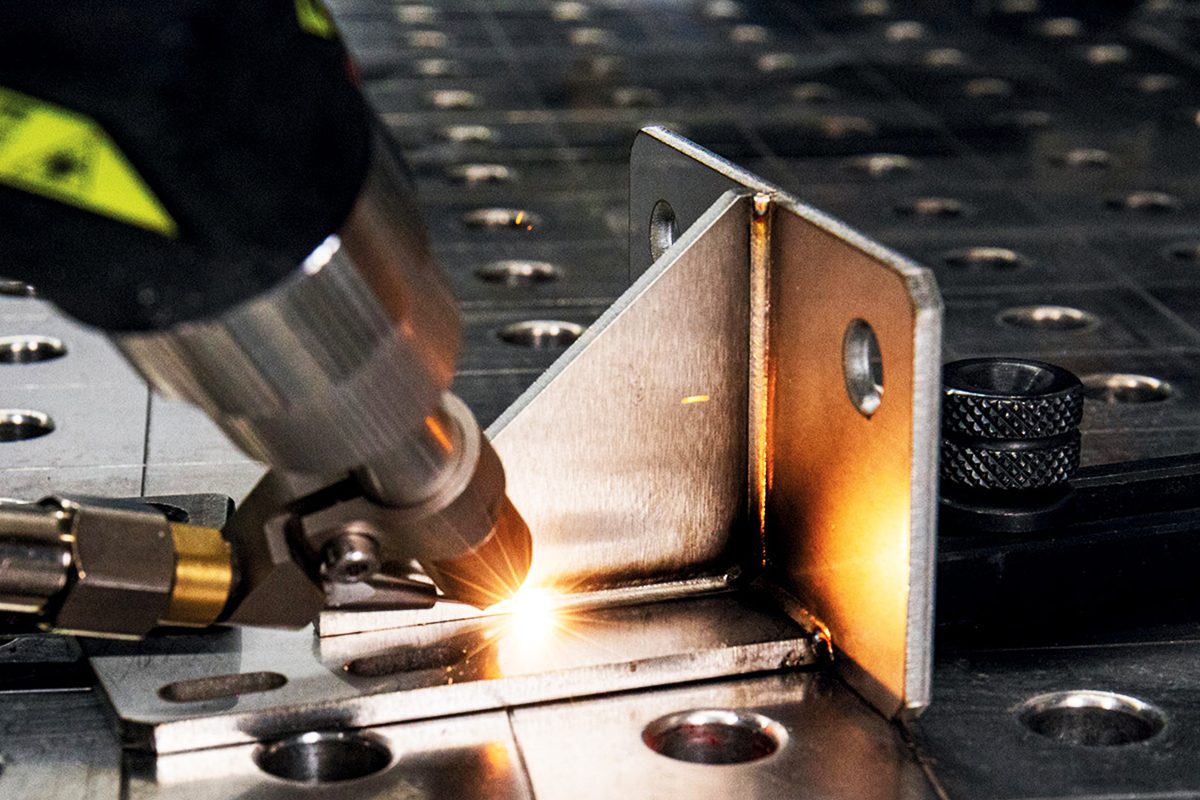
Autogenous VS Filler Laser Welding

This article explores the differences between autogenous and filler laser welding, including process principles, material behavior, joint design, defects, cost factors, and selection guidelines.
Home » Blog » Autogenous VS Filler Laser Welding
Autogenous VS Filler Laser Welding
Laser welding has become a cornerstone joining technology in modern manufacturing due to its high precision, deep penetration capability, low heat input, and excellent suitability for automation. As industries such as automotive, aerospace, electronics, medical devices, and precision metal fabrication continue to demand lighter structures, tighter tolerances, and higher production efficiency, laser welding methods are increasingly selected over conventional arc-based processes. Within laser welding, two fundamental approaches dominate practical applications: autogenous laser welding and filler laser welding. Understanding the differences between these two methods is essential for selecting the most appropriate process for a given material, joint design, and performance requirement.
Autogenous laser welding relies solely on melting and fusing the base materials without the addition of filler metal. The joint is formed by the laser’s concentrated energy, which creates a small, controlled molten pool that solidifies rapidly. This method is valued for its simplicity, high welding speed, minimal distortion, and clean weld appearance. It is commonly used for thin materials, precision components, and applications where tight dimensional control and high repeatability are critical.
In contrast, filler laser welding introduces an additional metal wire or powder into the molten pool during the welding process. The filler material helps bridge joint gaps, adjust weld chemistry, and improve mechanical properties or crack resistance. This approach offers greater flexibility when dealing with thicker sections, imperfect fit-up, dissimilar materials, or alloys prone to solidification defects. Although it adds process complexity, filler laser welding significantly expands the range of weldable materials and joint configurations.
This article provides a comprehensive comparison of autogenous and filler laser welding, exploring their principles, advantages, limitations, and typical applications. By examining how each method influences weld quality, process stability, and production efficiency, readers can gain a clearer understanding of which laser welding strategy best aligns with their manufacturing objectives.
Autogenous VS Filler Laser Welding

What “Autogenous” and “Filler” Laser Welding Mean

In laser welding terminology, autogenous and filler describe two fundamentally different strategies for forming the weld metal. The distinction goes beyond whether additional material is used; it directly influences joint design tolerance, process robustness, metallurgical control, and long-term performance of the welded component. While both approaches rely on the same high-energy, highly focused laser beam to generate a molten pool, they differ in how that molten pool is sustained, stabilized, and solidified. Understanding these meanings in depth is essential for correctly matching a laser welding method to material type, part geometry, and production conditions.

Autogenous Laser Welding (No Filler)

Autogenous laser welding produces a joint solely by melting and fusing the base materials, without adding any filler metal. The laser beam concentrates energy into a very small interaction zone, often forming a keyhole that enables deep penetration with minimal heat input. As the molten pool solidifies, the weld metal is chemically identical—or very close—to the parent material.
Because no additional material is available to compensate for imperfections, this process demands exceptional joint quality. Edge preparation, alignment, and surface cleanliness must be tightly controlled, and allowable joint gaps are extremely small. Autogenous laser welding, therefore, excels in applications where parts are manufactured with high dimensional accuracy and consistent repeatability. It is widely used for thin sheets, sealed joints, micro-welds, and precision assemblies where minimal distortion, narrow welds, and high processing speed are critical. However, the lack of filler also limits the ability to modify weld chemistry or mitigate metallurgical issues such as solidification cracking, porosity sensitivity, or reduced ductility in certain alloys.

Filler Laser Welding (Wire or Powder)

Filler laser welding introduces an additional material—most commonly a metal wire, and less frequently powder—into the laser-generated molten pool. The filler melts together with the base material and becomes part of the final weld metal. This added material fundamentally changes how the weld pool behaves and how the joint solidifies.
By supplying filler, the process gains greater tolerance to joint gaps, edge mismatch, and surface irregularities. More importantly, filler selection allows intentional control over weld metal composition, enabling improvements in crack resistance, mechanical strength, corrosion performance, or compatibility when joining dissimilar metals. Wire feeding is the preferred industrial solution because it offers stable deposition, precise control, and clean processing, especially in automated systems. Powder filler is typically reserved for specialized applications such as cladding or localized material buildup. Although filler laser welding requires additional equipment and more complex parameter coordination, it significantly expands the range of weldable thicknesses, materials, and joint designs.
Autogenous laser welding relies on precision and consistency, using only the base materials to achieve fast, clean, and low-distortion joints under tightly controlled conditions. Filler laser welding introduces adaptability, allowing the process to accommodate real-world variations in fit-up and material behavior while offering greater metallurgical control. Understanding what “autogenous” and “filler” laser welding truly mean provides a critical foundation for selecting the appropriate welding strategy and achieving reliable, high-quality results in industrial production.

How Laser Welds Form

The formation of a laser weld is governed by the interaction between laser power density, material properties, and heat transfer behavior at the joint. Depending on how much energy is delivered to a given area and how the material responds, laser welding operates primarily in either conduction mode or keyhole mode. These two regimes define the shape, depth, and stability of the molten weld pool and strongly influence whether a weld can be made autogenously or benefit from added filler material. Understanding these mechanisms is essential for selecting suitable process parameters and achieving consistent weld quality.

Conduction Mode

Conduction mode welding occurs when the laser’s power density is insufficient to cause significant material vaporization. The laser heats the surface, creating a shallow molten pool, and heat is transferred into the material mainly through thermal conduction. The weld pool is relatively calm, with smooth flow and limited penetration, typically resulting in a wide, shallow bead.
Because conduction-mode welds have low penetration and minimal turbulence, they are well-suited for thin materials, fine joints, and applications where surface quality and dimensional accuracy are critical. Autogenous laser welding is often effective in this mode, provided joint fit-up is precise and gaps are extremely small. However, conduction-mode welding offers little tolerance for variation. Minor gaps, surface irregularities, or changes in thickness can quickly lead to a lack of fusion or insufficient throat thickness. In such cases, the controlled addition of filler material can help compensate for geometric imperfections, improve bead profile, and increase joint reliability, even though overall penetration remains limited by the conduction regime.

Keyhole Mode

Keyhole mode welding is achieved when laser power density exceeds the vaporization threshold of the material. Localized vaporization generates a high-pressure metal vapor that displaces molten metal and forms a deep, narrow cavity—the keyhole. The laser beam is trapped within this cavity by multiple reflections, dramatically increasing energy absorption and enabling deep penetration with relatively low overall heat input.
Keyhole mode allows high-speed welding of thicker materials and full-penetration joints but introduces a more complex and dynamic molten pool. Instabilities in the keyhole can cause collapse, leading to porosity, spatter, or underfill. In autogenous laser welding, these effects are highly sensitive to joint gap consistency and material behavior during rapid solidification. Adding filler material in keyhole welding can stabilize the molten pool, supply additional metal to compensate for joint gaps, and reduce the risk of defects. Filler choice also enables control over weld metal composition, helping mitigate cracking and improve mechanical performance in alloys exposed to high cooling rates.
Conduction and keyhole modes represent two distinct laser welding mechanisms with different implications for filler use. Conduction mode favors stable, shallow welds and works best with autogenous laser welding on thin, well-fitted joints. Keyhole mode enables deep penetration and high productivity but is more sensitive to process disturbances, making filler material increasingly valuable for gap bridging, pool stabilization, and metallurgical control. Understanding how these modes form and behave is fundamental to choosing the appropriate laser welding strategy and filler approach for reliable, high-quality results.

What Changes When You Add Filler

Introducing filler material into laser welding fundamentally reshapes both the physical behavior of the weld pool and the metallurgical outcome of the joint. In autogenous laser welding, the process is constrained by a closed system: laser energy melts only the base material, and the final weld geometry and chemistry are dictated almost entirely by joint preparation and alloy behavior. When filler wire or powder is added, the system becomes open and adjustable. Mass input, heat balance, fluid flow, solidification path, and chemical composition can now be actively influenced. This expanded control is the reason filler laser welding can solve many real-world manufacturing problems—but it also introduces new sensitivities that must be understood and managed.

Mass Balance and Bead Geometry

The most immediate change caused by filler addition is the increase in available molten metal volume. In autogenous laser welding, the weld pool volume is limited to what can be melted from the joint edges. Any mismatch between joint volume and available molten metal leads directly to underfill, concavity, or burn-through. Filler breaks this limitation by supplying external material to satisfy the required weld volume.
This has a profound effect on bead geometry. Reinforcement height, bead width, and toe wetting can now be controlled independently of penetration depth. This is particularly important in laser welding, where penetration is often deep and narrow while surface fill is insufficient. However, mass balance must remain precise. Excessive filler can overfill the joint, shield sidewalls from laser energy, and create lack-of-fusion defects or high crowns that increase residual stress and reduce fatigue performance.

Heat Flow and Pool Dynamics

Filler addition significantly alters heat flow. Incoming wire or powder must absorb energy to melt, effectively acting as a moving heat sink. If laser power, focus, or travel speed are not adjusted, penetration depth can decrease, and keyhole stability can suffer. At the same time, the added molten metal increases pool volume and thermal inertia, often extending pool lifetime and moderating cooling rates.
Pool dynamics also change. Filler introduces mechanical momentum and modifies temperature gradients that drive surface-tension-based (Marangoni) flow. Correctly fed filler can smooth flow patterns, reduce underfill, and dampen keyhole oscillations. Poorly synchronized filler delivery can destabilize the keyhole, increase spatter, and trap gas, raising porosity risk. Wire angle, feed position, and timing, therefore, become critical control variables rather than secondary details.

Solidification Behavior

Laser welds are characterized by extremely high cooling rates, which promote steep thermal gradients and rapid solidification. Filler affects solidification in two key ways. First, a larger, more stable molten pool generally cools more slowly, reducing thermal stress and shrinkage strain. Second—and more importantly—filler chemistry directly controls how the weld metal solidifies.
Proper filler selection can narrow the solidification temperature range, alter solidification mode, and suppress hot cracking in crack-sensitive alloys. It can also improve toughness, ductility, and corrosion resistance by steering microstructure away from brittle phases. Conversely, mismatched fillers can increase hardness, promote segregation, or form brittle intermetallics, especially in dissimilar-metal welding, where laser cooling rates magnify compositional effects.

Dilution

Dilution defines the proportion of base material versus filler in the final weld metal and is a central metallurgical variable in filler laser welding. Autogenous laser welds are effectively 100% base metal. With filler, dilution becomes adjustable through joint design, penetration depth, and filler feed rate.
High dilution preserves base-metal chemistry but limits metallurgical correction. Lower dilution allows the filler to dominate, enabling intentional chemistry shifts to reduce cracking, improve corrosion resistance, or facilitate dissimilar metal joining. However, excessive reduction in dilution can create a weld metal that is chemically and mechanically mismatched to the base material, leading to fatigue, corrosion, or compatibility issues.
Adding filler transforms laser welding from a tightly constrained process into a tunable system. It changes the mass balance that defines bead geometry, reshapes heat flow and molten pool dynamics, alters solidification behavior and microstructure, and enables active control of weld chemistry through dilution. When these factors are carefully balanced, filler expands the laser welding process window—improving gap tolerance, stability, and metallurgical reliability. When they are not, filler can introduce new defects and performance risks. Mastery of these physical and metallurgical changes is essential for using filler effectively in high-quality laser welding.

Autogenous Laser Welding

Autogenous laser welding is a laser welding process in which the joint is formed entirely by melting and fusing the base materials, without adding any filler wire or powder. The laser delivers a highly concentrated energy density that produces a small, controlled molten pool and rapid solidification. As a result, weld shape, penetration, and final properties are governed almost exclusively by joint geometry, material characteristics, and laser parameters. This makes autogenous laser welding a high-precision, low-tolerance process, ideally suited to environments where part consistency and joint preparation can be tightly controlled.
Rather than compensating for variation, autogenous laser welding demands that it be eliminated upstream. When this condition is met, the process offers exceptional speed, cleanliness, and dimensional control.

Advantages

The most notable advantage of autogenous laser welding is its process simplicity. With no filler feeding system, the welding head is compact, mechanically stable, and easier to integrate into automated or robotic production lines. Fewer interacting variables reduce setup time, simplify parameter optimization, and improve long-term repeatability—key benefits in high-volume manufacturing.
Autogenous laser welding also delivers minimal heat input. The focused laser beam creates narrow welds and very small heat-affected zones, significantly reducing distortion, residual stress, and microstructural alteration of the base material. This is especially important for thin sheets, precision components, micro-welds, sealed enclosures, and assemblies with tight dimensional or cosmetic requirements.
Because the weld metal is chemically identical to the base material, autogenous laser welding avoids issues related to filler compatibility, dilution control, or unintended changes in corrosion or mechanical properties. This chemical continuity is particularly advantageous where uniform material performance is critical.

Disadvantages

The primary limitation of autogenous laser welding is its extremely narrow process window. Joint fit-up must be precise, with very small gaps, accurate alignment, and clean, well-prepared surfaces. Even minor deviations can lead to underfill, lack of fusion, or burn-through. As a result, quality risk is shifted upstream to machining accuracy, forming consistency, and fixturing precision.
Autogenous laser welding also provides no metallurgical flexibility. Because weld chemistry cannot be modified, alloys prone to hot cracking, segregation, or rapid solidification defects are difficult to weld reliably. Dissimilar metal welding is especially challenging. In thicker sections or keyhole-mode welding, the absence of additional molten metal can reduce weld pool stability, increasing sensitivity to porosity, keyhole collapse, and solidification defects.
Autogenous laser welding is a precision-focused joining method that excels when joint geometry, material behavior, and process conditions are tightly controlled. Its simplicity, high speed, low heat input, and clean weld quality make it ideal for thin materials and automated, high-repeatability production. However, its strict fit-up requirements and lack of metallurgical adaptability limit its suitability for variable joints, thicker sections, and crack-sensitive or dissimilar materials. In practice, autogenous laser welding is most effective when precision can be guaranteed rather than when flexibility is required.

Filler Laser Welding

Filler laser welding is a laser welding process in which additional material—most commonly metal wire, and in some applications powder—is introduced into the laser-generated molten pool during welding. Unlike autogenous laser welding, which relies entirely on melting the joint edges, filler laser welding deliberately supplies extra metal to satisfy joint volume, stabilize the molten pool, and modify weld metal chemistry. This changes laser welding from a tightly constrained, geometry-driven process into a more adaptable system that can be engineered to tolerate variation and address metallurgical challenges. For this reason, filler laser welding is widely used in industrial applications where joint fit-up, material behavior, or performance requirements exceed the limits of autogenous laser welding.

Advantages

The most significant advantage of filler laser welding is its robustness to real-world joint conditions. Adding filler metal allows the weld to bridge gaps, compensate for edge mismatch, and maintain consistent bead geometry even when parts are not perfectly aligned. This expanded tolerance dramatically reduces sensitivity to upstream manufacturing variation and fixturing accuracy, especially in thicker sections and complex joint designs.
Filler laser welding also provides active control over weld metal metallurgy. By selecting appropriate filler alloys and managing dilution, engineers can reduce hot cracking, control solidification behavior, improve ductility and toughness, and enhance corrosion resistance. This capability is critical for crack-sensitive alloys and for joining dissimilar materials. In keyhole welding, filler can further improve process stability by supplying additional molten metal that helps maintain bead fill and dampens keyhole and pool fluctuations.
Another important benefit is independent control of penetration and bead shape. Laser parameters can be optimized for penetration and fusion, while filler feed rate is adjusted to achieve the desired reinforcement and throat thickness. This separation of functions is especially valuable in deep-penetration laser welds, where penetration alone does not guarantee sufficient surface fill or mechanical strength.

Disadvantages

The advantages of filler laser welding come with increased process complexity. Additional hardware is required for wire or powder feeding, and precise synchronization between laser power, travel speed, filler feed rate, and filler position becomes critical. This increases setup time, maintenance requirements, and the level of operator or automation expertise needed to maintain stable production.
Improper filler use can introduce new risks. Excessive filler can block laser energy from reaching the joint sidewalls, leading to a lack of fusion, while unstable feeding or incorrect wire placement can disturb the molten pool and increase spatter or porosity. Poor filler selection or uncontrolled dilution can also produce excessive hardness, brittle microstructures, corrosion susceptibility, or reduced fatigue life. Compared with autogenous laser welding, filler laser welding is generally slower and slightly higher in heat input, which may increase distortion or post-weld finishing demands if not carefully managed.
Filler laser welding expands the laser welding process window by adding both material volume and metallurgical control. It offers superior gap tolerance, improved weld stability, and the ability to tailor weld metal properties for challenging materials and joint designs. These advantages come at the cost of greater system complexity and tighter process control requirements. When properly engineered and controlled, filler laser welding provides a versatile and reliable solution for demanding industrial welding applications where precision alone is not sufficient.

Joint Design and Fit-Up

Joint design and fit-up are where the practical differences between autogenous and filler laser welding become most visible. Autogenous laser welding is fundamentally volume-limited: all weld metal must be created by melting the joint edges. This makes it extremely efficient and clean when parts fit tightly, but unforgiving when gaps, mismatches, or variable thickness appear. Filler laser welding is volume-enabled: added wire or powder supplies extra metal to bridge gaps, build reinforcement, and stabilize bead formation. However, filler does not eliminate the need for sound joint design—poor access, unstable melt flow, or poorly defined joint geometry can still lead to a lack of fusion or inconsistent weld quality. The divergence between the two methods grows as joint volume increases, fit-up becomes less predictable, or access becomes more complex.

Butt Joints

Butt joints provide the clearest contrast between autogenous and filler laser welding. In autogenous butt joints, success depends on precise edge preparation and alignment. Even small gaps increase the weld volume requirement; without filler, this often results in concave beads, underfill, or reduced effective throat thickness. These geometric deficiencies can compromise fatigue strength and leak tightness, even if penetration appears adequate. Autogenous butt welding, therefore, works best with laser-cut or machined edges, rigid fixturing, and thin to moderate material thickness.
In filler butt welding, the added wire compensates for gap variation and supports a consistent surface fill. This is especially important in thicker sections or beveled joints, where groove volume increases rapidly. Filler allows penetration and bead shape to be controlled independently, but it introduces sensitivity to wire placement: poor aiming or excessive feed can block sidewall fusion or create excessive reinforcement.

Lap Joints

Lap joints are attractive for fixturing but challenging for fusion quality. In autogenous lap welding, intimate contact at the faying interface is critical. Small gaps or trapped coatings reduce heat transfer and can produce welds that look sound from the top while lacking fusion at the interface. Coated materials, such as galvanized steel, further complicate lap joints by generating vapor at the interface, increasing spatter and porosity risk.
Filler lap welding is less common for simple overlaps but becomes useful when joint flatness varies, when edge underfill occurs, or when a fillet-style reinforcement is required at the lap edge. However, filler cannot fully overcome vapor-driven instability; joint venting, beam positioning, and penetration control remain essential.

Fillet Joints

Fillet joints inherently require additional weld metal to form a defined throat. This pushes autogenous fillet welding toward its practical limits. On thin materials with tight corner contact, small autogenous fillets are possible, but even minor root gaps dramatically increase the required weld volume. The result is often undersized fillets, poor toe wetting, or lack of root fusion.
Filler laser welding is typically preferred for fillets because wire supplies the necessary volume to build a consistent throat and smooth toe transitions. This improves static strength and fatigue performance. Precise wire positioning is critical: uneven delivery can cause asymmetric wetting, incomplete root fusion, or excessive buildup on one leg.

Edge Welds and Hem Joints

Edge welds and hem joints are highly sensitive to alignment and clamping. In autogenous edge welding, consistent edge contact and thickness are essential. Heat can escape rapidly at free edges, making penetration inconsistent if alignment varies. Hem joints add complexity due to multiple layers and changing thickness, increasing the risk of intermittent fusion or burn-through.
Filler edge and hem welding can help fill variable gaps and provide reinforcement for stiffness or sealing. However, access is often limited, and reliable wire placement may be difficult. If filler cannot be delivered consistently into the molten pool, improving clamping and fit-up is usually more effective than forcing filler into a constrained joint.

Tube-to-Sheet and Tube-to-Tube Joints

Tubular joints magnify fit-up challenges because perfect circumferential contact is rare. In autogenous tube-to-sheet welding, excellent results are possible when seating is precise and gaps are uniform, producing clean, low-distortion, leak-tight welds. The risk lies in local gap variation: a small unfused segment can create a leak path even if most of the weld appears sound.
Filler laser welding is frequently used for tube joints to accommodate circumferential gap variation and maintain consistent bead height and throat size. It is also advantageous when strength or fatigue performance requires defined reinforcement. The challenge is process control along a three-dimensional path—wire aim, shielding, and heat balance must remain stable around the entire circumference to avoid uneven buildup or local lack of fusion.
Joint design is where autogenous and filler laser welding diverge most in real manufacturing. Autogenous laser welding excels when joint volume is low, gaps are minimal, and fit-up is tightly controlled—such as precision butt joints, well-clamped lap seams, and select edge welds. Filler laser welding becomes increasingly advantageous as joint volume grows, fit-up varies, or reinforcement is required for strength or sealing, as seen in fillets, tubular joints, and variable hems. In essence, autogenous laser welding rewards precision, while filler laser welding buys tolerance and control, provided the joint geometry and access are designed to support stable filler delivery and fusion.

Materials Perspective

From a materials standpoint, the choice between autogenous and filler laser welding is rarely neutral. Laser welding imposes extreme conditions on the molten pool: very high energy density, steep thermal gradients, and rapid solidification. These conditions magnify intrinsic alloy behaviors such as hardenability, solidification cracking tendency, gas solubility, oxide stability, reflectivity, and thermal conductivity. Autogenous laser welding works best when an alloy tolerates these conditions without requiring chemical adjustment or extra weld metal volume. Filler laser welding becomes increasingly important when alloy behavior must be moderated, when joint gaps cannot be eliminated, or when dilution must be controlled to avoid brittle phases or property loss. Viewed this way, alloy type often drives the welding strategy rather than merely influencing it.

Carbon Steels

Low-carbon steels are among the most forgiving materials for laser welding. They generally tolerate rapid solidification well and show low susceptibility to hot cracking, making autogenous laser welding highly effective for thin sheets, tailored blanks, and high-speed seam welding. The narrow weld and small heat-affected zone preserve strength and dimensional accuracy.
As carbon content and strength increase, the concern shifts to hardening and cold cracking. Rapid cooling promotes martensite formation, raising hardness and crack risk, especially in the presence of hydrogen. In these cases, filler may be used to lower the effective carbon content in the weld metal, improve toughness, and widen the process window. Preheat, cleanliness, and cooling control often work together with filler to manage cracking risk.

Stainless Steels

Stainless steels require alloy-family-specific decisions.
Austenitic grades are often welded autogenously with good results when fit-up and shielding are excellent. However, rapid solidification can promote hot cracking in some compositions. Filler laser welding is frequently used to control solidification mode—often by ensuring a small ferrite fraction in the weld metal—while preserving corrosion resistance.
Ferritic and martensitic stainless steels are more sensitive to rapid cooling, which can increase hardness and reduce toughness. Filler selection and heat input control become important to avoid brittle welds. Duplex stainless steels present a different challenge: laser welding’s fast cooling can suppress austenite formation. Filler may be required to help restore phase balance and maintain corrosion performance, particularly in thicker joints.

Aluminum Alloys

Aluminum alloys strongly favor filler use in laser welding. High reflectivity and thermal conductivity narrow the process window, while hydrogen solubility and oxide films increase porosity risk. Many aluminum alloys—especially 6xxx and 7xxx series—are also prone to solidification cracking under rapid cooling.
Autogenous laser welding can succeed on carefully prepared joints with excellent fit-up, but the margin for error is small. Filler laser welding is commonly preferred because suitable filler alloys can reduce cracking susceptibility, improve wetting, and provide necessary weld metal volume. Even with filler, strict surface preparation and shielding are essential to control porosity and oxide-related defects.

Nickel Alloys

Nickel-based alloys often exhibit sensitivity to segregation and solidification cracking, particularly under the steep thermal gradients of laser welding. Autogenous laser welding may be feasible for certain compositions and thin sections, but the process window can be narrow.
Filler laser welding is frequently used to stabilize weld chemistry, reduce cracking tendency, and ensure that corrosion and high-temperature properties are preserved. As section thickness increases or restraint becomes significant, filler becomes an important tool for maintaining weld integrity and service performance.

Titanium

Titanium is generally well suited to autogenous laser welding because it has low hot-cracking susceptibility and benefits from the laser’s low overall heat input. Thin titanium components are often welded autogenously with excellent dimensional control.
The dominant concern with titanium is contamination, not cracking. Oxygen, nitrogen, or hydrogen pickup at high temperature can embrittle the weld. Filler is used primarily when joint gaps exist, when reinforcement is required for fatigue performance, or when thickness variation demands additional weld metal. In all cases, shielding quality is more critical than the choice between autogenous and filler laser welding.

Copper and Copper Alloys

Copper presents challenges due to extremely high thermal conductivity and reflectivity, which make stable energy coupling difficult. Autogenous laser welding requires very high power density and precise control to maintain penetration.
Filler can assist with bead formation and gap filling, but does not overcome copper’s fundamental thermal behavior. For copper and copper alloys, laser wavelength choice, surface condition, and parameter stability often dominate the decision, with filler used selectively when joint volume or fit-up requires it.

Dissimilar Metal Combinations

Dissimilar metal welding is where filler most often becomes essential. Differences in melting temperature, thermal conductivity, and thermal expansion can destabilize the weld pool and create uneven dilution. More critically, many dissimilar combinations can form brittle intermetallic compounds that severely limit joint strength.
Autogenous laser welding may work for carefully selected material pairs with controlled dilution, but the process window is narrow. Filler (or interlayer materials) is commonly used to act as a metallurgical buffer—steering weld chemistry away from brittle phases, improving wetting, and reducing cracking risk. In these cases, joint design, dilution control, and filler selection must be treated as an integrated system.
From a materials perspective, alloy behavior is often the deciding factor between autogenous and filler laser welding. Autogenous laser welding is most successful when the alloy tolerates rapid solidification, and joints are precise, as seen in low-carbon steels, many austenitic stainless steels, and thin titanium with excellent shielding. Filler laser welding becomes increasingly valuable as cracking sensitivity, phase-balance requirements, porosity risk, thickness, or joint variability increase—particularly in aluminum alloys, many nickel alloys, duplex or martensitic stainless steels, copper applications, and dissimilar metal combinations. In practice, the choice reflects a balance between alloy forgiveness and the need for metallurgical control: autogenous laser welding rewards tolerant materials and perfect fit-up, while filler laser welding provides the control needed when the material system is less forgiving.

Gap Tolerance

In laser welding, a gap is not just a space between parts—it fundamentally changes how the weld forms. Because laser welding relies on a very small, highly energized molten pool, even minor gaps immediately alter mass balance, heat transfer, and molten pool stability. This is why gap tolerance is one of the sharpest dividing lines between autogenous and filler laser welding. Autogenous laser welding has no way to replace missing metal, so gaps quickly push the process out of its stable window. Filler laser welding can compensate by supplying additional material, but only within well-defined physical and metallurgical limits. Understanding what actually happens at the weld pool level explains why gap tolerance behaves the way it does in practice.

What Gaps Do in Autogenous Laser Welding

In autogenous laser welding, the weld pool is formed entirely by melting the joint edges. When a gap is present, the first and unavoidable consequence is a loss of weld metal volume. There is simply not enough molten material to fill the joint cross-section. This manifests as surface concavity or underfill, but the more serious issue is a reduction in effective throat thickness, which directly lowers load-carrying capacity and fatigue resistance.
Gaps also disrupt thermal symmetry. With tight fit-up, heat flows efficiently across the joint, allowing balanced melting on both sides. A gap breaks this thermal bridge. One edge may overheat while the other remains partially unmelted, leading to a sidewall or root lack of fusion. In lap joints, gaps at the faying surface are especially dangerous because the top sheet can appear welded while the interface remains unfused.
In keyhole-mode autogenous laser welding, gaps further destabilize the process. The molten metal surrounding the keyhole helps support the vapor cavity. When that support is reduced by a gap, the keyhole becomes more sensitive to collapse and oscillation. This increases spatter, porosity, and local penetration loss. Attempts to compensate by raising laser power or slowing travel speed often increase heat input and distortion without solving the fundamental problem: missing metal. As a result, the usable process window for autogenous laser welding collapses rapidly as gap size or variability increases.

What Gaps Do in Filler Laser Welding

In filler laser welding, the presence of a gap triggers a different chain of effects. Because filler wire or powder supplies external molten metal, the weld is no longer limited to what can be melted from the joint edges. Properly matched filler feed can replace missing volume, allowing the weld pool to remain filled and maintaining surface reinforcement and throat thickness even as the gap changes along the joint.
Filler also influences molten pool and keyhole behavior. Additional liquid metal increases pool volume and can help stabilize flow, reducing underfill and bead discontinuities caused by gap variation. In keyhole welding, filler can partially support the keyhole and smooth transient fluctuations, making the process more forgiving than autogenous laser welding.
However, filler does not make gap tolerance unlimited. As the gap size increases, filler demand rises sharply. If filler feed is too low, the same underfill and lack-of-fusion issues reappear. If filler feed is too high, excess metal can block laser energy from reaching the joint sidewalls or root, creating hidden lack-of-fusion defects beneath a visually acceptable bead. Large or inconsistent gaps also change cooling and solidification behavior, increasing the risk of porosity or cracking if filler chemistry and shielding are not well matched.
Critically, filler laser welding cannot compensate for fundamentally poor joint design. Beyond a certain gap size or variability, stability must be restored through mechanical means—better fit-up, bevels, backing features, or redesigned joints—rather than parameter adjustment alone.
In autogenous laser welding, gaps immediately create a combined mass deficit and heat-flow imbalance that the process cannot correct, causing rapid loss of bead integrity, fusion quality, and stability. The allowable gap range is therefore extremely small and sensitive to variation. In filler laser welding, added material can replace missing volume and help stabilize the molten pool, significantly expanding usable gap tolerance. That tolerance, however, is conditional and finite, depending on correct filler delivery, laser parameters, and joint geometry. In real production, gap tolerance is not a fixed number, but the result of how weld volume, heat transfer, and pool stability interact—making it one of the most decisive factors when choosing between autogenous and filler laser welding.

Defect Types

Defects in laser welding are not accidental—they are the natural result of how each process manages weld metal volume, energy distribution, fluid flow, and solidification inside an extremely small and fast-freezing molten pool. Autogenous and filler laser welding use the same laser source, but they fail in different ways because they solve different problems. Autogenous laser welding is constrained by insufficient metal and limited metallurgical control, while filler laser welding introduces additional metal and variables that must be precisely managed. Each process, therefore, has a recognizable defect “fingerprint.” Understanding these tendencies is essential for correct process selection, inspection planning, and root-cause analysis.

Autogenous Laser Welding

The most characteristic defect in autogenous laser welding is underfill, often accompanied by a concave bead profile. Because no filler metal is added, the weld must be formed entirely from molten joint edges. Any joint gap, edge mismatch, or thickness variation immediately reduces available weld metal. Even when penetration appears acceptable, the effective throat thickness may be insufficient, leading to reduced static strength, fatigue life, and sealing reliability.
Lack of fusion is another frequent and dangerous defect. In butt joints, uneven melting can leave one sidewall partially unfused. In lap joints, the defect is often hidden: the top sheet melts and forms a visible bead, while the faying interface remains unfused due to poor thermal coupling. These defects are especially problematic because they are difficult to detect visually and often require destructive testing or advanced NDT methods.
Autogenous laser welding is also highly susceptible to keyhole instability–related porosity. Small changes in gap size, surface condition, coatings, or laser parameters can destabilize the vapor cavity. When the keyhole collapses intermittently, gas becomes trapped in the rapidly solidifying weld metal. Without filler to stabilize the molten pool, these instabilities can appear suddenly and intermittently, making porosity difficult to control.
From a metallurgical perspective, autogenous laser welding offers no corrective mechanism. Crack-sensitive alloys may develop solidification cracking because weld chemistry cannot be adjusted. Rapid cooling can also produce excessive hardness in certain steels and stainless grades, increasing cold cracking risk. If the base alloy is unforgiving, autogenous laser welding provides no margin for correction.

Filler Laser Welding

Filler laser welding addresses many volume-related defects but introduces a different class of risks tied to filler delivery and dilution control. One of the most common problems is a hidden lack of fusion beneath a visually acceptable bead. Excessive filler feed or poor wire positioning can shield the joint sidewalls or root from laser energy. The bead looks full and smooth, but fusion underneath is incomplete—a particularly dangerous defect in load-bearing joints.
Porosity remains a concern in filler laser welding, but for different reasons. Unstable wire feeding, contaminated filler, insufficient shielding, or poor synchronization between laser power and filler feed can introduce or trap gas in the molten pool. In some cases, the larger pool created by filler increases solidification time, allowing gas to be trapped if process control is inadequate.
Filler laser welding is also prone to reinforcement-related defects. Excessive bead height, sharp toe angles, or uneven wetting create stress concentrations that significantly reduce fatigue performance. Conversely, insufficient filler relative to joint volume can still result in underfill, defeating the purpose of using filler in the first place.
Metallurgically, filler mismatch and dilution errors are a major risk. Incorrect filler selection or poorly controlled dilution can lead to excessive hardness, brittle phases, reduced corrosion resistance, or mechanical property mismatch with the base material. In dissimilar metal welding, uncontrolled dilution can accelerate the formation of brittle intermetallic compounds, resulting in catastrophic joint failure despite good surface appearance.
Autogenous laser welding is most prone to defects driven by insufficient weld metal volume and fixed chemistry, including underfill, hidden lack of fusion, keyhole-related porosity, and cracking in sensitive alloys. Filler laser welding mitigates many of these issues but introduces new defect mechanisms related to filler delivery, energy shielding, reinforcement control, and dilution management. Each process has a distinct and predictable defect profile rooted in its fundamental physics. Recognizing these tendencies allows engineers to select the correct welding strategy proactively—and to diagnose defects accurately when problems arise.

Process Parameters

Process parameters are where the philosophical difference between autogenous and filler laser welding becomes operational. Autogenous laser welding is governed almost entirely by how laser energy is delivered to the joint. Filler laser welding adds a second system—material addition—that competes for that same energy and reshapes molten pool behavior. The key distinction is not what parameters exist, but how tightly coupled they are. Autogenous laser welding has fewer variables and a narrower, more fragile process window. Filler laser welding has more variables and a wider window for joint variation, but only when those variables are coordinated correctly. Understanding parameter interaction—rather than tuning parameters in isolation—is what separates stable processes from chronic defect chasing.

Laser-Side Variables (Both Processes)

These parameters define weld mode, penetration, and fundamental stability in both autogenous and filler laser welding:

  • Laser power and temporal control determine how much melting capacity is available and whether the process operates in conduction or keyhole mode. In autogenous laser welding, power directly translates into penetration depth and bead size. In filler laser welding, the same power must also melt the filler, effectively reducing the energy available for base material fusion unless compensated elsewhere.
  • Spot size and power density control how concentrated the energy is. A small spot increases penetration capability but dramatically narrows tolerance to focus drift, joint height variation, and gap changes—especially in autogenous laser welding. Slight defocus, or a larger spot is often used to improve robustness, widen the pool, and enhance wetting, particularly when filler is present.
  • Focus position (axial offset) governs where peak energy is deposited relative to the joint. Small focus shifts can change keyhole stability, porosity tendency, and sidewall fusion quality. In filler laser welding, the focus position also affects whether the filler is fully melted or only partially absorbed into the pool.
  • Travel speed sets energy input per unit length. Higher speed lowers heat input and distortion but raises the risk of incomplete fusion. In autogenous laser welding, speed changes immediately affect penetration and underfill risk. In filler laser welding, speed must remain synchronized with filler feed rate; any mismatch directly alters bead size, dilution, and fusion quality.
  • Beam aiming position, angle, and oscillation determine how energy is distributed across the joint. Small offsets are often used to manage lap joints or coated materials. Oscillation (wobble) can widen the pool, improve sidewall fusion, and increase tolerance to fit-up variation in both processes. However, excessive oscillation increases heat input and can destabilize the keyhole.
  • Shielding gas type, flow, and coverage control oxidation, plasma behavior, and gas pickup. Poor shielding affects both processes, but filler laser welding is more sensitive because the molten pool is larger and persists longer, increasing exposure time to oxygen and nitrogen.

Additional Filler-Side Variables

Once filler is introduced, the process gains new degrees of freedom—and new failure modes:

  • Filler chemistry and alloy match directly influence solidification behavior, crack resistance, hardness, corrosion performance, and dissimilar metal compatibility. Laser welding’s rapid cooling amplifies chemistry effects, making filler selection more critical than in slower arc processes.
  • Filler feed rate controls added weld metal volume. Too little filler fails to compensate for joint gaps and leads to underfill. Too much filler creates excessive reinforcement and, more critically, can shield joint sidewalls from laser energy, causing a hidden lack of fusion beneath a visually sound bead.
  • Filler entry position and angle determine how efficiently the filler couples into the molten pool. If the filler enters outside the hottest region, it chills the pool and reduces penetration. If it enters too aggressively, it can disturb flow, destabilize the keyhole, or cause spatter. This sensitivity is especially high in deep, narrow keyhole welds.
  • Feed stability and consistency are often underestimated. Small fluctuations in wire speed, stick-out, or powder flow create periodic bead irregularities, porosity bursts, or dilution swings. Many filler-related defects are mechanical feed issues misdiagnosed as laser parameter problems.

The Energy Balance Concept

A unifying way to understand parameter interaction is energy balance per unit length.

In autogenous laser welding, the energy budget is spent on:

  • Melting joint edges
  • Sustaining a stable conduction pool or keyhole
If energy is insufficient, a lack of fusion and inconsistent penetration occur. If excessive, keyhole instability, spatter, distortion, and porosity dominate.

In filler laser welding, the same energy budget must be shared among:

  • Melting base material
  • Melting filler material
  • Maintaining pool and keyhole stability while ensuring sidewall and root fusion
This is why filler laser welding feels more complex. Increasing filler feed without increasing power or reducing speed diverts energy away from base material fusion. Increasing power without adjusting filler feed increases dilution, spatter, and metallurgical risk. Every parameter change redistributes where the energy goes.
The result is a wider but more interdependent process window: filler laser welding tolerates more geometric variation, but only when laser and filler parameters are tuned as a coordinated system.
In autogenous laser welding, control is dominated by laser-side parameters that directly govern penetration and stability within a narrow, unforgiving window. In filler laser welding, those same parameters must be balanced with additional filler-side variables that influence weld volume, pool dynamics, and metallurgy. The central principle linking both processes is energy balance: the laser supplies a finite energy budget, and filler laser welding increases the number of competing demands on that energy. Stable, production-ready welding is achieved not by optimizing individual parameters, but by managing how all parameters interact as a system.

Shielding Gas

In laser welding, shielding gas is not just a chemical barrier—it is a process stabilizer. It influences oxidation control, keyhole stability, plume behavior, heat transfer, wetting, and ultimately defect formation. Because laser welding operates with a very small, high-energy molten pool and extremely fast solidification, even subtle changes in shielding coverage or flow behavior can shift the process from stable to unstable. The difference between autogenous and filler laser welding further amplifies this effect. Autogenous laser welding depends heavily on clean, stable keyhole behavior within a narrow window. Filler laser welding introduces a larger, longer-lived pool and an incoming material stream that must be fully integrated and protected. In both cases, shielding gas directly interacts with process physics—not just surface chemistry.

Autogenous Laser Welding and Shielding

In autogenous laser welding, shielding gas primarily protects and stabilizes a small but highly energetic molten pool. However, its role extends beyond simple oxidation prevention.

  • Oxidation and Surface Chemistry Control: Molten metal reacts rapidly with oxygen and nitrogen. Even thin oxide films can impair wetting, trap inclusions, and degrade corrosion resistance—especially in stainless steel and aluminum. In titanium, contamination can lead to brittle welds and visible discoloration. Because autogenous laser welding has no filler to dilute or modify chemistry, contamination effects are magnified. Shielding must therefore be uniform and stable, not merely present.
  • Keyhole Stability and Porosity Control: In keyhole-mode autogenous laser welding, a vapor cavity forms and must remain stable for consistent penetration. Shielding gas influences the pressure field above the weld and the behavior of the metal vapor plume. Poor coverage or turbulent flow can allow air entrainment, destabilizing the keyhole and increasing the likelihood of pore formation. Autogenous laser welding is particularly sensitive to this because there is no added molten metal to dampen fluctuations.
  • Plume and Energy Coupling Effects: The metal vapor plume above the weld can partially absorb or deflect the laser beam. Shielding gas helps manage this plume, improving energy coupling and penetration consistency. In some cases, helium is used to improve plume behavior and enhance penetration stability, though it also increases overall heat input sensitivity.
  • Flow Quality Over Flow Quantity: Increasing flow rate does not automatically improve protection. Turbulent shielding can actually entrain air into the weld zone. Proper nozzle design, stand-off distance, travel direction, and laminar flow control are often more important than simply increasing gas volume.

Filler Laser Welding and Shielding

In filler laser welding, shielding gas must manage a more complex system: a larger molten pool, additional molten metal input, and extended liquid lifetime.

  • Protection of Both Pool and Filler: The incoming wire or powder introduces additional surfaces that must be protected from oxidation. Any contamination on the filler—moisture, lubricants, oxides—can contribute to porosity if shielding is inadequate. The gas envelope must therefore protect not only the weld pool but also the filler entry region.
  • Longer Pool Lifetime and Gas Entrapment Risk: Filler addition typically enlarges the molten pool and may extend its solidification time. While this can improve wetting and bead formation, it also increases exposure time to atmospheric gases. If shielding is inconsistent, the risk of gas entrapment and porosity increases compared to autogenous laser welding.
  • Interaction with Wire Capture and Pool Dynamics: Shielding flow direction and velocity directly affect wire capture. Excessive or misdirected flow can deflect the wire, disturb molten metal flow, or destabilize the keyhole. Unlike autogenous laser welding, where the main concern is plume and oxidation control, filler laser welding must balance shielding effectiveness with pool stability and wire positioning.
  • Gas Selection and Metallurgical Implications: In filler laser welding, gas choice can subtly influence dilution and wetting behavior. Inert gases such as argon are most common because they minimize chemical reactions. Helium may be used to increase penetration or improve heat distribution. However, reactive gas additions require careful validation, as laser welding’s rapid solidification makes it less tolerant of uncontrolled chemical reactions than arc processes.
Shielding gas in laser welding serves multiple roles: preventing oxidation, stabilizing the keyhole, controlling plume behavior, protecting filler material, and influencing molten pool dynamics. In autogenous laser welding, shielding must preserve a narrow and highly sensitive process window by maintaining keyhole stability and clean fusion surfaces. In filler laser welding, shielding becomes even more critical because the molten pool is larger, the liquid lifetime is longer, and the filler stream introduces additional contamination and instability pathways. Ultimately, effective shielding is defined less by gas type alone and more by coverage quality, flow stability, and interaction with weld pool physics. Proper shielding design is therefore a central element of robust laser welding—not an afterthought.

Mechanical Performance

Mechanical performance is the final proof of whether a welding strategy is appropriate. In laser welding, performance is governed by three tightly linked elements: effective load-bearing geometry, weld and heat-affected zone (HAZ) microstructure, and defect population. Autogenous and filler laser welding can both produce high-strength joints, but they reach mechanical reliability through different pathways. Autogenous laser welding depends heavily on precise joint fit-up, complete penetration, and minimal geometric discontinuities. Filler laser welding introduces the ability to actively shape weld geometry and tailor weld metal chemistry, expanding mechanical robustness—particularly in less forgiving materials or variable joints. The differences become most evident when examining tensile strength, fatigue behavior, and fracture resistance under realistic service conditions.

Tensile Strength

Under static tensile loading, laser welds often demonstrate high strength due to their narrow fusion zones and limited overall heat input. However, how that strength is achieved differs.

  • In autogenous laser welding, tensile capacity is directly controlled by penetration depth and effective throat thickness. Because no filler is added, the weld cross-section is limited to the melted base material. When joint fit-up is tight and penetration is complete, tensile failure commonly occurs in the base metal rather than in the weld, indicating adequate strength. However, even a small underfill, concavity, or incomplete root fusion reduces net section area and can shift the fracture into the weld. This sensitivity becomes more pronounced in thicker sections or fillet-type geometries, where the absence of additional metal may limit load capacity.
  • In filler laser welding, tensile strength benefits from controlled reinforcement and consistent weld metal volume. Proper filler addition ensures sufficient throat thickness even when gaps or joint irregularities exist. Moreover, filler chemistry can be selected to match or slightly overmatch base metal strength. However, excessive dilution, poor energy balance, or filler mismatch can create local hardness peaks or compositional gradients that influence where fracture initiates. When parameters are optimized, filler laser welding generally provides greater geometric consistency and less sensitivity to minor fit-up variation under tensile loading.

Fatigue Performance

Fatigue performance often reveals more about weld quality than tensile testing because cyclic loading amplifies geometric and metallurgical imperfections.

  • In autogenous laser welding, the typically low reinforcement profile can reduce geometric stress concentration if the bead shape is smooth and underfill is absent. However, because there is no added metal to compensate for joint variation, small concavities, toe undercut, or micro lack-of-fusion defects can become crack initiation sites. Autogenous laser welds, therefore, perform well in fatigue when geometry is tightly controlled, but fatigue life can degrade sharply when even minor discontinuities are present.
  • In filler laser welding, bead shaping becomes a powerful tool. Controlled reinforcement and smooth toe transitions can reduce stress concentration and improve fatigue life compared to undersized autogenous fillets. However, this advantage is conditional. Excessive reinforcement, sharp toe angles, or uneven wetting significantly increase stress concentration. Additionally, internal discontinuities—such as porosity from unstable filler melting or hidden lack of fusion beneath a full bead—can dramatically reduce fatigue life. Thus, filler laser welding expands geometric optimization options but requires strict process control to avoid defect-driven fatigue failure.

Toughness and Fracture Behavior

Fracture resistance depends on weld microstructure, hardness gradients, residual stress distribution, and internal discontinuities.

  • In autogenous laser welding, rapid cooling produces fine microstructures that can increase strength but may reduce ductility in certain alloys. In carbon and martensitic steels, fast cooling can elevate fusion zone or HAZ hardness, increasing susceptibility to brittle fracture or hydrogen-assisted cracking. Since weld chemistry cannot be adjusted, crack-sensitive alloys remain limited by base material composition. In favorable alloys, however, the small HAZ and low distortion can improve fracture consistency by minimizing residual stress.
  • In filler laser welding, toughness can be actively managed through alloy selection. Filler can reduce hot cracking susceptibility, control phase balance (as in duplex stainless steels), and moderate hardness in high-strength steels. In aluminum and nickel alloys, filler selection plays a decisive role in controlling solidification behavior and reducing cracking. However, dilution must be carefully managed; improper mixing can create brittle phases or intermetallic compounds, particularly in dissimilar metal welding. While filler offers metallurgical flexibility, it also introduces new fracture pathways if energy balance and chemistry control are inadequate.
Autogenous and filler laser welding can both achieve excellent mechanical performance, but they do so through different strengths and limitations. Autogenous laser welding provides high tensile strength and potentially strong fatigue performance when geometry is precise and materials are tolerant, benefiting from low heat input and minimal distortion. However, it is highly sensitive to underfill and fit-up variation and offers limited metallurgical flexibility. Filler laser welding expands mechanical robustness by enabling controlled reinforcement and tailored weld chemistry, improving tolerance to joint variation and enhancing toughness in crack-sensitive alloys. This advantage comes with increased parameter interdependence and defect risk if not properly managed. Ultimately, mechanical performance is determined not by the presence or absence of filler alone, but by how effectively geometry, metallurgy, and process stability are integrated within the selected welding strategy.

Corrosion and Environmental Durability

Corrosion performance is often more sensitive to welding strategy than tensile strength. Laser welding concentrates heat into a very small zone, creating steep thermal gradients, rapid solidification, and narrow heat-affected regions. These features are beneficial for distortion control—but they also create localized chemical, microstructural, and stress variations that strongly influence corrosion behavior.
The key difference between autogenous and filler laser welding from a durability perspective lies in chemical control. Autogenous laser welding preserves base-metal chemistry but offers limited ability to correct segregation or sensitization effects. Filler laser welding allows intentional adjustment of weld metal composition, but introduces dilution gradients and additional contamination pathways. Environmental durability is therefore not just a material issue—it is the combined outcome of welding method, shielding quality, dilution control, surface condition, and service environment.

How Laser Welding Alters Corrosion Behavior

Before comparing the two approaches, it is important to understand what laser welding changes at a fundamental level:

  • Microsegregation During Rapid Solidification: Laser welds cool extremely fast. Alloying elements may segregate to dendrite boundaries, forming microscopic chemical inhomogeneities. These regions can act as micro-galvanic cells, increasing susceptibility to pitting.
  • Heat-Affected Zone Transformations: Although the HAZ is narrow, it still encompasses temperature ranges that may trigger sensitization, precipitation, or phase imbalance. In corrosion-resistant alloys, small microstructural changes can significantly affect passive film stability.
  • Surface Oxidation and Heat Tint: Shielding effectiveness determines oxide thickness and composition. Thick oxide layers or heat tint in stainless steels correlate strongly with reduced pitting resistance in chloride environments.
  • Residual Stresses: Rapid thermal cycling generates tensile residual stresses in the vicinity of the weld. These stresses are critical in environments prone to stress corrosion cracking (SCC) or corrosion fatigue.
These mechanisms apply to both autogenous and filler laser welding—but their severity and controllability differ.

Autogenous Laser Welding and Corrosion Behavior

In autogenous laser welding, the weld metal is compositionally identical to the base metal. This offers both advantages and limitations.

Advantages

  • No Filler Mismatch Risk: The weld metal retains base alloy chemistry.
  • Uniform Electrochemical Potential: Reduced risk of galvanic differences within the weld metal.
  • Narrow HAZ: Limits the volume of potentially sensitized material compared to higher-heat-input processes.

Limitations

  • No Chemistry Correction: If solidification produces chromium-depleted regions (in stainless steel) or segregation bands, there is no filler-based method to rebalance composition.
  • Sensitization Risk in Certain Stainless Steel Grades: Even brief exposure in the critical temperature range can reduce corrosion resistance near the fusion boundary.
  • Porosity and Oxide Entrapment in Aluminum: Autogenous aluminum welds are sensitive to oxide inclusions, which disrupt passive film continuity and increase localized attack risk.
  • High Hardness in Some Steels: Rapid cooling can increase hardness in carbon or martensitic steels, raising susceptibility to hydrogen-assisted cracking in corrosive environments.
Autogenous laser welding performs best when the base alloy is inherently corrosion-stable and when shielding and surface preparation are excellent.

Filler Laser Welding and Corrosion Behavior

Filler laser welding introduces additional flexibility—but also additional complexity.

Chemical Control Advantages

  • Alloy Adjustment: Filler composition can compensate for segregation or improve phase balance.
  • Improved Crack Resistance without Sacrificing Corrosion Properties: Particularly important in aluminum, duplex stainless steels, and nickel alloys.
  • Dissimilar Metal Buffering: Proper filler selection can reduce brittle intermetallic formation and limit galvanic potential differences.

Dilution and Gradient Risks

  • Dilution Zones: The weld metal becomes a mixture of filler and base metal. Uneven dilution can create local electrochemical gradients.
  • Galvanic Mismatch: In dissimilar welding, improper filler selection may accelerate corrosion instead of mitigating it.
  • Powder Contamination Risk: Powder systems are more sensitive to moisture and oxygen pickup, increasing porosity and oxide inclusion risk.

Larger Molten Pool Sensitivity

Because filler laser welding often increases molten pool volume and liquid lifetime, shielding becomes even more critical. Any exposure to atmospheric gases increases oxide formation and porosity risk, which directly affects corrosion durability.

Specific Environmental Failure Modes

  • Pitting and Crevice Corrosion: Localized attack is strongly influenced by microsegregation and surface oxide condition. Smooth bead geometry and proper post-weld cleaning (especially removal of heat tint in stainless steel) significantly improve resistance.
  • Stress Corrosion Cracking (SCC): Residual tensile stresses combined with susceptible microstructure and aggressive environments (e.g., chlorides) increase cracking risk. Welding method influences stress distribution and hardness gradients.
  • Galvanic Corrosion: More likely in dissimilar joints or where filler chemistry differs substantially from the base metal. Area ratio effects and electrolyte conductivity determine severity.
  • Corrosion Fatigue: Surface irregularities and porosity become especially damaging when cyclic loading occurs in corrosive environments. Filler laser welding can optimize bead shape, but internal defects dramatically reduce fatigue life.
Corrosion and environmental durability in laser welding depend on how welding modifies local chemistry, microstructure, surface condition, and residual stress.
Autogenous laser welding preserves base alloy chemistry and benefits from a narrow HAZ, but offers limited ability to correct segregation or sensitization effects. It performs best when the base material is inherently corrosion-resistant, and the shielding quality is high.
Filler laser welding introduces valuable metallurgical flexibility, allowing chemistry tuning and improved phase control—especially in crack-sensitive or dissimilar systems. However, it also introduces dilution gradients and greater dependence on shielding and cleanliness.
Long-term durability is not determined solely by whether filler is used, but by how effectively welding parameters, filler selection, shielding strategy, and post-weld treatment are aligned with the service environment.

Distortion and Residual Stress

Laser welding is widely selected for its low overall heat input and excellent dimensional control. Compared with conventional arc welding, both autogenous and filler laser welding typically produce less visible distortion because the fusion zone and heat-affected zone (HAZ) are narrow and the thermal cycle is short. However, distortion and residual stress are not eliminated—they are redistributed and concentrated differently depending on weld metal volume, heat flow, and joint restraint.
The fundamental distinction between autogenous and filler laser welding lies in weld pool size, solidification shrinkage, and energy distribution. Autogenous laser welding minimizes molten volume but concentrates contraction stresses in a small region. Filler laser welding increases molten volume and total shrinkage strain, but can redistribute stresses and improve geometric balance in certain joints. Understanding the thermal–mechanical sequence explains why both processes can produce low distortion overall while still generating significant localized residual stresses.

Thermal–Mechanical Fundamentals

Distortion originates from non-uniform thermal expansion and contraction:

  • The weld zone heats rapidly and expands.
  • Surrounding cooler material restrains expansion.
  • As the weld cools and solidifies, it contracts.
  • This contraction is restrained, producing tensile residual stress in the weld and compressive stress in adjacent regions.
Laser welding intensifies thermal gradients because heating is highly localized. While this reduces the total heated area, it increases the strain gradient between the weld centerline and base metal. The result is low global distortion but potentially high local stress concentration.

Autogenous Laser Welding

Autogenous laser welding produces the smallest molten pool and lowest total heat input per unit length. These characteristics reduce overall shrinkage strain and typically minimize:

  • Angular distortion in butt joints
  • Warping in a thin sheet
  • Longitudinal shrinkage over long seams
Because molten volume is small, total contraction forces are limited. This is why autogenous laser welding is favored in precision assemblies, thin automotive panels, electronic enclosures, and battery components.

However, several important stress-related characteristics must be recognized:

  • High Local Residual Stress: Rapid cooling produces steep temperature gradients, concentrating tensile stress near the weld centerline and fusion boundary. Even with minimal visible distortion, peak residual stress can approach the material’s yield strength.
  • Microstructural Hardening Effects: In carbon and martensitic steels, rapid cooling may produce hard microstructures in the fusion zone or HAZ, increasing susceptibility to cracking under restraint.
  • Sensitivity to Asymmetry: Because the weld bead is narrow and reinforcement is minimal, any asymmetry in penetration depth or joint preparation can produce uneven contraction and angular distortion.
Autogenous laser welding tends to produce minimal macroscopic distortion but highly concentrated residual stresses.

Filler Laser Welding

Filler welding modifies the stress balance in several ways.

  • Increased Weld Metal Volume: Added filler increases total molten metal volume. More molten metal means greater contraction during solidification. In fillet joints and gap-bridging applications, this can increase shrinkage forces compared with autogenous welding.
  • Slightly Broader Thermal Influence: Although laser power may remain similar, melting filler consumes energy and can slightly extend pool lifetime. The HAZ may become marginally wider, redistributing residual stress over a broader region.
  • Reinforcement and Structural Stiffness: Filler reinforcement increases local stiffness. In some geometries, this added rigidity can reduce post-weld deformation because the joint becomes less flexible. In other geometries—particularly asymmetric fillets—excessive reinforcement increases angular distortion due to unbalanced shrinkage.
  • Residual Stress Distribution: Residual stress in filler welds is often less sharply concentrated but distributed across a slightly wider zone. Peak stress levels can still be high, but the gradient is less abrupt than in autogenous welds.
Thus, filler welding generally introduces slightly higher global shrinkage potential, but sometimes reduces distortion sensitivity in joints that would otherwise suffer from underfill or asymmetric contraction.

Joint Type and Restraint Effects

Distortion outcomes depend strongly on joint configuration:

  • Butt Joints: Autogenous laser welding usually produces the lowest distortion when fit-up is precise. Filler may increase shrinkage if reinforcement is excessive.
  • Fillet Joints: Intrinsically asymmetric. Filler is common, but reinforcement height must be controlled to limit angular distortion.
  • Lap Joints: Differential contraction between sheets can produce bending. Autogenous laser welding often minimizes this effect.
  • Highly Restrained Assemblies: Visible distortion may be minimal, but internal residual stresses may be high in both processes.
Restraint determines whether shrinkage becomes visible distortion or stored internal stress.

Long-Term Implications of Residual Stress

Residual tensile stress is not merely a dimensional issue. It interacts with service conditions:

  • Promotes stress corrosion cracking in susceptible alloys.
  • Reduces fatigue life by accelerating crack initiation.
  • In hardened microstructures, increases cracking risk of cracking under impact or thermal cycling.
Laser welding’s low heat input reduces overall distortion compared with arc welding, but peak residual stresses can remain significant.

Mitigation Approaches

Effective strategies include:

  • Optimizing power and speed to balance penetration and heat input.
  • Using symmetric joint designs where possible.
  • Applying strong fixturing to control distortion during welding.
  • Controlling reinforcement height in filler welds.
  • Using beam oscillation to distribute heat more evenly.
Employing post-weld stress relief or heat treatment when required by alloy and service conditions.
Laser welding inherently reduces global distortion due to its concentrated heat source and small molten pool.
Autogenous laser welding typically produces the least visible distortion because of minimal weld metal volume and heat input, though it concentrates residual stresses sharply near the fusion zone. Filler laser welding increases weld metal volume and shrinkage strain, potentially increasing distortion, but can redistribute stresses and improve geometric stability in certain joint types.
Ultimately, distortion and residual stress are governed by the interaction of heat input, weld volume, joint geometry, and structural restraint—not solely by whether filler is used.

Design for Manufacturability

Laser welding robustness is rarely achieved by parameter tuning alone. It is achieved when part design, tolerance strategy, fixturing, process selection, and inspection philosophy are aligned from the beginning. Autogenous and filler laser welding can both be highly stable in production—but they demand different design priorities.
Autogenous laser welding is a precision-driven process. It rewards tight fit-up, controlled tolerances, and symmetric heat flow. It punishes variability because it has no mechanism to compensate for missing weld volume or chemistry imbalance.
Filler laser welding is a control-driven process. It can tolerate more geometric variation and allows metallurgical tuning, but it introduces additional complexity. It becomes robust only when joint geometry supports stable filler absorption, predictable dilution, and consistent shielding.
Design for manufacturability (DFM) means designing the joint so the process operates comfortably inside its stable window—not at its edge.

For Autogenous Laser Welding

Autogenous laser welding must be designed around predictability and symmetry.

Engineer Gap Out of the System

Autogenous laser welding cannot “add metal.” Therefore:

  • Specify flatness, straightness, and edge squareness at the weld interface.
  • Minimize burrs and edge roll from cutting processes.
  • Control stack-up tolerance at the joint—not just at the overall part dimension.

Where possible, design:

  • Step joints or joggled edges that force contact.
  • Interlocking features that limit lateral shift.
  • Local lands that guarantee beam targeting accuracy.
The gap should be controlled by geometry, not by hoping that fixturing compensates.

Design for Symmetric Heat Flow

Autogenous laser welding is sensitive to asymmetry in:

  • Thickness transitions
  • Edge preparation
  • Coating distribution
  • Heat sinking differences
Avoid sudden thickness changes across the weld path. If unavoidable, reposition the weld or redesign the joint to maintain symmetric heat distribution.
Symmetry reduces angular distortion and uneven shrinkage.

Integrate Fixturing into Product Design

Autogenous laser welding relies heavily on mechanical restraint.

Design parts with:

  • Defined clamp surfaces.
  • Hard to locate datums.
  • Controlled Z-height surfaces for focus repeatability.
If the part is flexible or unstable during welding, distortion will become unpredictable even with low heat input.

Make Shielding and Monitoring Accessible

Design weld seams so shielding gas can form a stable laminar envelope. Avoid:

  • Deep recessed channels without ventilation.
  • Obstructed corners that trap plume and disrupt shielding.
  • Welds that cannot be visually or optically monitored.
Autogenous laser welding has limited tolerance for contamination or instability—the design must protect the process.

Match Joint Type to Process Strength

Autogenous laser welding is strongest in:

  • Precision butt joints
  • Edge welds with tight clamping
  • Thin-sheet applications

It is weaker in:

  • Large fillet geometries
  • Gap-variable assemblies
  • Dissimilar joints requiring chemistry control
Robust DFM means choosing autogenous laser welding only where its physical limits align with product needs.

For Filler Laser Welding

Filler welding expands capability but increases system complexity. Robust design must manage volume, dilution, and filler absorption behavior.

Provide a Defined Melt Geometry

Filler must be absorbed into a predictable molten pool.

Design joints with:

  • Controlled bevel angles
  • Defined root faces
  • Stable groove shapes
Avoid flat-on-flat geometries where filler has no defined containment region. The joint should guide molten metal flow, not allow it to wander.

Control Dilution Through Geometry

Dilution affects corrosion resistance, cracking risk, and mechanical properties.

Joint geometry influences:

  • Mixing intensity
  • Fusion boundary shape
  • Thermal gradients
Deep narrow joints promote strong mixing; wider conduction-mode welds reduce aggressive dilution gradients.
When corrosion or toughness is critical, geometry becomes a metallurgical tool.

Ensure Physical Clearance for Filler Delivery

Filler laser welding requires:

  • Stable wire entry angle
  • Consistent stand-off
  • Uniform shielding envelope
Design must allow full seam access, including corners and terminations. If the wire cannot maintain a consistent entry, process instability will dominate.

Design Bead Shape Targets into the Product

Fatigue and corrosion performance depend on the smoothness and reinforcement height.

Specify acceptable:

  • Throat size
  • Reinforcement limits
  • Toe radius
Then design the joint so those targets are naturally achievable without extreme parameter sensitivity.

Engineer for Real Production Conditions

Filler welding introduces additional contamination risks.

Design with:

  • Reasonable cleaning assumptions.
  • Wire-based systems when consistency matters most.
  • Shielding strategies that are tolerant to minor environmental variation.
Robust DFM assumes real-world variability—not laboratory conditions.

Cross-Process Design Principles

Regardless of method:

  • Avoid welding at extreme parameter limits.
  • Maintain consistent part height to protect focus stability.
  • Reduce abrupt heat sink changes.
  • Design weld start/stop zones carefully to prevent crater defects.
  • Align inspection strategy with likely defect modes.
Manufacturability improves when the joint naturally supports stable molten pool formation and consistent heat distribution.
Robust laser welding begins at the design stage.
Autogenous laser welding becomes reliable when the joint enforces tight gap control, symmetric heat flow, strong fixturing, and consistent shielding—because the process cannot compensate for missing metal or chemistry imbalance.
Filler laser welding becomes reliable when the joint geometry provides a controlled melt reservoir, supports predictable dilution, ensures physical access for filler and shielding, and maintains bead shape consistency—because the process introduces additional variables that must be coordinated.
In both cases, manufacturability is achieved when the product is designed so the welding process operates comfortably inside its stable window every cycle—not when the process is forced to compensate for uncontrolled variability.

Cost Considerations

When choosing between autogenous and filler laser welding, many assume the main cost differentiator is between consumables (filler material) and equipment costs. However, the real cost implications extend beyond these categories. The decision involves a range of factors that influence the overall cost of production, including weld speed, material efficiency, post-weld processing, and part design.
While autogenous laser welding can offer significant consumable savings, it demands higher precision in joint fit-up and clamping, which can lead to higher fixturing costs. Conversely, filler laser welding provides more flexibility in joint design and gap filling, but it introduces higher consumable costs due to filler materials, increased process complexity, and additional equipment requirements. The key to understanding the true cost of each method is recognizing that welding method selection depends on part complexity, tolerance requirements, material type, and volume.
This section will examine the primary cost drivers for both autogenous and filler laser welding and explore how factors such as process speed, material utilization, and post-weld processing can impact the total cost of ownership and the cost per unit.

Autogenous Laser Welding Process Cost Drivers

Autogenous laser welding can be cost-effective in high-volume production due to its low consumable requirements and quick processing speeds. However, it also has specific cost drivers related to the precision required for successful execution.

  • Consumable Costs: The most obvious cost benefit of autogenous laser welding is the lack of filler material. Since no filler is added, there are no wire or powder costs. The only consumables are shielding gases, which tend to be relatively inexpensive compared to filler material. This is a significant advantage for industries that require large volumes of welding, such as the automotive, electronics, and aviation industries, where high-throughput manufacturing is the norm.
  • Process Speed and Efficiency: Autogenous laser welding generally results in faster welding speeds compared to filler laser welding. This is due to the narrow weld pool and reduced need for filler material, which allows for higher throughput and reduced cycle times. In applications where high-volume production is critical, this can lead to lower per-unit labor costs and faster delivery times, which improves overall cost efficiency.
  • Precision and Fixturing Requirements: Autogenous laser welding requires precise joint fit-up to avoid issues such as lack of fusion or underfill. Even small gaps or misalignments can cause defects, leading to increased scrap rates or the need for rework. This creates additional fixturing costs to ensure accurate alignment, clamping, and gap control. If precise alignment is not achieved, the process may become more labor-intensive, time-consuming, and costly due to the higher risk of defects.
  • Material Utilization: Autogenous laser welding uses the base material directly, which makes it highly material-efficient. Since no additional filler is introduced, the process does not create extra waste. The minimal material loss can be advantageous for high-value materials, such as stainless steel, titanium, and high-strength alloys, where material costs are substantial. However, the process’s sensitivity to joint fit-up means that misalignment can result in wasted material and increased scrap rates.
  • Post-Weld Processing: Autogenous laser welds generally require less post-weld processing because there is no excess material that needs to be ground or removed. Weld appearance and dimensional tolerance are easier to control, which means less grinding, polishing, or machining. The reduction in post-processing costs makes autogenous laser welding more cost-effective in applications where surface quality is critical and secondary operations need to be minimized.

Filler Laser Welding Process Cost Drivers

While filler laser welding is more flexible and can handle a wider range of part geometries, it introduces several cost drivers that can increase overall production costs. These additional costs must be weighed against the benefits of the process’s ability to handle imperfect fit-up, dissimilar materials, and larger gaps.

  • Consumable Costs: The major cost driver for filler laser welding is the filler material (wire or powder). These materials can be costly, particularly in the case of high-performance alloys or specialty wires used for specific applications (e.g., nickel alloys, cobalt-based alloys, or specialty stainless steels). In high-volume production, the costs of consumables can significantly increase the per-unit cost, especially when using premium materials. Additionally, the need to stock and manage different types of filler material further complicates supply chain management.
  • Filler Delivery Systems and Equipment: Filler laser welding often requires more complex equipment for filler delivery. This can include wire feeders, nozzles, and powder handling systems (in powder-fed welding). These systems require regular maintenance and calibration, and can introduce additional downtime or setup costs if they are not properly optimized. The initial investment for this equipment can be higher compared to autogenous laser welding setups, making capital costs a significant consideration.
  • Increased Welding Time and Process Complexity: Filler laser welding is generally slower than autogenous laser welding due to the time required to melt both base material and filler. This slower process increases the cycle time per part, which leads to higher labor costs and lower throughput. The need to coordinate between laser power, travel speed, and filler feed rate adds process complexity and increases the potential for defects. As a result, the overall cost per weld tends to be higher in filler laser welding than in autogenous laser welding for simple geometries.
  • Post-Weld Processing: Filler laser welding often results in excess reinforcement or uneven bead shapes, which can require post-weld finishing. In high-precision applications, additional machining, grinding, or polishing may be necessary to achieve the required dimensional accuracy and appearance. These post-processing steps increase labor costs and production time, especially when welding thick or complex materials. The cost of finishing work is an important consideration for industries like aerospace, medical devices, and automotive.
  • Material Waste: Filler laser welding can be less material-efficient than autogenous laser welding. In some cases, excess filler material may be deposited, leading to waste or excess buildup that needs to be removed. While the ability to fill larger gaps or correct imperfections is an advantage, it comes with increased material usage. This is particularly important when using high-cost filler materials, as the excess material becomes an additional cost burden.
  • Flexibility and Design Freedom: Filler laser welding allows for more design flexibility in terms of joint geometry. It can accommodate larger gaps, dissimilar materials, and imperfect fit-up. This flexibility can potentially reduce part rework and complexity in pre-welding preparation, saving costs in the long run. However, the initial setup cost for filler-laser welding systems, along with the required process optimization, can raise the upfront cost. The long-term benefits of flexibility, especially in custom parts or complex geometries, can offset these initial expenses.

When evaluating the cost of autogenous vs filler laser welding, the decision goes beyond simple consumables vs equipment cost:

  • Autogenous laser welding offers significant savings in consumables and lower post-weld processing costs, but it demands tight fit-up, precision in joint geometry, and high-quality fixturing. While the process is faster and more material-efficient, its sensitivity to gap variation and misalignment can lead to higher rework costs if the joint preparation is not perfect.
  • Filler laser welding, on the other hand, offers greater flexibility in joint design, allowing for larger gaps, dissimilar material combinations, and greater tolerance to imperfect fit-up. However, it introduces higher consumable costs, longer weld times, and increased post-weld finishing requirements. Additionally, equipment complexity and filler feed systems add to the initial investment and maintenance costs.
The choice between these two methods should not be based solely on consumables or equipment costs, but should also take into account part geometry, production volume, material properties, and tolerance requirements. In high-volume or precision-driven applications, autogenous laser welding may be the better choice due to its efficiency, while filler laser welding is ideal for more complex or variable part designs. The real savings and efficiency come from aligning the correct welding method with the overall product design and production needs.

Example Application Scenarios

The practical choice between autogenous and filler laser welding is best understood through real production cases where geometry, alloy behavior, performance requirements, and manufacturing variability intersect. In theory, both processes can produce high-quality welds. In practice, the dominant constraint—gap variation, crack sensitivity, corrosion resistance, distortion control, cosmetic requirements, or dissimilar metallurgy—determines which method becomes robust and economical.
Autogenous laser welding excels when the joint is tightly controlled, weld volume requirements are small, and base material chemistry is already optimized for service. Filler laser welding becomes necessary when the joint must tolerate variation, when metallurgy must be modified to prevent cracking or corrosion issues, or when dissimilar materials are involved. The following examples illustrate not only which process is preferred, but why from a physics, metallurgy, and manufacturability standpoint.

Thin Stainless Enclosure Seam

Thin-gauge austenitic stainless steel (typically 0.7–2.0 mm) is used in battery enclosures, electronic housings, food equipment covers, or architectural panels. Long seam welds, often visible, with strict cosmetic and flatness requirements.

  1. Preferred process: Autogenous laser welding
  2. Why it works
  • Thin material allows reliable full penetration without added filler.
  • Minimal weld metal volume reduces longitudinal shrinkage and distortion.
  • Narrow HAZ preserves dimensional accuracy and surface finish.
  • Smooth bead profile eliminates secondary grinding.
  • High travel speed supports large production volumes.
  • In these applications, the dominant requirements are appearance, dimensional precision, and cycle time. Filler would introduce reinforcement that may require post-processing and increase cost without improving performance.
  1. Critical engineering controls
  • Tight gap and edge quality control to avoid underfill.
  • High-quality shielding to prevent heat tint that could reduce pitting resistance.
  • Symmetrical heat flow to prevent panel warping.
When geometry is stable and fit-up is precise, autogenous laser welding delivers maximum efficiency.

Aluminum Butt Joint with Variable Gap

Extruded aluminum structural members or housings where dimensional tolerances and thermal expansion produce inconsistent butt joint gaps.

  1. Preferred process: Filler laser welding
  2. Why it works
  • Aluminum’s high thermal conductivity destabilizes autogenous keyhole welding when gaps vary.
  • The native oxide layer increases sensitivity to incomplete fusion.
  • Many aluminum alloys are crack-sensitive in autogenous mode.
  • Filler wire bridges the gap variation and improves crack resistance.
  • Reinforcement ensures adequate structural throat thickness.
  • In aluminum assemblies where gap control is not economically feasible at the machining stage, filler welding significantly expands the stable process window.
  1. Critical engineering controls
  • Proper filler alloy selection to reduce hot cracking.
  • Hydrogen control to minimize porosity.
  • Dilution management to maintain corrosion resistance.
Here, filler provides geometric tolerance and metallurgical control simultaneously.

Nickel Alloy Component with High Crack Sensitivity

Nickel-based superalloys (e.g., Inconel) are used in turbine housings, heat exchangers, and chemical processing components operating at elevated temperatures.

  1. Preferred process: Filler laser welding
  2. Why it works
  • Nickel alloys exhibit segregation and solidification cracking in autogenous welds.
  • Rapid laser cooling intensifies crack susceptibility.
  • Filler chemistry can shift solidification mode to reduce cracking.
  • Adjusted composition improves ductility and creep performance.
  • Controlled dilution stabilizes microstructure.
  • In high-temperature alloys, metallurgical control outweighs simplicity. Autogenous welding provides no chemistry adjustment capability and therefore carries a higher risk.
  1. Critical engineering controls
  • Balanced dilution to avoid reverting to a crack-prone composition.
  • Controlled heat input to limit grain coarsening.
  • Post-weld inspection due to critical service demands.
Filler welding becomes essential for long-term reliability in crack-sensitive alloys.

Titanium Tube Weld for Aerospace or Medical Applications

Thin-wall titanium tubing in aerospace hydraulic systems or medical implant assemblies requiring high purity and dimensional precision.

  1. Preferred process: Autogenous laser welding (with advanced shielding)
  2. Why it works
  • Thin sections do not require additional weld volume.
  • The base titanium composition is already optimized for corrosion and strength.
  • Narrow bead minimizes internal flow disruption.
  • Reduced distortion preserves concentricity.
  • In precision tube welding, filler often introduces unnecessary variability and potential contamination.
  1. Critical engineering controls
  • Strict shielding (including trailing shields and oxygen monitoring).
  • Precise tube alignment.
  • Surface cleanliness to avoid contamination.
When shielding integrity is guaranteed, autogenous welding produces high-strength, low-mass joints with excellent corrosion resistance.

Dissimilar Steel-to-Stainless Joint

Carbon steel components joined to stainless steel in industrial structures, processing equipment, or structural assemblies.

  1. Preferred process: Filler laser welding
  2. Why it works
  • Autogenous welding creates uncontrolled dilution.
  • A mixed fusion zone may form hard martensite.
  • Chromium dilution can degrade corrosion resistance.
  • Filler provides a metallurgical bridge between alloys.
  • Controlled composition reduces brittleness and residual stress cracking risk.
  • In dissimilar joints, composition management is critical. Filler welding allows control over dilution ratio and mechanical compatibility.
  1. Critical engineering controls
  • Beam placement to control mixing.
  • Filler chemistry selection to balance corrosion and strength.
  • Monitoring to prevent excessive dilution.
Without filler, joint reliability becomes unpredictable.
The optimal welding method is not determined by simplicity or tradition, but by aligning weld physics, alloy behavior, tolerance control, and long-term service requirements into a stable, manufacturable, and economically sound solution.

Troubleshooting Guide

Laser welding defects are rarely random. They are almost always the result of an imbalance between four interacting domains:

  • Geometry: gap, alignment, joint design, restraint
  • Energy Balance: power, speed, focus, absorption, stability
  • Fluid Dynamics: keyhole behavior, melt flow, filler integration
  • Metallurgy: composition, dilution, cooling rate, residual stress
Autogenous laser welding is especially sensitive to geometry and energy balance because there is no filler to compensate for missing metal or chemistry limitations. Filler laser welding expands tolerance but introduces additional failure modes tied to wire coordination, dilution control, and shielding stability.
The goal of troubleshooting is not to “change settings until it works,” but to identify which of the four domains is unstable and correct the root cause. The following sections break down common symptoms in that structured way.

Insufficient Weld Filler or Surface Depressions

Typical Symptoms

  • Concave weld bead
  • Reduced effective throat thickness
  • Visible centerline collapse
  • Intermittent depressions along the seam

Root Mechanism: Inadequate Molten Volume

In autogenous welding, weld metal volume comes entirely from melted joint edges. If the gap increases even slightly, the available volume is physically insufficient. The pool collapses during solidification, forming a depression.
In filler welding, depressions occur when the wire feed does not match the penetration depth or when filler is not fully incorporated into the molten pool.

Likely Causes

  1. Autogenous:
  • Gap exceeding process tolerance
  • Slight misalignment of the beam
  • Travel speed too high for given power
  • Excessive penetration with insufficient lateral melt
  1. Filler:
  • The wire feed is too low
  • Wire not entering the high-energy zone
  • Laser energy is insufficient to melt both filler and base metal

Fix Direction

  • Measure the gap under the actual clamping load
  • Improve fixture rigidity and repeatability
  • Reduce travel speed slightly before increasing power
  • Re-center the beam precisely
  • In filler welding, incrementally increase the wire feed and confirm fusion
  • Confirm correct wire entry position (front third of pool)
If gap variability cannot be controlled economically, switching to filler welding may be the correct systemic solution.

Porosity

Typical Symptoms

  • Internal gas voids (X-ray or sectioning)
  • Surface pinholes
  • Fatigue cracks initiating at pore clusters

Root Mechanism: Gas Entrapment During Rapid Solidification

Laser welding solidifies quickly. If gas cannot escape before freezing, pores remain.

Likely Causes

  • Surface contamination (oil, moisture, oxides)
  • Hydrogen pickup (especially aluminum)
  • Keyhole instability or collapse
  • Turbulent shielding entraining air
  • Contaminated filler wire or powder
  • Excessively rapid freezing

Fix Direction

  • Strengthen cleaning protocol and surface prep
  • Improve shielding geometry—not just increase flow
  • Reduce turbulence (high flow can worsen porosity)
  • Adjust focus and power slightly to stabilize the keyhole
  • Verify filler cleanliness and storage
  • Consider a slight beam oscillation to improve gas escape
Always correct contamination and shielding first before adjusting laser parameters.

Lack of Fusion

Typical Symptoms

  • Unbonded sidewalls
  • Root not fully penetrated
  • Good surface appearance but weak mechanical performance

Root Mechanism: Inadequate Energy at Fusion Boundary

Lack of fusion occurs when energy density is insufficient at the interface—even if surface metal appears melted.

Likely Causes

  • Power too low or speed too high
  • Beam offset from the joint center
  • Reflective surface reduces absorption
  • Poor contact between faying surfaces
  • In filler welding, excessive wire shielding of the sidewalls

Fix Direction

  • Section weld to confirm penetration depth
  • Re-align the beam to the joint centerline
  • Reduce speed slightly before increasing power
  • Improve surface preparation on reflective alloys
  • Reduce filler feed if sidewalls are shadowed
  • Improve clamping in lap joints
Hidden lack of fusion is especially common in lap joints and filler welds with excessive reinforcement.

Spatter

Typical Symptoms

  • Ejected molten droplets
  • Rough bead surface
  • Increased optics contamination
  • Audible instability during welding

Root Mechanism: Keyhole or Melt Pool Instability

Spatter is usually a pressure imbalance in the vapor cavity or unstable melt dynamics.

Likely Causes

  • Excessive power density
  • Focus too tight
  • Sudden thickness transitions
  • Turbulent shielding
  • Wire striking the keyhole improperly

Fix Direction

  • Slightly defocus the beam or reduce peak power
  • Improve shielding laminar flow
  • Adjust the wire angle to avoid direct keyhole disruption
  • Smooth abrupt thickness transitions
  • Verify laser power stability
Spatter is often dynamic—stabilizing melt flow is more effective than drastic parameter changes.

Cracks

Typical Symptoms

  • Centerline solidification cracks
  • Edge cracking in aluminum
  • HAZ cracking in hardenable steels
  • Delayed cracking hours after welding

Root Mechanism: Metallurgical Incompatibility Under Shrinkage Stress

Cracks form when shrinkage stress exceeds ductility during solidification or cooling.

Likely Causes

  • Crack-sensitive alloy chemistry
  • Improper filler selection
  • Excessive dilution
  • Rapid cooling producing brittle microstructure
  • High restraint and residual stress

Fix Direction

  • Introduce or optimize filler composition
  • Adjust dilution via joint geometry or beam placement
  • Slightly reduce the cooling rate if the alloy permits
  • Preheat crack-sensitive steels
  • Reduce restraint or redesign the joint for stress relief
Cracking is rarely solved by simple power adjustment—it requires metallurgical correction.
Autogenous laser welding failures are most often tied to gap sensitivity and energy precision, while filler laser welding failures are frequently linked to wire coordination, dilution imbalance, or shielding complexity. A disciplined troubleshooting approach—geometry first, shielding second, energy balance third, metallurgy fourth—produces faster, more reliable correction than adjusting parameters randomly.

Decision Framework

When deciding between autogenous and filler laser welding, the speed of decision comes from clarity about constraints. The goal is not to choose the “simpler” or “more advanced” process, but to identify which process reduces your dominant technical and production risk.
Autogenous laser welding removes filler metal from the system. This simplifies coordination, reduces consumables, and often maximizes travel speed—but it also removes your ability to compensate for gaps, adjust weld metal chemistry, or build structural reinforcement.
Filler laser welding introduces added variables—wire feed rate, dilution, bead shaping, shielding interaction—but those variables give you powerful control over geometry tolerance, crack resistance, corrosion performance, and load capacity.
The quickest way to choose is to walk through the following questions in order. The first hard limitation often determines the answer.

Can You Guarantee Fit-Up and Gap Control?

This is the primary filter because it governs physical feasibility.
Autogenous laser welding relies entirely on melting the joint edges to create sufficient weld volume. If gap variation exceeds the molten pool’s ability to bridge it, the weld will show underfill, concavity, or insufficient throat thickness—even if penetration appears complete.

Autogenous laser welding is appropriate when:

  • Edge preparation is repeatable and burr-free
  • Formed parts maintain dimensional stability
  • Clamping ensures consistent contact along the full seam
  • Z-height and focal position remain stable
  • Stack-up variation is tightly controlled
If your production environment includes variable forming distortion, inconsistent extrusion tolerance, or assembly mismatch that cannot be economically corrected upstream, filler laser welding provides the margin needed to compensate for those variations.
Decision Anchor: If geometry control is uncertain, filler laser welding improves stability.

Is the Alloy Crack-Sensitive in Laser Welding?

Laser welding introduces steep thermal gradients and rapid solidification. Some alloys tolerate this well; others crack without metallurgical adjustment.
Autogenous laser welding offers no control over weld metal chemistry. If the base composition is susceptible to hot cracking, segregation cracking, or brittle microstructure formation, parameter adjustments alone may not be sufficient.

Filler laser welding allows:

  • Adjustment of solidification behavior
  • Reduction of crack susceptibility
  • Control of dilution
  • Improved ductility during shrinkage
For crack-sensitive aluminum alloys, certain stainless steels, nickel alloys, and high-strength steels, filler laser welding often provides a more reliable process window.
Decision Anchor: If the metallurgical cracking risk is significant, filler laser welding is usually safer.

Do You Need Reinforcement or Defined Fillet Sizes?

Some joints depend on weld metal geometry, not just fusion.

Autogenous laser welding works best when:

  • The joint is a tight butt seam
  • Load transfer occurs primarily through penetration
  • Added reinforcement is unnecessary
However, it cannot reliably create a controlled fillet throat size or reinforcement height when the gap varies.

Filler laser welding allows:

  • Defined fillet dimensions
  • Controlled throat thickness
  • Load-bearing reinforcement
  • Fatigue toe shaping
If structural performance depends on weld metal volume rather than just base metal fusion, filler laser welding provides the necessary control.
Decision Anchor: If weld metal geometry is specified in the design, filler laser welding offers greater predictability.

Is Corrosion Resistance or Weld Metal Chemistry Critical?

In aggressive environments, small changes in weld composition can influence long-term durability.

Autogenous laser welding preserves base metal chemistry but cannot correct:

  • Dilution effects in dissimilar joints
  • Phase imbalance
  • Local compositional segregation

Filler laser welding enables:

  • Metallurgical buffering between dissimilar materials
  • Restoration of corrosion-resistant elements
  • Phase balance control
However, filler laser welding also requires careful dilution management to avoid unintended gradients.
Decision Anchor: If service life depends on controlled weld metal chemistry, filler laser welding gives you more control.

Are You Optimizing for Maximum Speed and Minimal Consumables?

Autogenous laser welding generally provides:

  • Higher potential travel speeds
  • No filler consumable cost
  • Simpler system configuration
  • Reduced post-weld finishing when geometry is stable
However, these advantages hold only when scrap rates remain low.
Filler laser welding adds consumable cost and coordination complexity, but may reduce rework in less controlled environments.
Decision Anchor: If production is highly repeatable and scrap risk is low, autogenous laser welding maximizes efficiency.

Are You Optimizing for Robustness Against Real Production Variation?

This is often the deciding factor in real manufacturing environments.
Autogenous welding operates within a narrower stability window. When upstream variation is tightly managed, it performs extremely well. When variation increases, defect sensitivity rises quickly.

Filler laser welding widens the window by allowing compensation for:

  • Moderate gap changes
  • Slight misalignment
  • Thickness variation
  • Batch-to-batch material differences
If your process must tolerate supplier variation, mixed production lots, or long assemblies with distortion risk, filler laser welding improves yield stability.
Decision Anchor: If robustness across variable conditions is more important than maximum theoretical speed, filler laser welding is often preferred.

Consolidated Quick-Selection Logic

Choose Autogenous Laser Welding when:

  • Fit-up and gap control are reliably tight
  • Alloy is not crack-sensitive
  • No defined reinforcement is required
  • Base chemistry already satisfies corrosion demands
  • Throughput and minimal consumables are primary objectives
  • Production variation is low and controlled

Choose Filler Laser Welding when:

  • Gap variation cannot be eliminated
  • Alloy exhibits crack sensitivity under concentrated heat
  • A defined fillet size or reinforcement is required
  • Corrosion resistance depends on weld metal chemistry
  • Dissimilar materials are being joined
  • Robustness against real-world variation is essential
Autogenous laser welding is optimized for precision, speed, and simplicity, but requires strong upstream control. Filler laser welding is optimized for control, adaptability, and robustness, but introduces additional coordination and consumable cost.
A fast and reliable decision emerges when you identify your dominant risk—geometry instability, metallurgical sensitivity, structural demand, corrosion exposure, or production variability—and select the process that directly addresses that risk rather than the one that appears simpler on paper.

Best Practices Checklist

The difference between a stable laser welding process and a fragile one is rarely the laser itself—it is discipline. Autogenous laser welding removes filler as a variable but demands extreme control over geometry and energy precision. Filler laser welding adds powerful control levers (extra volume and adjustable chemistry) but introduces synchronization and dilution risks.
The most robust operations treat laser welding as a system: joint preparation, energy delivery, shielding, metallurgy, monitoring, and validation must all align. The checklist below is structured around preventing the most common failure mechanisms for each process rather than simply listing setup tips.

Autogenous Laser Welding Best Practices

Autogenous laser welding is optimized for precision and throughput. Its stability depends on eliminating geometric and energy variability before welding begins.

Lock Down Joint Geometry

  • Define maximum allowable gap during design, not just during production.
  • Control edge quality—square cuts and burr removal are essential.
  • Verify flatness and part consistency before clamping.
  • Use fixtures that enforce intimate contact and consistent Z-height.
  • Audit upstream forming or machining variation regularly.
Autogenous laser welding fails most often because geometry drifts outside the process window.

Establish a Stable Energy Balance

  • Calibrate laser power output periodically.
  • Set focus position intentionally relative to material thickness.
  • Avoid over-tight focus that destabilizes the keyhole.
  • Balance power and travel speed so penetration is stable but not excessive.
  • Maintain consistent standoff distance across long seams.
Energy precision matters more in autogenous laser welding because there is no filler to compensate for imbalance.

Optimize Shielding Quality

  • Use laminar shielding rather than simply increasing the flow rate.
  • Ensure full coverage of the molten pool and hot metal trailing the weld.
  • Prevent oxygen pickup, especially with stainless and titanium.
  • Inspect shielding nozzles and gas lines regularly.
Shielding integrity directly affects corrosion resistance, surface quality, and porosity risk.

Validate Fusion Internally

  • Do cross-section checks during initial setup and after parameter changes.
  • Monitor penetration depth, not just surface bead appearance.
  • Perform mechanical validation during qualification.
  • Confirm consistency across long seam lengths.
Surface appearance alone does not guarantee structural integrity.

Monitor for Drift

  • Track recurring underfill or concavity trends.
  • Monitor upstream dimensional stability.
  • Use seam tracking or monitoring tools if available.
  • Re-validate after optics cleaning or maintenance.
Autogenous laser welding works exceptionally well—but only inside a narrow stability window.

Filler Laser Welding Best Practices

Filler laser welding expands process flexibility but requires disciplined coordination between laser energy, filler delivery, and chemistry control.

Synchronize Wire Feed and Energy

  • Match filler feed rate to penetration depth and travel speed.
  • Ensure the wire enters the high-energy region of the molten pool.
  • Avoid wire shadowing the joint sidewalls.
  • Prevent feeding interruptions or inconsistent tension.
Poor synchronization is the most common source of lack of fusion in filler laser welding.

Control Dilution Intentionally

  • Define the target base-to-filler mixing ratio during process planning.
  • Position the beam strategically in dissimilar joints.
  • Avoid excessive penetration that changes weld chemistry unexpectedly.
  • Validate chemistry when corrosion or cracking resistance is critical.
Filler laser welding gives chemistry control—but only if dilution is actively managed.

Shape Weld Geometry Deliberately

  • Deposit only as much reinforcement as required.
  • Control bead profile to reduce fatigue stress concentration.
  • Avoid excessive buildup that increases post-processing.
  • Use beam oscillation carefully to balance width and penetration.
Filler allows geometry control—uncontrolled buildup increases cost and distortion.

Stabilize Shielding and Filler Interaction

  • Shield both the molten pool and the incoming wire.
  • Maintain laminar gas flow to prevent oxidation.
  • Avoid excessive gas flow that entrains air.
  • Ensure filler is clean and properly stored.
Shielding complexity increases in filler laser welding because both the base metal and filler must remain protected.

Validate Metallurgical Performance

  • Check crack susceptibility in sensitive alloys.
  • Inspect porosity in aluminum and high-strength materials.
  • Confirm corrosion resistance in critical environments.
  • Monitor dilution in dissimilar joints.
Because filler laser welding changes composition, metallurgical validation must be part of the qualification.

Shared Best Practices for Both Processes

Regardless of method, robust laser welding requires system discipline:

  • Clean surfaces thoroughly before welding.
  • Standardize material preparation procedures.
  • Keep optics clean and inspect regularly.
  • Calibrate power output at defined intervals.
  • Document approved parameter windows.
  • Re-validate the process after maintenance or equipment adjustment.
Train operators to recognize early signs of instability (spatter sound, bead shift, shielding discoloration).
Autogenous laser welding best practices focus on precision control of geometry and energy, delivering maximum speed and minimal consumables when upstream variation is tightly managed.
Filler laser welding best practices focus on wire–energy synchronization, dilution management, and metallurgical validation, delivering greater tolerance and chemistry control at the cost of added coordination.
In both processes, long-term reliability depends on managing the system—not just adjusting parameters. Stable geometry, stable energy, stable shielding, and controlled metallurgy form the foundation of consistent, high-quality laser welds.

Summary

Autogenous and filler laser welding are not competing technologies, but complementary solutions designed for different manufacturing constraints. The core distinction is simple: autogenous laser welding melts only the base material, while filler laser welding introduces additional metal and, with it, additional control over weld volume and chemistry. From that difference flows every practical consideration—geometry tolerance, crack resistance, corrosion behavior, structural capacity, speed, and robustness in production.
Autogenous laser welding excels when fit-up and gap control are tightly managed, the alloy is not crack-sensitive, and the joint does not require added reinforcement. It offers high travel speeds, minimal consumables, reduced post-processing, and a clean, narrow weld profile. However, its process window is narrower. It is highly sensitive to gap variation, energy imbalance, and keyhole instability. When upstream manufacturing discipline is strong, autogenous laser welding delivers exceptional efficiency and repeatability.
Filler laser welding expands the process window by adding two powerful tools: additional weld metal volume and adjustable chemistry. This allows gap bridging, defined fillet size control, dilution management in dissimilar joints, and improved crack resistance in sensitive alloys. The trade-off is increased system complexity, consumable cost, and the need for coordinated control of wire feed, energy input, shielding, and dilution. When geometry variation, metallurgical sensitivity, or structural requirements dominate the risk profile, filler laser welding often provides greater reliability and yield stability.
Ultimately, the correct choice depends on identifying the dominant constraint in your application. If precision and throughput are paramount and geometry is controlled, autogenous laser welding is typically optimal. If robustness against variation, metallurgical control, or defined weld geometry is required, filler laser welding becomes the safer and more scalable solution. The most effective manufacturing strategies align process selection with material behavior, joint design, and real-world production variability.

Get Laser Welding Solutions

Choosing between autogenous and filler laser welding is not just a theoretical decision—it directly affects your production efficiency, weld quality, and long-term reliability. Faster Laser, as a professional manufacturer of intelligent laser equipment, provides complete laser welding solutions tailored to your materials, joint design, and production goals.
Whether you require high-speed autogenous laser welding for precision stainless steel seams or filler laser welding for crack-sensitive alloys, dissimilar metals, or structural fillet joints, Faster Laser offers advanced laser welding systems designed for stability and flexibility. Our solutions include fiber laser welding machines with precise power control, intelligent wire feeding systems, adjustable beam shaping, and optimized shielding configurations to ensure consistent weld quality.
For autogenous laser welding applications, we help customers achieve maximum speed and minimal consumables through accurate focus control, stable keyhole management, and optimized clamping strategies. For filler laser welding applications, our systems integrate synchronized wire feeding, dilution control support, and adaptive parameter tuning to maintain metallurgical integrity and geometric consistency.

Faster Laser’s engineering team works closely with customers to evaluate:

  • Material type and thickness
  • Joint configuration and fit-up tolerance
  • Crack sensitivity and corrosion requirements
  • Production volume and automation needs
  • Desired weld geometry and structural performance
From initial sample testing and parameter development to full production system integration, we provide technical guidance to help you build a stable and efficient welding process.
If you are unsure whether autogenous or filler laser welding is right for your application, contact Faster Laser today. Our experts will help you analyze your welding challenges and recommend a customized, intelligent laser welding solution that maximizes performance, reliability, and return on investment.
Picture of Kenley Yang
Kenley Yang

Drawing upon years of deep expertise in industrial laser cutting, welding, marking, and cleaning, this article presents information based on practical experience and the latest industry insights. By providing clear and technically sound guidance, it helps readers select the right machines, understand process trade-offs, and optimize workflows.
My goal is to help engineers, shop floor managers, and production decision-makers make informed choices that perfectly combine innovation, quality, and operational efficiency.

Picture of Kenley Yang
Kenley Yang

Drawing upon years of deep expertise in industrial laser cutting, welding, marking, and cleaning, this article presents information based on practical experience and the latest industry insights. By providing clear and technically sound guidance, it helps readers select the right machines, understand process trade-offs, and optimize workflows.
My goal is to help engineers, shop floor managers, and production decision-makers make informed choices that perfectly combine innovation, quality, and operational efficiency.