
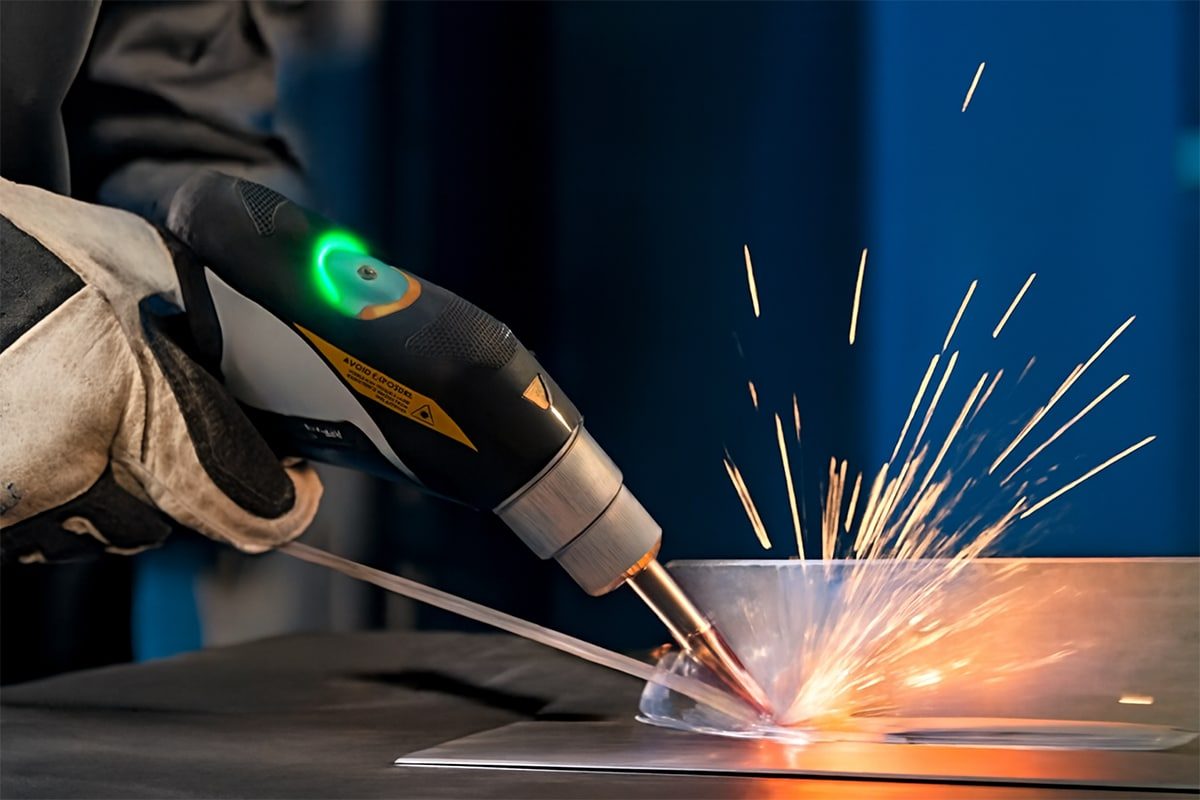
What Is Laser Welding?
Working Principle
Laser sources generate a coherent, monochromatic beam that is guided through optics and focused onto the workpiece. The metal absorbs the focused energy, causing localized heating and melting. Depending on the power density, the weld forms in one of two modes:
- Conduction Mode: At lower energy density, only the surface melts. The weld pool is shallow and smooth, ideal for thin materials and cosmetically-critical joints.
- Keyhole Mode: At high energy density, the metal surface vaporizes, forming a narrow cavity or “keyhole.” The keyhole allows heat to penetrate deeply, enabling fast, deep welds with a narrow profile. This mode is essential for industrial production where penetration and speed matter.
Types of Lasers Used in Welding
Laser welding can be performed using several types of laser sources, each with its own advantages and typical use cases.
- Fiber Lasers: Fiber lasers are the most widely used lasers in modern welding. They offer high electrical efficiency, excellent beam quality, long service life, and fiber-optic delivery that simplifies integration with robotic systems. They are ideal for automotive components, battery assemblies, steel and aluminum welding, and high-speed production lines.
- Disk Lasers: Disk lasers feature a solid-state design similar to fiber lasers but offer excellent thermal management and stable beam quality even at high power. They support deep penetration, precise energy control, and long-duty cycles. Disk lasers are common in powertrain welding, heavy-plate joining, and applications requiring consistent beam parameters under demanding conditions.
- CO2 Lasers: CO2 lasers produce infrared light at 10.6 μm and were historically dominant in welding thicker steel plates and non-ferrous metals. They offer high power and good penetration, but their beam delivery relies on mirrors rather than flexible fibers. As a result, CO2 lasers are less favored for modern robotic welding but still useful for certain thick-plate, non-reflective metal applications.
- Nd:YAG Lasers: Nd:YAG (neodymium-doped yttrium aluminum garnet) lasers generate light at 1.064 μm. They can operate in both continuous and pulsed modes, making them valuable for micro-welding, jewelry repair, medical components, and electronics. While largely replaced by fiber lasers in many industries, Nd:YAG systems are still used where specific pulse characteristics or legacy tooling are required.
Equipment Components
A laser welding system typically includes:
- Laser Source: The generator that produces the beam—fiber, disk, CO2, or Nd:YAG—chosen based on material, thickness, penetration requirements, and production goals.
- Beam Delivery System: Fiber-optic cables for fiber/disk lasers or mirror-based beam paths for CO2 and some Nd:YAG systems. This system ensures the beam travels cleanly to the welding head.
- Focusing Optics / Welding Head: Lenses and mirrors that shape and focus the beam. Some heads include beam oscillation modules, galvo scanners, coaxial imaging cameras, seam trackers, or weld-depth monitoring sensors.
- Motion System: Robots, CNC stages, gantries, or Cartesian systems that move the part or the head during welding. High-end setups combine robotics with real-time sensor feedback.
- Shielding Gas System: Delivers gas to the weld zone to reduce oxidation, minimize porosity, and improve penetration stability.
- Cooling System: Chillers or liquid cooling loops regulate the temperature of the laser source and optics to maintain consistent operation.
- Control and Monitoring System: Software and electronics that control laser power, pulse shape, beam modulation, travel speed, and focal position. Advanced systems can log weld quality, detect defects, and automatically adjust parameters.
Key Characteristics
Laser welding is defined by a set of performance traits that are hard to achieve with arc welding methods like MIG:
- Extremely High Energy Density: The laser’s ability to concentrate power into a tiny spot enables immediate melting and deeper penetration without heating the surrounding material.
- Deep, Narrow Weld Geometry: Laser welds often feature high aspect ratios, especially in keyhole mode. Penetration is deep while the bead remains narrow, reducing material distortion.
- High Welding Speeds: Laser systems can weld at several meters per minute, depending on power, material, and joint configuration—significantly faster than MIG for many applications.
- Minimal Heat-Affected Zone (HAZ): The surrounding metal experiences very little thermal change, preserving material strength and reducing post-weld straightening or machining.
- Precise, Real-Time Parameter Control: Laser power, pulse width, waveform, focus position, and beam oscillation can be tightly controlled, allowing micro-scale welding and heat-sensitive assembly.
- Non-Contact Process: No electrode wear, no physical pressure on the workpiece, and no spatter typical of MIG welding.
- Automation Compatibility: Fiber and disk lasers integrate easily with robotic arms, scanners, and vision systems, allowing fully automated, high-throughput welding.
Advantages
Laser welding offers several benefits that MIG welding cannot easily match:
- Low Distortion and Shrinkage: The small HAZ keeps components dimensionally stable even when welding close to edges or precision features.
- High Throughput and Productivity: Fast travel speeds and short cycle times make laser welding ideal for mass production.
- Superior Weld Appearance: Laser welds are clean, narrow, and require little to no post-processing.
- High Penetration and Strength: Keyhole welding achieves deep fusion with strong metallurgical bonds and excellent fatigue resistance.
- Ideal for Thin or Delicate Parts: Heat input can be tightly controlled to avoid burn-through or warping.
- Excellent Repeatability: Once parameters are set, laser welding delivers consistent results with minimal variation.
- Lower Consumables Cost: Typically, no filler wire, no electrodes, and reduced maintenance compared to MIG systems.
- Dissimilar Material Welding: Laser systems—especially pulsed or ultrafast—can join metals with different melting points, supporting modern battery and electronics assembly.
Disadvantages
Despite its capabilities, laser welding has several limitations:
- High Initial Cost: Laser sources, optics, safety enclosures, and automation equipment represent a significant investment.
- Tight Joint Fit-Up Requirements: Because the beam is small, joints must be precise. MIG welding is more forgiving in gap filling.
- Setup and Calibration Complexity: Beam alignment, focal position, shielding gas flow, and pulse shaping all require skilled technicians.
- Reflective Materials Challenge the Beam: Metals like aluminum, copper, and brass can reflect part of the laser energy, requiring higher power or specialized wavelengths.
- Keyhole Instability Risks: In deep penetration welding, an unstable keyhole can cause porosity, spatter, or underfill.
- Safety Demands: Class 4 laser systems require fully enclosed, interlocked cells; improper exposure can cause instant damage to eyes or skin.
Applications
Laser welding is used across industries where precision, low heat input, and speed are critical:
- Automotive and EV Manufacturing: Battery tabs and busbars, cell casings, motor housings, hairpin windings, fuel systems, exhaust components, body panels, and sensors. Laser welding is now standard in EV battery module production due to its penetration accuracy and low distortion.
- Aerospace and Defense: Thin titanium and nickel alloys, turbine components, fuel system parts, lightweight assemblies, and flight-critical structures requiring traceable weld quality.
- Medical Devices: Implants, pacemaker housings, surgical instruments, nitinol components, and micro-assemblies that must remain sterile and dimensionally precise.
- Electronics and Micro-Welding: Sensors, connectors, relay contacts, heat-sensitive housings, circuit links, and hermetically sealed packages.
- Jewelry and Watchmaking: Precision welding of gold, silver, platinum, and delicate assemblies without damaging surrounding details.
- Energy and Power Systems: Fuel cell plates, photovoltaic connectors, turbine components, and thin-foil assemblies.
- General Manufacturing: Thin sheet metal welding, cosmetic welds, automation-ready joining, and dissimilar material fusion.
What Is MIG Welding?
Working Principle
Equipment Components
A MIG welding system typically consists of:
- Power Source: A constant-voltage (CV) power supply that stabilizes the arc. Modern machines may include inverter technology for finer arc control and energy efficiency.
- Wire Feeder: Feeds the consumable wire at a controlled speed. The wire feed rate is closely tied to current output and deposition rate.
- Welding Gun (Torch): Delivers the wire electrode, electrical power, and shielding gas to the joint. The gun includes a contact tip, nozzle, and liner that guide and stabilize the wire.
- Consumable Wire Electrode: Typically, solid steel, stainless, or aluminum wire, although metal-cored and flux-cored variations exist. The wire melts continuously during welding.
- Shielding Gas Supply: Common mixtures include argon, CO2, Ar–CO2 blends, and specialty gas combinations designed for specific metals. Gas selection strongly affects arc stability, spatter behavior, and penetration.
- Ground Clamp: Completes the electrical circuit to establish the arc.
- Drive Rolls and Liners: Mechanisms that grip, push, and guide the electrode wire from the feeder to the torch without interruption.
Modes of Operation
MIG welding can operate in several metal transfer modes. Each mode determines how molten metal moves from the electrode to the weld pool, affecting heat input, penetration, and spatter levels.
- Short-Circuit Transfer: The wire tip contacts the weld pool repeatedly, causing the arc to switch on and off rapidly. This mode runs cooler and is ideal for thin materials, out-of-position welding, and general fabrication. It produces more spatter than other modes but allows good control.
- Globular Transfer: Molten droplets larger than the wire diameter fall irregularly into the weld pool. This mode has high heat input, significant spatter, and less control, making it less desirable except for thick materials and high productivity at low cost.
- Spray Transfer: A high-heat, stable mode in which tiny droplets are propelled from the electrode to the weld pool in a continuous spray. It provides smooth, high-quality welds with deep penetration but requires higher currents and works best on thicker materials in flat or horizontal positions.
- Pulsed-Spray Transfer: The machine alternates between high and low current levels, producing controlled spray droplets. This mode combines the penetration and quality of spray transfer with improved control for out-of-position welding and thinner materials.
Key Characteristics
MIG welding has distinctive operating traits that define its performance:
- High Deposition Rates: The continuously fed wire electrode allows MIG to deposit large amounts of filler metal quickly.
- Wide Weld Bead and Broad HAZ: Compared to laser welding, MIG produces a larger melt pool, higher heat input, and greater distortion—but also better gap-filling capability.
- Forgiving Joint Fit-Up: MIG can bridge gaps and tolerate imperfect edges, making it suitable for general fabrication and field work.
- Relatively Easy to Learn: Its simple, semi-automatic operation allows beginners to achieve workable welds quickly.
- Significant Spatter Formation: Especially in short-circuit or globular transfer, spatter is common and may require grinding or cleanup.
- Versatile Across Metals: Works with carbon steels, stainless steels, aluminum, and several alloys using appropriate wire and gas combinations.
- Strong Mechanical Performance: Produces structurally sound welds suitable for load-bearing applications when properly configured.
- Manual, Semi-Automatic, and Robotic Friendly: MIG welding is adaptable to all levels of automation, though controlling spatter and consistency becomes more important in robotic systems.
Advantages
MIG welding remains popular because it offers numerous practical benefits:
- Lower Equipment Cost Compared to Laser Welding: Initial investment is far smaller, making MIG accessible to small shops and general fabricators.
- Excellent for Thick and Structural Materials: High deposition rates and robust penetration make MIG ideal for heavy-duty applications.
- Good Gap Bridging: The wire electrode fills gaps effectively, reducing the need for precision machining or tight tolerances.
- Simple Operation and Training: Operators can become competent quickly, unlike laser systems that require advanced parameter control and alignment.
- Versatility Across Environments: MIG can be used in shops, manufacturing floors, and field work. It handles a wide range of joint types and positions.
- Works Well with Many Alloys: Steel, stainless, aluminum, and nickel alloys are all weldable with the right settings and filler wire.
- High Productivity at Low Cost: Good deposition rates and low consumable prices make MIG welding cost-effective for mass production and repair work.
Disadvantages
MIG welding also has limitations that affect weld quality and suitability:
- Higher Heat Input and Distortion: The larger weld pool increases the chance of warping, especially in thin materials.
- More Post-Weld Cleanup: Spatter, slag (in flux-cored variants), and heat tint may require grinding or finishing.
- Wider Weld Beads: This may not be acceptable for precision or cosmetic applications.
- Less Suitable for Very Thin Metals: Burn-through is more likely compared to laser or TIG welding.
- Shielding Gas Sensitivity: Wind or air movement can disrupt gas coverage, leading to porosity. This makes outdoor MIG welding challenging without flux-cored wire.
- Lower Precision Compared to Laser Welding: Beam-level accuracy is impossible with an arc process.
- Consumable Wear: Contact tips, liners, nozzles, and drive rolls require routine maintenance.
Applications
MIG welding is used broadly across industries due to its versatility and cost-effectiveness:
- Automotive Manufacturing and Repair: Body panels, frames, brackets, exhaust components, and subframe structures. MIG is commonly used in assembly lines and repair shops alike.
- General Fabrication: Frames, railings, structural beams, machinery components, and heavy equipment parts.
- Construction and Infrastructure: Steel structures, support beams, platforms, and various on-site fabrication tasks.
- Shipbuilding and Marine Applications: Mild and stainless steel assemblies, hull repairs, decking reinforcement, and structural joints.
- Agricultural and Heavy Equipment: Thick steel frames, attachments, housings, and wear-resistant components.
- Furniture and Appliance Manufacturing: Tubular frames, sheet metal housings, brackets, and enclosures.
- Robotic Welding Cells: Automated MIG systems are widely used for high-volume steel fabrication when laser welding is unnecessary or too costly.
Laser Welding vs MIG Welding: Technical Comparison
Heat Input and Thermal Effects
Penetration Characteristics
Weld Geometry
Speed and Productivity
Material Compatibility
Weld Quality
Equipment Costs
Consumables and Maintenance
Skill Requirements
Joint Assembly Requirements
Spatter, Cleanup, and Post-treatment
Automation and Integration
Environmental Impact
Safety Precautions
Detailed Metallurgical Comparison
Heat-Affected Zone Differences
Laser Welding HAZ
Laser welding produces an extremely localized thermal footprint due to its high energy density and fast travel speeds. The result is a small, narrow HAZ with steep thermal gradients. Key features include:
- Minimal Grain Growth: The short thermal cycle limits the time available for grains to coarsen.
- Reduced Softening in Precipitation-Hardened Alloys: Al-Mg-Si and Al-Cu alloys experience less overaging compared to MIG welding.
- Lower Distortion and Residual Stress: The small HAZ cools quickly, reducing expansion and contraction cycles.
- Sharper Microstructural Boundaries: Rapid cooling creates clearly defined transitions between weld metal, HAZ, and base material.
MIG Welding HAZ
MIG welding generates a larger heat input and a wider melt pool, producing a broad HAZ with slower cooling rates. Metallurgical effects include:
- Significant Grain Growth: Higher temperatures and longer exposure times lead to coarser grains, reducing toughness.
- Softening or Overaging in Heat-Treated Alloys: Common in aluminum and quenched-and-tempered steels.
- Greater Distortion Risk: The large HAZ expands and contracts during welding, creating residual stresses.
- Gradual Transition Zones: Thermal gradients are shallower, resulting in broader transformation regions.
Solidification Patterns
Laser Welding Solidification
Laser welding typically produces high solidification rates due to fast cooling. This leads to:
- Fine Dendritic Structures: Small dendrite arm spacing enhances strength but may reduce ductility slightly.
- High Aspect Ratio Weld Pools: Laser keyhole welds are deeper than they are wide, shaping columnar grain growth along the keyhole walls.
- Directional Solidification: The steep thermal gradients encourage grains to grow toward the heat source path.
- Reduced Hot Cracking Susceptibility: The rapid cooling can reduce solidification cracking, although certain alloys still require careful control.
- Metastable Phase Formation: In some alloys (e.g., titanium or certain steels), rapid cooling may trap metastable phases that alter hardness.
MIG Welding Solidification
MIG welding produces slower cooling and larger weld pools, resulting in:
- Coarse Dendrites: Wider dendrite spacing reduces weld metal strength but increases ductility and toughness.
- Wider Weld Beads: The melt pool spreads heat over a large area, influencing grain orientation.
- Mixed Solidification Modes: Depending on the material, a combination of equiaxed and columnar grains forms.
- More Time for Segregation: Slower cooling promotes solute segregation, which can lead to micro-porosity or reduced fatigue resistance.
- Greater Susceptibility to Hot Cracking in Certain Alloys: Especially in aluminum and nickel alloys with wide solidification temperature ranges.
Microstructural Control
Laser Welding Microstructural Control
Laser welding offers tight control over heat input and cooling rates, enabling:
- Refined Grain Structures: Ideal for high-strength steels, superalloys, and titanium.
- Predictable Hardness Variations: Rapid cooling can increase hardness, but with minimal softening around the HAZ.
- Reduced Carbide Precipitation or Grain Coarsening: Especially important for stainless steels and tool steels.
- Ability to Weld Heat-Sensitive Components: Such as precision medical parts, thin foils, and battery cell components.
- Improved Consistency Through Automation: Automated beam control ensures the same microstructure weld after weld.
MIG Welding Microstructural Control
MIG welding provides less precise control due to varying arc characteristics, wire feed inconsistencies, and manual operator influence. Its microstructural traits include:
- Coarser Microstructure: Larger grains and slower cooling reduce hardness but increase toughness.
- Pronounced Thermal Softening: Especially in aluminum, heat-treated steels, and high-strength alloys.
- Variation in Grain Size Due to Manual Operation: Human factors can influence bead size, cooling, and heat input.
- Increased Susceptibility to HAZ Softening: Particularly in steels designed for automotive crash performance.
- Better Ductility for Heavy Structural Applications: The wider solidification patterns help absorb impact loads.
Application-by-Application Comparison
Automotive Manufacturing
Laser Welding in Automotive
Laser welding is widely adopted for components that demand precision, repeatability, and minimal distortion. Its primary roles include:
- EV Battery Trays, Busbars, and Cell Casings: Lasers deliver controlled penetration without overheating sensitive materials.
- Hairpin (stator) Welding: Fiber lasers create precise copper joints essential for electric motors.
- Body-in-White (BIW) Assembly: Lasers are used for roof seams, door panels, and tailored blanks where long, continuous welds and clean aesthetics are required.
- High-Strength Steel Structures: The narrow HAZ helps maintain crash performance and dimensional accuracy.
MIG Welding in Automotive
MIG welding is still heavily used for:
- Chassis Components and Heavy-Gauge Steel Parts: MIG handles thicker materials efficiently.
- Brackets, Mounts, and Reinforcements: MIG’s gap-filling ability simplifies fit-up in varied assembly conditions.
- Repair and Aftermarket Work: MIG is affordable, easy to use, and works well for structural repairs.
Aerospace
Laser Welding in Aerospace
Laser welding is favored for components requiring:
- Minimal distortion in thin-walled and high-strength materials such as titanium, nickel-based alloys, and specialty steels.
- Precision welds on instrument housings, sensors, and turbine components.
- Hermetic seals where leak resistance is critical.
- Real-time monitoring and traceability, which laser systems integrate easily.
MIG Welding in Aerospace
While MIG welding is not used on flight-critical parts, it is common for:
- Ground support equipment, jigs, and fixtures.
- Heavy structural frames are used in maintenance and assembly.
- Non-critical aluminum and steel components where cost and speed outweigh precision needs.
Electronics and Batteries
Laser Welding in Electronics and Batteries
Laser welding is the dominant process for:
- Battery Cell Tabs (Li-ion, EV, Consumer Electronics): Lasers produce clean welds with minimal thermal impact.
- Micro-Connectors and Sensor Housings: High precision avoids damaging sensitive circuitry.
- Copper, Aluminum, and Dissimilar Metal Joints: Laser wavelengths and ultrafast systems allow joining materials that MIG cannot handle.
- Micro-welds and hermetic seals for devices requiring airtight containment.
MIG Welding in Electronics and Batteries
MIG welding is rarely used in this sector due to:
- Excessive heat input
- Large weld beads
- Risk of damaging surrounding components
Metal Fabrication Shops
Laser Welding in Fabrication Shops
Laser welding is adopted when shops require:
- High-quality cosmetic welds on stainless steel, aluminum, or thin-gauge parts.
- Precision for architectural metalwork or food-grade welds.
- Fast cutting-welding hybrid workflows using laser systems with dual capabilities.
- Reduced rework and finishing thanks to cleaner welds.
MIG Welding in Fabrication Shops
MIG welding is the backbone of metal fabrication due to:
- Low cost and easy setup
- Ability to weld thick materials and fill gaps
- Compatibility with carbon steel, stainless steel, and aluminum
- Robust performance in varied job conditions
Medical Device Manufacturing
Laser Welding in Medical Manufacturing
Laser welding is widely used because it:
- Produces extremely clean welds with minimal contamination.
- Maintains tight dimensional tolerances necessary for surgical tools and implants.
- Welds thin-walled stainless steel, titanium, and nitinol without affecting mechanical properties.
- Supports micro-welding for pacemakers, catheters, and miniature assemblies.
MIG Welding in Medical Manufacturing
MIG welding has limited use, typically restricted to:
- Fabricating hospital furniture, carts, frames, and non-implant components.
- Manufacturing support fixtures and non-critical assemblies.
Jewelry Industry
Laser Welding in Jewelry
Laser welding plays a major role in:
- Welding gold, silver, platinum, and delicate alloys without overheating gemstones or thin features.
- Repairing intricate settings without removing heat-sensitive components.
- Microscopic welds that would be impossible with arc welding.
- Clean, nearly invisible joints that require minimal finishing.
MIG Welding in Jewelry
MIG welding is effectively unused in this industry because:
- The weld bead is too large and uncontrolled.
- Heat input is too high for precious metals.
- Aesthetic requirements exceed MIG’s capabilities.
Cost Comparison: Laser Welding vs MIG Welding
Initial Investment
Laser welding systems require a much higher upfront investment than MIG welding. The cost difference stems from:
- Laser Sources and Optics: High-power fiber or disk lasers, precision lenses, beam delivery systems, and protective optics windows drive equipment costs into the high five- or six-figure range. Enclosed welding cells, safety interlocks, and dedicated cooling systems further increase the investment.
- Automation Requirements: Laser welding is most effective when paired with robotics, vision systems, and process monitoring sensors. These technologies add substantial capital cost but are essential for consistent performance.
- Facility Modifications: Laser welding often requires a dedicated room or enclosure to meet safety standards, adding architectural and compliance expenses.
Operating Costs
Laser Welding Operating Costs
Laser welding systems consume less electrical energy relative to their output due to high efficiency. Modern fiber and disk lasers have long lifespans and low maintenance needs. Consumables are minimal:
- Occasional replacement of protective optics windows
- Shielding gas for certain materials
- Routine inspection and calibration
MIG Welding Operating Costs
MIG welding has substantially higher recurring expenses:
- Wire electrodes are consumed continuously, with cost depending on material and production volume.
- Nozzles, contact tips, and liners wear out frequently and require regular replacement.
- Drive rolls, consumable parts, and spatter cleanup tools add to recurring costs.
- Shielding gas consumption is higher than in laser welding.
- Energy costs rise with heat-intensive transfer modes like spray transfer.
Labor Costs
Laser Welding Labor Costs
Laser welding works best with automation, meaning:
- One operator can supervise multiple welding cells.
- Most welds are repeatable, requiring little manual correction.
- Automatic seam tracking, monitoring, and quality logging reduce human involvement.
- Highly skilled labor is needed for system setup, but day-to-day operation requires less manual welding skill.
MIG Welding Labor Costs
MIG welding is labor-intensive, especially in manual or semi-automatic environments. Costs come from:
- Operator training and ongoing skill development
- Manual torch manipulation
- Heat distortion correction
- Cleaning spatter and refining weld surfaces
- Multi-pass welding on thicker materials
- Rework from the inconsistent operator technique
Long-Term ROI (Return on Investment)
Laser Welding ROI
Laser welding offers a strong long-term ROI when:
- Production volume is high
- Precision and repeatability matter
- Part quality reduces downstream inspection or rework
- Cycle time needs to be minimized
- Automation reduces labor dependency
- Thin or heat-sensitive components are common
MIG Welding ROI
MIG welding provides excellent ROI for operations that:
- Weld thick, structural materials
- Require flexibility for different part shapes
- Use lower-volume or custom fabrication
- Do not need extreme precision or low heat input
- Must minimize initial capital expenditure
Choosing Between Laser and MIG Welding
Choose Laser Welding If You Need
Ultra-High Precision and Tight Dimensional Tolerance
Laser welding maintains extremely tight control over heat input. This is critical when:
- The welded component cannot tolerate distortion beyond a few hundred microns.
- Parts must maintain geometric accuracy for downstream assembly or sealing.
- You’re working with precision housings, thin-walled tubes, micro-assemblies, or compressed tolerances common in aerospace and medical devices.
Minimal Heat Input and Practically No Distortion
If the application cannot tolerate heat-related deformation, laser welding is the clear choice. Its narrow heat-affected zone protects:
- Thin stainless steel sheets
- Heat-treated steels that lose strength when overheated
- Aluminum components that warp with MIG
- Battery foils and tabs that fail when over-tempered
High-Speed, High-Volume Production Through Automation
Laser welding delivers unmatched throughput:
- Travel speeds can exceed several meters per minute.
- Multi-axis robotic integration enables simultaneous welding and inspection.
- Galvo-scanning heads can reposition the beam in milliseconds, improving takt time.
- Inline penetration monitoring ensures every weld meets spec without manual checking.
Clean, Aesthetic, Near-Spatter-Free Welds
Laser welds are visually tight and consistent:
- Minimal bead reinforcement
- No spatter or molten droplets
- Reduced discoloration
- Smooth surface requiring little to no grinding or finishing
Welding of Dissimilar, Reflective, or Otherwise Difficult Materials
Laser welding can join combinations that MIG cannot manage effectively:
- Copper-to-aluminum (common in EV batteries)
- Titanium-to-nickel alloys
- Thin stainless steel to thick steel
- Ultra-thin foils in electronics
Consistency and Repeatability Across Thousands or Millions of Parts
Laser welding’s automated nature ensures:
- Repeatable penetration depth
- Controlled thermal input
- Automated quality logging
- Minimal variation due to operator technique
Reduced Long-Term Labor Dependency
Laser welding shifts the skills requirement from manual dexterity to technical oversight:
- One technician can supervise multiple automated laser cells.
- Manual correction and rework are drastically reduced.
- Operator fatigue and variation have little impact on weld outcome.
Choose MIG Welding If You Need
Low Initial Equipment Cost
For many fabrication shops, the upfront cost of laser welding is simply unrealistic. MIG welding is the economical alternative:
- MIG power sources are inexpensive.
- Equipment can be deployed quickly with minimal facility upgrades.
- Capital risk is low, making MIG ideal for startups or repair shops.
Excellent Gap-Filling Ability and Tolerance for Poor Fit-Up
If you’re welding parts that:
- Arrive with inconsistent edge prep
- Fit together imperfectly
- Vary in thickness
- Come from low-cost fabrication processes
Versatility Across a Wide Range of Materials and Thicknesses
MIG welding transitions easily between material types and gauges:
- Thin automotive sheet metal
- Heavy structural beams
- Stainless steel handrails
- Aluminum frames
- Repair work on unknown materials
Strong Structural Performance on Thick Sections
For heavy-duty or load-bearing fabrication—such as construction beams, agricultural equipment, trailers, or machinery frames—MIG welding is:
- Strong
- Reliable
- Easy to multi-pass
- Highly cost-efficient
Laser welding can weld thick materials, but equipment cost and joint prep requirements often make MIG the practical choice.
Simple Operation and Broad Workforce Accessibility
MIG is beginner-friendly:
- Most operators can weld competently after a few hours of training.
- Visual control of the arc makes the learning curve intuitive.
- Multiple welders can be trained quickly for production surges.
Suitability for On-Site or Outdoor Work
Laser welding requires controlled environments. MIG welding can be used:
- On construction sites
- Outdoors with flux-cored wire
- In shipyards
- In field repair and maintenance
Lower-Cost Maintenance and Quick Repairs
If something breaks:
- Torches, tips, liners, and drive rolls are inexpensive and quick to replace.
- Troubleshooting is straightforward.
- Downtime is minimal compared to highly complex laser welding systems.
Summary
Get Laser Welding Solutions
Drawing upon years of deep expertise in industrial laser cutting, welding, marking, and cleaning, this article presents information based on practical experience and the latest industry insights. By providing clear and technically sound guidance, it helps readers select the right machines, understand process trade-offs, and optimize workflows.
My goal is to help engineers, shop floor managers, and production decision-makers make informed choices that perfectly combine innovation, quality, and operational efficiency.
Drawing upon years of deep expertise in industrial laser cutting, welding, marking, and cleaning, this article presents information based on practical experience and the latest industry insights. By providing clear and technically sound guidance, it helps readers select the right machines, understand process trade-offs, and optimize workflows.
My goal is to help engineers, shop floor managers, and production decision-makers make informed choices that perfectly combine innovation, quality, and operational efficiency.