
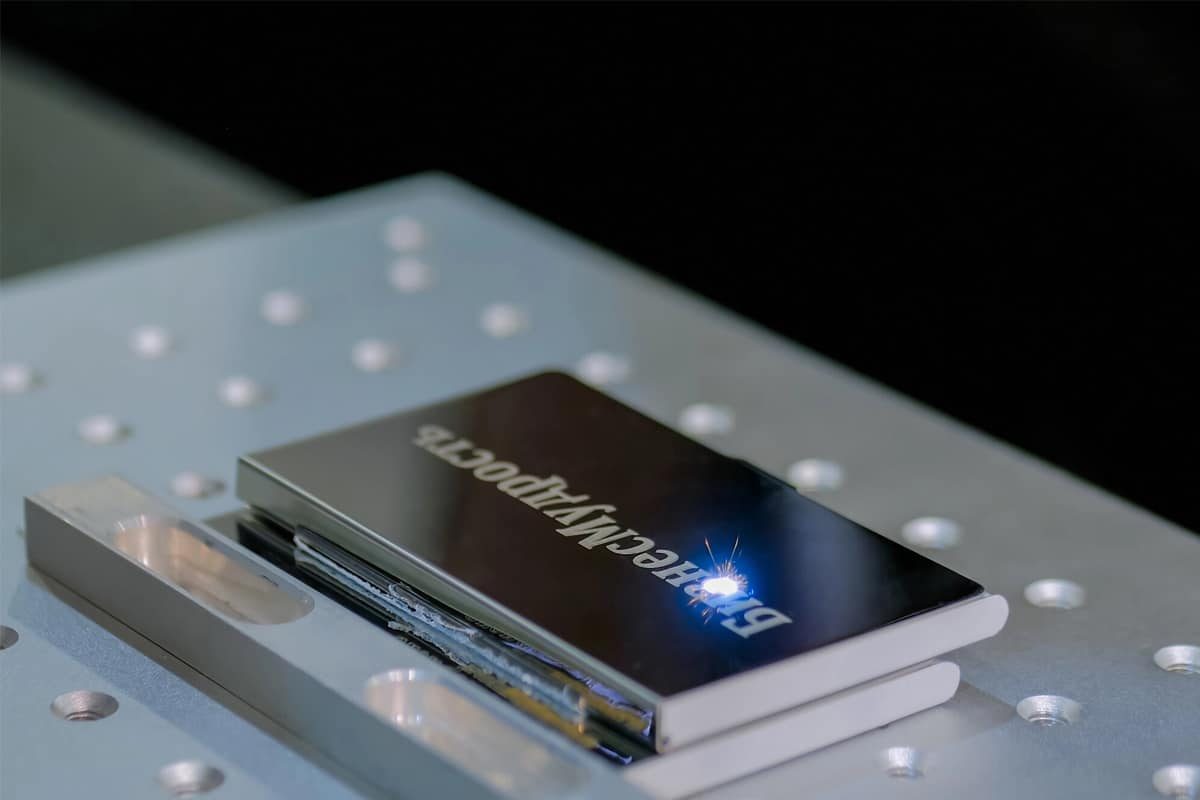
What Is Laser Marking?
Working Principle
Interaction Mechanisms
Laser–material interaction can occur in several forms:
- Surface Heating and Oxidation: The beam increases material temperature, allowing oxygen or atmospheric gases to cause controlled oxidation that appears as dark, high-contrast marks (common in stainless steel).
- Annealing: A controlled low-energy process where subsurface layers heat and change color without melting, ideal for medical and food-industry stainless steel because it does not damage passive protective layers.
- Ablation and Material Removal: High-energy pulses vaporize or eject micro layers of the surface, creating engraved-like cavities. This is used for deep marking, paint removal, coating removal, and carving patterns.
- Carbonization and Foaming (in Plastics): Heat decomposes polymer chains, causing carbon-rich dark marks (carbonization) or creating light-colored raised structures (foaming).
- Photochemical Reaction (UV Lasers): Short-wavelength laser photons directly break chemical bonds with minimal thermal diffusion, enabling micro-marking on sensitive materials.
Beam Delivery and Scanning
Thermal Control and Spot Size
Types of Lasers Used
Fiber Lasers (1064 nm)
Fiber lasers excel in:
- Deep engraving
- High-speed barcode and QR marking
- Black marking on stainless steel
- Annealing colors
- Engraving on anodized aluminum
- Traceability codes for automotive and aerospace parts
CO2 Lasers (10.6 µm)
CO2 lasers operate in the far-infrared spectrum and are strongly absorbed by organic materials. Because the wavelength interacts poorly with bare metals but extremely well with non-metals, CO2 lasers are ideal for:
- Wood engraving
- Plastics and packaging films
- Leather and fabrics
- Paperboard and labels
- Rubber and ceramic marking
UV Lasers (355 nm)
Suitable for:
- Electronic components and microchips
- Medical plastics
- Glass and fused silica
- High-density polymers
- Detailed micro-text and micro-QR codes
MOPA Lasers (Variable Pulse Fiber Laser)
Used for:
- High-quality black marking on anodized aluminum
- Multi-color marking on stainless steel
- Fine plastic coding without burning
- Delicate surface texturing
- Ultra-high-resolution vector marking
Equipment Components
Laser marking systems integrate optical, mechanical, electronic, and software elements to deliver stable and repeatable performance.
- Laser Source: Generates the coherent beam. Stability, beam quality (M² value), and output power determine marking capability.
- Optical Path: Includes mirrors, fiber-optic cables, collimators, and focusing lenses that shape and guide the beam.
- Galvanometer Scanner: A pair of high-speed mirrors positioned on electromagnetic motors. They steer the beam with extreme precision, enabling rapid vector marking.
- F-Theta Lens: Ensures consistent spot size across the entire marking field, enabling uniform quality from center to edges.
- Control Software: Manages vector paths, image processing, barcode/QR generation, pulse modulation, and integration with PLCs, MES systems, or automated conveyors.
- Machine Frame and Enclosure: Protects operators from laser radiation, houses components, and supports fixtures and automated loading systems.
- Cooling System: Fiber and UV lasers often use air cooling; higher-power lasers may require water cooling for thermal stability.
- Fume Extraction: Removes debris, vaporized particles, and smoke generated during ablation processes.
Characteristics
Laser marking exhibits several defining characteristics that distinguish it from mechanical methods:
- Non-contact process, eliminating wear and mechanical deformation
- Micron-level precision, suitable for complex or miniature geometry
- High marking speed, especially with galvanometer-driven scanners
- High contrast and readability, suitable for cameras and machine vision systems
- Permanent marks resistant to abrasion, chemicals, and UV exposure
- Wide material compatibility, from metals to organics to semiconductors
- No consumables, reducing long-term operating costs
- Minimal environmental impact, producing only micro-debris and fumes
Advantages
Laser marking offers numerous operational, economic, and technical benefits:
- Exceptional Precision: Capable of producing ultra-fine lines, micro text, dense 2D DataMatrix codes, and detailed logos with consistent clarity.
- Longevity and Durability: Marks remain readable for decades, even under harsh industrial environments involving heat, moisture, chemicals, or mechanical wear.
- No Consumables: No need for inks, solvents, tool tips, or pressurization components, significantly reducing operational costs.
- Minimal Maintenance: Fiber and UV lasers operate for tens of thousands of hours with little maintenance, providing excellent cost efficiency.
- Fast Processing: High-speed scanners and short processing cycles make laser marking ideal for high-volume production.
- Automation-Friendly: Easily integrated with conveyors, robotic arms, rotary devices, and Industry 4.0 digital systems.
- High Aesthetic Quality: Producing marks with clean edges, consistent contrast, and visually appealing detail.
- Material Versatility: From metal automotive components to delicate semiconductor wafers, laser marking covers a wider spectrum of materials than most marking technologies.
Disadvantages
Despite its strength, laser marking presents some limitations:
- Higher Initial Cost: Laser systems require a larger upfront investment compared to dot peen or mechanical systems.
- Limited Deep Indentation: Although capable of engraving, laser marks often lack the strong tactile depth produced by impact-based marking.
- Material-Specific Challenges: Highly reflective materials (copper, gold, polished aluminum) may require special wavelengths or higher power.
- Safety Requirements: Laser systems require controlled environments, protective eyewear, enclosure interlocks, and proper ventilation.
- Potential Heat-Affected Zones: Although small, improper parameter settings can cause melting, warping, or discoloration.
Applications
Laser marking is used across almost all major industrial sectors.
- Automotive and Aerospace: Marking VINs, engine components, gears, brake systems, turbine parts, structural metals, and tracking barcodes.
- Electronics & Semiconductors: Micro-marking on ICs, PCBs, microchips, connectors, housing plastics, and ultra-small DataMatrix codes.
- Medical Devices: UDI marking on stainless steel instruments, titanium implants, surgical tools, and medical plastics—often using annealing to avoid corrosion.
- Machinery & Tools: Serial numbers, branding, instructional symbols, and deep engraving on steel and alloy components.
- Consumer Goods: Logos, personalization, serial identifiers on metal products, electronics, packaging, and household items.
- Jewelry and Luxury Products: Fine engraving, anti-counterfeit micro-marking, and texture creation.
- Packaging and Coding: High-speed expiration date, batch code, and traceability marking on packaging materials.
What Is Dot Peen Marking?
Working Principle
Impact Mechanics
When the stylus strikes the material, mechanical force displaces the surface layer, creating plastic deformation. The depth of indentation depends on:
- Impact force
- Stylus tip geometry
- Material hardness
- Marking speed
- Pneumatic or electromagnetic driving power
Drive Methods: Pneumatic vs. Electromagnetic
- Pneumatic Dot Peen Systems: Use compressed air to drive the stylus. They deliver a stronger impact force, making them ideal for deep marking on hard metals and rough industrial surfaces.
- Electromagnetic Dot Peen Systems: Use electromagnetic coils to drive the pin. They deliver more precise control, lower noise, and smoother marking, suitable for electronics, automotive components, and applications requiring finer detail.
Marking Path Control
Surface Deformation and Material Behavior
Equipment Components
Dot peen marking systems consist of several integrated components designed for durability and precision.
- Marking Head: Contains the stylus and internal actuators. It determines marking field size, dot density, and resolution.
- Stylus / Pin: Made from high-hardness materials such as tungsten carbide or diamond-coated steel. Stylus tips vary in angle and shape depending on the desired mark depth and material hardness.
- Drive Mechanism: Either pneumatic (air-driven) or electromagnetic (coil-driven). The mechanism controls impact force and frequency.
- X-Y Motion System: Stepper motors, servo motors, or mechanical rails move the marking head horizontally across the workpiece.
- Controller and Software: Coordinates the motion path, impact frequency, character styles, barcode creation, DataMatrix coding, and integration with PLCs and industrial networks.
- Base Structure or Support Fixture: Holds the workpiece securely to ensure stable marking. Custom jigs are used for irregular geometries.
- Power Supply and Pneumatic System: Pneumatic units require air compressors and regulators. Electromagnetic units require stable electrical power.
- Optional Add-ons
- Rotary axis for cylindrical parts
- Depth control systems
- Robotic integration
- Portable hand-held marking guns for large or immovable components
Characteristics
Dot peen marking is defined by its physical, tactile, impact-based nature. Its main characteristics include:
- Permanent Indentation: marks remain readable even after coating, sandblasting, or heavy wear
- Deep Penetration Capability: ideal for parts subjected to harsh industrial conditions
- Resistance to Environmental Exposure: mechanical deformations do not fade under heat, chemicals, oil, or abrasion
- Wide Material Compatibility: can mark metals, castings, hardened steel, alloys, and some plastics
- High Contrast Under Raking Light: depth rather than color provides legibility
- Moderate Marking Speed: slower than laser marking, especially for large or detailed codes
- Audible Noise and Vibration: inherent to impact-based processes
- Visible Deformation: may alter surface finish, which is unsuitable for cosmetic or precision parts
Advantages
Dot peen marking provides several strong advantages, particularly in industrial sectors requiring rugged marks.
- Exceptional Durability: Physical indentations do not wear off easily. Marks remain visible even after machining, painting, coating, or harsh environmental exposure.
- Deep, Tactile Marking: Dot peen can create very deep marks that laser systems cannot match unless using slow, high-power engraving cycles.
- Excellent Performance on Hard or Rough Surfaces: Cast iron, forged steel, and uneven surfaces can be marked reliably.
- Low Operating Cost: Aside from stylus wear, there are no consumables. Pneumatic or electromagnetic components require minimal maintenance.
- Reliable Traceability in Harsh Environments: Automotive, aerospace, and defense industries rely on dot peen for parts exposed to oil, dust, abrasive forces, and high mechanical stress.
- Portable Options: Handheld dot peen markers can mark large, heavy, or on-site industrial components such as pipelines, machinery housings, and ship structures.
- Lower Initial Investment: Dot peen machines are generally more affordable than industrial laser marking systems.
Disadvantages
Dot peen marking also has limitations that must be considered when comparing it with laser marking.
- Produces Surface Deformation: The process may damage delicate, thin-walled, or precision-machined components. Cosmetic parts may show undesirable indentations.
- Limited Aesthetic Quality: Marks consist of individual dots, not smooth, continuous lines. Fine details or artistic logos may appear coarse.
- Noisy Operation: Impact forces generate significant noise, unsuitable for quiet or cleanroom environments.
- Slower Marking Speed: Compared to high-speed galvo laser systems, dot peen is slower, especially for large 2D codes or long serial numbers.
- Higher Maintenance on Stylus: Stylus tips wear and require periodic replacement—especially when marking hard steel or cast iron.
- Limited Performance on Soft Plastics: The plastic may deform inconsistently, reducing legibility.
- Cannot Mark Sensitive or Brittle Materials: Glass, ceramics, and thin electronic components may crack under impact.
Applications
Dot peen marking remains widely used across sectors that value durability and physical depth over aesthetic smoothness.
- Automotive Industry: Marks engine blocks, chassis components, crankshafts, camshafts, pistons, suspension parts, brake components, and gear systems. Deep marks ensure traceability even after long-term wear.
- Aerospace and Defense: Critical components such as turbine parts, structural frames, landing gear components, and aerospace fasteners require permanent identification resistant to fuel, lubricant, and environmental stress.
- Heavy Machinery and Construction Equipment: Ideal for large castings, forged parts, hydraulic cylinders, track components, and mining machinery.
- Metal Fabrication Workshops: Used for steel plates, metal beams, and custom fabrication requiring direct part numbering or job tracking.
- Oil & Gas and Shipbuilding: Portable dot peen systems are used on pipelines, valves, drilling components, and large steel structures that cannot be moved to a marking station.
- Tool and Die Manufacturing: Marking die blocks, molds, tools, and hardened metals where deep durability is required.
- Industrial Asset Management: Equipment serial numbers, maintenance tags, and permanent asset labels.
- Low-Aesthetic but High-Durability Applications: Areas where appearance is secondary to traceability, such as warehouse racks, steel containers, and transport packaging crates.
Laser Marking vs Dot Peen Marking: Technical Comparison
Precision and Marking Quality
Laser Marking
Dot Peen Marking
Depth and Permanence
Dot Peen Marking
Dot peen is unmatched in tactile mark depth and mechanical permanence. Because the stylus physically penetrates the material, dot peen marks remain readable even after:
- Painting
- Shot blasting
- Sandblasting
- Welding heat exposure
- Long-term abrasion
- Oil, grease, and chemical exposure
- Outdoor weathering
- Machining or grinding of surface layers
Laser Marking
Speed and Throughput
Laser Marking
Laser marking is significantly faster for most marking tasks. Since the process is non-contact, there is no mechanical inertia or impact time. A galvanometer can reposition the beam almost instantly, enabling:
- Ultra-fast serial numbers
- High-speed DataMatrix code marking
- Continuous production line marking
- Multi-part batch marking
Dot Peen Marking
Material Compatibility
Laser Marking
Laser marking compatibility depends on wavelength (fiber, CO2, UV, MOPA):
- Fiber lasers excel on metals, including steel, aluminum, copper alloys, titanium, and nickel alloys.
- CO2lasers mark wood, acrylic, rubber, leather, textiles, paper, and ceramic coatings.
- UV lasers enable photochemical (cold) marking on plastics, silicon, and medical polymers.
- MOPA lasers enable high-contrast black marking on aluminum and stainless steel, as well as fine plastic marking.
Dot Peen Marking
Dot peen is primarily compatible with:
- Metals (carbon steel, stainless steel, aluminum, cast iron, hardened alloys)
- Some rigid plastics (with variable quality)
Dot peen is unsuitable for:
- Glass (cracking risk)
- Ceramics (brittleness)
- Composites requiring pristine surface layers
- Very thin metals that might deform under impact
- Soft materials like rubber or thin plastic housings
Surface Requirements
Dot Peen Marking
Dot peen marking performs exceptionally well on:
- Rough surfaces
- Textured castings
- Uneven forged surfaces
- Dirty, oily, or oxidized metals
Laser Marking
Laser marking performs best on:
- Clean, prepared surfaces
- Smooth or semi-smooth metals
- Uniformly pigmented plastics
- Anodized coatings
Environmental Considerations
Laser Marking
Laser marking is a clean process with minimal waste. However, ablation may produce:
- Fumes
- Micro-particles
- Vaporized metal oxides
Dot Peen Marking
Dot peen marking is robust and not sensitive to temperature, humidity, or ambient industrial contamination. However, it produces:
- Impact noise
- Metal flakes (particularly when marking softer alloys)
- Stylus wear debris
Power Consumption
Laser Marking
Fiber lasers are among the most energy-efficient industrial tools:
- Low power draw
- No need for compressed air
- Long operational lifespan
Dot Peen Marking
Pneumatic dot peen systems require:
- Compressed air (high energy consumption)
- Frequent compressor cycling
- Moisture management in airlines
Noise and Vibration
Laser Marking
Laser marking is effectively silent except for internal cooling fans. There is no vibration, making it suitable for:
- Quiet production lines
- Laboratories
- Medical device assembly
- Electronics manufacturing
Dot Peen Marking
Dot peen marking inherently produces:
- Impact noise
- Structural vibration
- Resonance in large or thin parts
Maintenance Requirements
Laser Marking
Laser marking systems require minimal maintenance:
- Occasional lens cleaning
- Fume extraction filter replacement
- Periodic optical alignment (rare)
- Internal components sealed and non-contact
Dot Peen Marking
Dot peen requires frequent maintenance:
- Stylus tips wear and must be replaced
- Mechanical parts require lubrication
- Pneumatic lines need drying and filtering
- Actuators wear due to constant impact
Automation and Integration
Laser Marking
Laser marking systems integrate seamlessly with:
- Robotic arms
- Pick-and-place automation
- Conveyors and indexing tables
- Machine vision verification
- MES and database systems
- ERP and traceability networks
- Industry 4.0 digital architecture
Dot Peen Marking
Dot peen can be automated, but with limitations:
- Slower cycle time restricts throughput
- Impact forces require stable fixtures
- Higher maintenance interrupts automation reliability
Safety Considerations
Laser Marking
Laser marking systems require strict compliance with:
- Laser radiation safety
- Enclosure interlocks
- Operator protective eyewear
- Fume extraction
Dot Peen Marking
Dot peen safety concerns include:
- High noise levels
- Vibration exposure
- Metal debris
- Pinch hazards in mechanical actuators
Consumables and Maintenance
Laser Marking
Consumable usage is minimal:
- Electricity
- Occasional lens or filter replacement
Dot Peen Marking
Consumables include:
- Stylus tips
- Air filters
- Lubricants
- Occasional drive coil replacements
Overall Performance Analysis
Laser marking excels in:
- Aesthetic quality
- Precision and resolution
- Speed and throughput
- Material versatility
- Cleanliness
- Automation capability
- Long-term cost efficiency
Dot peen excels in:
- Deep, rugged, tactile marks
- Legible marks on rough or dirty surfaces
- Durability under extreme environments
- Heavy industry applications
- Large, heavy, or non-movable components
- Low initial equipment cost
Cost Comparison and Long-Term ROI Analysis
Initial Investment Costs
Laser Marking
Dot Peen Marking
Operating Cost and Consumables
Laser Marking
Laser marking systems require virtually no consumables. There are no inks, stylus tips, or chemical agents. Power consumption is relatively low, especially for fiber lasers, which convert electricity into optical energy with high efficiency. Operating costs consist of:
- Electrical power
- Occasional lens cleaning supplies
- Replacement filters for fume extraction (if used)
Dot Peen Marking
Dot peen marking involves several consumable and wear-related costs:
- Stylus tips wear out and must be replaced regularly (faster when marking hard metals)
- Pneumatic systems consume compressed air (a major hidden energy cost)
- Lubricants are required for mechanical components
- Coils or actuators may require replacement over time
Maintenance Costs
Laser Marking
Laser marking machines require minimal maintenance due to their non-contact design. There is no stylus tip to break, no mechanical impact, and no high-wear components. Routine maintenance typically includes:
- Cleaning the lens periodically
- Replacing fume extractor filters
- Occasional optical alignment (rare for fiber lasers)
- Basic cooling-system checks
Dot Peen Marking
Dot peen systems face significantly higher maintenance needs because all marking is mechanical. Mechanical impact introduces wear into nearly every component. Common maintenance activities include:
- Frequent stylus replacement
- Lubrication of bearings, rails, and drive mechanisms
- Replacement of electromagnetic coils or solenoid assemblies
- Servicing pneumatic valves, air regulators, and moisture filters
- Calibration of impact force and dot spacing
Productivity and Cycle-Time Economics
Laser Marking
Cycle time is a critical cost driver in modern manufacturing, and laser marking is the clear winner in productivity:
- Galvanometer scanners move at extremely high speeds
- Codes, logos, and serials are marked in seconds
- Complex 2D codes require minimal extra time
- Inline automation is simple and fast
- Deep engraving requires multiple passes but remains efficient
Dot Peen Marking
Dot peen marking is inherently slower since:
- Each dot requires a physical impact
- Deep marks require reduced speed or multiple passes
- Large 2D codes dramatically increase marking time
- Curved or irregular surfaces may require repositioning
- Vibration can slow down the process for delicate components
Durability and Rework Cost
Dot Peen Marking
Dot peen is unmatched in long-term durability. Even under severe abrasion, corrosion, and pollution, dot peen marks remain readable, reducing or eliminating:
- Re-marking
- Rejected parts due to faded marks
- Long-term readability issues
- Machine-vision scanning failures in rugged environments
Laser Marking
Laser markings are exceptionally durable under chemical and thermal exposure, but may require:
- Deeper engraving on parts exposed to heavy abrasion
- Additional laser passes for high-wear environments
- Careful parameter tuning to achieve optimal contrast
Automation and Labor Cost Impact
Laser Marking
Laser marking excels in automated production:
- Nearly instantaneous marking cycle time
- No contact means no part fixture stress
- High-speed integration with conveyors, robots, and PLCs
- Automatic focus systems reduce operator involvement
- Machine vision systems can verify marks instantly
Dot Peen Marking
Dot peen automation is possible but limited by:
- Slower marking cycles
- Vibration sensitivity
- Heavier mechanical heads
- Higher downtime due to stylus wear
- More frequent operator intervention
Machine Lifetime ROI (Total Cost of Ownership)
Laser Marking
Laser marking systems excel in total cost of ownership:
- Long optical lifetime (50,000–100,000 hours for fiber lasers)
- Minimal consumables
- Nearly maintenance-free operation
- High throughput, reducing cost per part
- Excellent automation compatibility
- Predictable performance and stable output quality
Dot Peen Marking
Dot peen machines have a lower upfront cost but higher long-term expenses:
- Frequent stylus replacement
- Increased mechanical wear
- Energy-intensive air supply (pneumatic systems)
- Slower throughput
- More frequent operator attention
- More downtime due to mechanical failures
Application Comparison
Manufacturing and Industrial Production
Laser Marking
Laser marking is widely used in precision manufacturing, including electronics, medical devices, automotive subcomponents, and consumer goods. In these industries, markings must be clear, clean, high-resolution, and machine-readable:
- Micro 2D DataMatrix codes on electronic chips
- Branding and logos on consumer items
- High-contrast identification on coated metals
- Compliance marks on safety equipment
- Corrosion-resistant annealed marks on stainless steel medical tools
Dot Peen Marking
Dot peen dominates heavy industrial manufacturing environments where ruggedness is critical:
- Chassis frames
- Engine blocks
- Crankshafts, camshafts, pistons
- Structural metal components
- Heavy construction equipment parts
Automotive and Aerospace Applications
Laser Marking
Laser marking systems are used for components requiring:
- Traceability
- High-speed inline coding
- Machine vision scanning
- Non-deformed surfaces
Applications include:
- VIN marking on body panels (via deep laser engraving or UV marking on coated layers)
- Component identification on sensors, housings, and electronics
- QR codes on brake systems, airbags, ECUs, and interior components
- UDI-style coding for aerospace electronics or turbine blades
Dot Peen Marking
For automotive and aerospace, dot peen is preferred when:
- The component is large, heavy, or uneven
- Marks must survive abrasive or thermal exposure
- Deep physical indentation is legally required
Examples include:
- Engine blocks and cylinder heads
- Landing gear components
- Large forged or cast parts
- Transmission housings
- Structural components subject to harsh service environments
Electronics and Semiconductors
Laser Marking
Laser marking overwhelmingly dominates this field because it is:
- Non-contact
- Heat-minimal (especially UV lasers)
- Capable of micro-precision
- Suitable for delicate substrates
Applications include:
- Marking PCBs and microchips
- QR codes on IC packages
- Polarity marks for SMD components
- Traceability coding on connectors and housings
- Branding on lithium-ion battery casings
Medical Devices and Surgical Instruments
Laser Marking
Laser marking is preferred due to:
- Corrosion-resistant annealing
- Micro-scale UDI marks
- Sterile, non-contaminating process
- Minimal heat input with UV lasers
- Fine, clean surfaces are required in surgical applications
Dot Peen Marking
Heavy Machinery, Construction Equipment, and the Energy Sector
Dot Peen Marking
Dot peen is the industry standard because:
- Marks must withstand abrasion, corrosion, solvents, and weather
- Surfaces are rough, uneven, or unmachined
- Parts are large and cannot be moved easily
- Portable dot peen systems can mark onsite
- Deep mechanical indentation ensures readability over decades
Typical applications include:
- Hydraulic cylinders
- Mining components
- Pipeline systems and valves
- Drill rigs and oilfield equipment
- Steel beams, plates, and machine housings
Laser Marking
Laser marking is only used in heavy industry when:
- The surface has been machined or coated
- High-contrast branding or barcoding is needed
- Fine detail is necessary for machine vision systems
Consumer Goods and Branding
Laser Marking
Laser marking dominates in consumer industries thanks to:
- Aesthetic surface finishes
- Smooth lines and refined detail
- Ability to mark plastics, metals, wood, and anodized surfaces
- Capacity for artistic engraving and personalization
Applications include:
- Nameplates
- Jewelry engraving
- Branding on electronics
- Personalization on gadgets, gifts, and accessories
Industrial Asset Management and Traceability
Dot Peen Marking
Ideal for tagging:
- Durable assets
- Machinery
- Steel racks
- Outdoor equipment
- Transport containers
Laser Marking
Better suited for:
- Indoor equipment
- Manufacturing equipment labeling
- Small fixtures and gauges
- Aesthetic logos and identification tags
Marking on Curved, Textured, or Irregular Surfaces
Dot Peen Marking
Dot peen performs exceptionally well on:
- Cast iron
- Forged parts
- Rough, uneven, or dirty surfaces
- Heavily textured metals
Laser Marking
Lasers require:
- Consistent focal distance
- Reasonably stable surface geometry
Marking Large or Immobile Components
Dot Peen Marking
Dot Peen’s mobility is a major advantage:
- Handheld marking machines can be brought to the party
- No need for complex fixturing
- Ideal for field marking and maintenance marking
Examples include:
- Aircraft structures
- Ship hull components
- Large steel plates
- Pipelines and storage tanks
Laser Marking
Portable laser marking exists, but it is:
- More expensive
- More complex
- Subject to more safety restrictions
Environmental and Regulatory Applications
Laser Marking
Preferred where regulation demands clarity and machine readability, such as:
- UDI (medical devices)
- CE, RoHS labeling for electronics
- EU battery regulation traceability
- Automotive traceability under VDA standards
Dot Peen Marking
Chosen where regulations emphasize permanence and durability, such as:
- Aerospace component identification
- Automotive engine block serialization
- Oil & gas equipment traceability under ISO/IEC standards
Factors To Consider When Choosing Marking Methods
Identify Your Primary Marking Requirement
The first and most important factor is defining what the mark must achieve:
- Is the mark for traceability? High-speed codes, serialized numbers, and machine-readable identifiers favor laser marking due to superior precision and contrast.
- Is the mark for extreme durability? Heavy machinery, engine components, and outdoor equipment often require the deep indentation produced by dot peen marking.
- Is aesthetic quality important? Consumer goods, branding, and visible components benefit from clean, continuous laser-engraved lines.
- Is the mark subject to certification or inspection? Regulatory labels (UDI, CE, aerospace traceability) may require the fine resolution achievable only through lasers.
Evaluate Your Material Type and Surface Condition
Laser Marking
Lasers offer broad compatibility, but wavelength selection is key:
- Fiber lasers for metals
- CO2 lasers for organics and coated materials
- UV lasers for sensitive plastics and micro-components
- MOPA lasers for color marking and fine detail
Dot Peen Marking
Dot peen excels in:
- Rough castings
- Forged surfaces
- Oily, dirty, or unprocessed metals
- Large and irregular shapes
Consider Marking Depth Requirements
Depth is a critical performance factor:
- Laser marking can create shallow markings (for high precision) or deeper engravings, but deep engraving requires multiple passes and longer cycle time.
- Dot peen marking inherently produces deep, tactile marks ideal for components exposed to abrasive conditions, shot blasting, or harsh environments.
Assess Production Speed and Workflow
Laser Marking
Laser marking systems deliver extremely fast marking due to:
- Non-contact beam movement
- Galvanometer-based scanning
- Minimal repositioning
- High-speed character generation
Dot Peen Marking
Dot peen marking is slower because:
- Each dot requires physical contact
- Deep marks require a slower impact frequency
- Long serial numbers and 2D codes increase cycle time
Analyze Environmental and Durability Conditions
Laser Marking
Ideal for:
- Clean environments
- Medical-grade surfaces
- Electronics
- Indoor or moderate industrial use
Dot Peen Marking
Dot peen marks remain visible even after:
- Sandblasting
- Painting or coating
- Long-term corrosion
- Extreme mechanical wear
- Outdoor UV exposure
- Oil and chemical exposure
Evaluate Automation Requirements
Laser Marking
Laser marking excels in automated workflows:
- Robotic integration
- Conveyor-based marking
- Machine-vision verification
- Database-driven serialization
- Seamless MES/ERP integration
- Closed-loop marking with real-time scanning
Dot Peen Marking
Dot peen can be automated, but with limitations:
- Slower cycle times
- Higher mechanical wear
- More frequent downtime
- Vibration sensitivity
- Greater need for fixturing stability
Consider Safety and Environmental Requirements
Laser Marking
Requires strict optical safety:
- Enclosed marking cells
- Interlock systems
- Safety eyewear
- Fume extraction
- Proper laser classification and training
Dot Peen Marking
Major safety considerations include:
- Noise exposure from repeated impacts
- Vibration affecting operators or sensitive components
- Metal debris generation
- Pinch points in mechanical actuators
Compare Budget, Operating Cost, and Long-Term ROI
Laser Marking
Higher upfront investment but lower lifetime cost:
- Minimal consumables
- Little maintenance
- High energy efficiency
- Fast throughput reduces labor cost
- High automation compatibility
- Long machine lifespan
Dot Peen Marking
Lower upfront investment but higher operating costs:
- Stylus tips wear and must be replaced
- Pneumatic systems consume energy
- Mechanical maintenance required
- More downtime in continuous operation
- Labor involvement is often higher
Consider Regulatory Requirements
Laser Marking
Used when regulations require:
- High readability
- Precise code geometry
- Minimal surface alteration
- Corrosion resistance
- Micro-scale identification
This includes:
- FDA UDI (medical devices)
- Aerospace traceability
- Automotive OEM coding
- CE, WEEE, RoHS labeling
Dot Peen Marking
Required or preferred when regulations emphasize durability:
- Engine component serialization
- Aerospace structural parts
- Oil & gas pressure equipment
- Components exposed to heavy wear
Choosing Between Laser Marking and Dot Peen Marking
Choose Laser Marking If You Need
High Precision and Fine Detail
Clean, Aesthetic, and Non-Deforming Marks
High-Speed Production and Short Cycle Times
Laser marking’s non-contact nature means the beam can move almost instantaneously. This makes it ideal for:
- High-volume production lines
- Automated conveyor systems
- Robotic marking cells
- Machine-vision scanning environments
Marking Delicate or Thin Materials
Because laser marking does not physically strike the workpiece, it is safe for:
- Thin-walled metals
- Microcomponents
- Precision-machined surfaces
- Sensitive plastics or coatings
Broad Material Compatibility
Different laser wavelengths can mark nearly all industrial materials:
- Metals
- Plastics
- Ceramics
- Silicon
- Glass
- Organic materials
Automation and Digital Traceability
Laser marking systems integrate seamlessly with:
- Robotics
- PLCs
- MES/ERP systems
- Database-driven serialization
- Camera-based code validation
Low Long-Term Operating Costs
Laser marking has:
- Minimal consumables
- Virtually no mechanical wear
- Long laser lifetimes
- Low maintenance requirements
Choose Dot Peen Marking If You Need
Extremely Deep, Tactile, and Permanent Marks
Dot peen marks penetrate the material surface mechanically, creating indentations that remain readable after:
- Painting
- Coating
- Sandblasting
- Long-term abrasion
- Exposure to chemicals or extreme weather
Rugged Environments and Harsh Service Conditions
Dot peen marking thrives in:
- Mining
- Oil and gas
- Construction
- Transportation equipment manufacturer
- Shipbuilding
- Aerospace structural parts
Marking Rough, Dirty, or Unfinished Surfaces
Dot peen marking is unaffected by surface irregularities such as:
- Casting texture
- Forging marks
- Rust layers
- Oil, dust, or rough machining marks
Portable and On-Site Marking
Dot peen systems are easy to carry and operate in the field:
- Pipeline identification
- Structural steel marking
- MRO operations
- Marking installed components that cannot be moved
Low Initial Investment
Compliance With Durability-Based Standards
Some sectors require deep, indented marks for lifetime traceability, such as:
- Engine serial numbers (automotive)
- Aerospace structural components
- Heavy-duty machine parts
- Pressure vessels
Decision Factors
What Is Mark’s Primary Purpose?
- Traceability with high scanning accuracy → choose laser marking.
- Deep, indented, lifetime marks → choose dot peen marking.
What Material Are You Marking?
- Mixed materials or sensitive plastics → laser marking.
- Hard metals and cast surfaces → dot peen marking.
How Fast Must Your Production Line Operate?
- High-throughput lines require laser marking.
- Slower batch production can accommodate dot peen.
What Are the Environmental Conditions of the Final Product?
- Clean indoor environments → laser marking.
- Harsh outdoor or abrasive environments → dot peen marking.
Do You Require Automation or Industry 4.0 Integration?
- Laser marking integrates far more efficiently with digital manufacturing
- Dot peen automation is possible, but less stable and slower.
What Is Your Long-Term Cost Strategy?
- Low operating cost, low maintenance, minimal consumables → laser.
- Low upfront cost but higher long-term maintenance → dot peen.
Are There Regulatory Requirements?
- Medical, electronics, aerospace electronics → laser.
- Aerospace structural, engine components, oil & gas → dot peen.
Summary
Get Laser Marking Solutions
Drawing upon years of deep expertise in industrial laser cutting, welding, marking, and cleaning, this article presents information based on practical experience and the latest industry insights. By providing clear and technically sound guidance, it helps readers select the right machines, understand process trade-offs, and optimize workflows.
My goal is to help engineers, shop floor managers, and production decision-makers make informed choices that perfectly combine innovation, quality, and operational efficiency.
Drawing upon years of deep expertise in industrial laser cutting, welding, marking, and cleaning, this article presents information based on practical experience and the latest industry insights. By providing clear and technically sound guidance, it helps readers select the right machines, understand process trade-offs, and optimize workflows.
My goal is to help engineers, shop floor managers, and production decision-makers make informed choices that perfectly combine innovation, quality, and operational efficiency.