
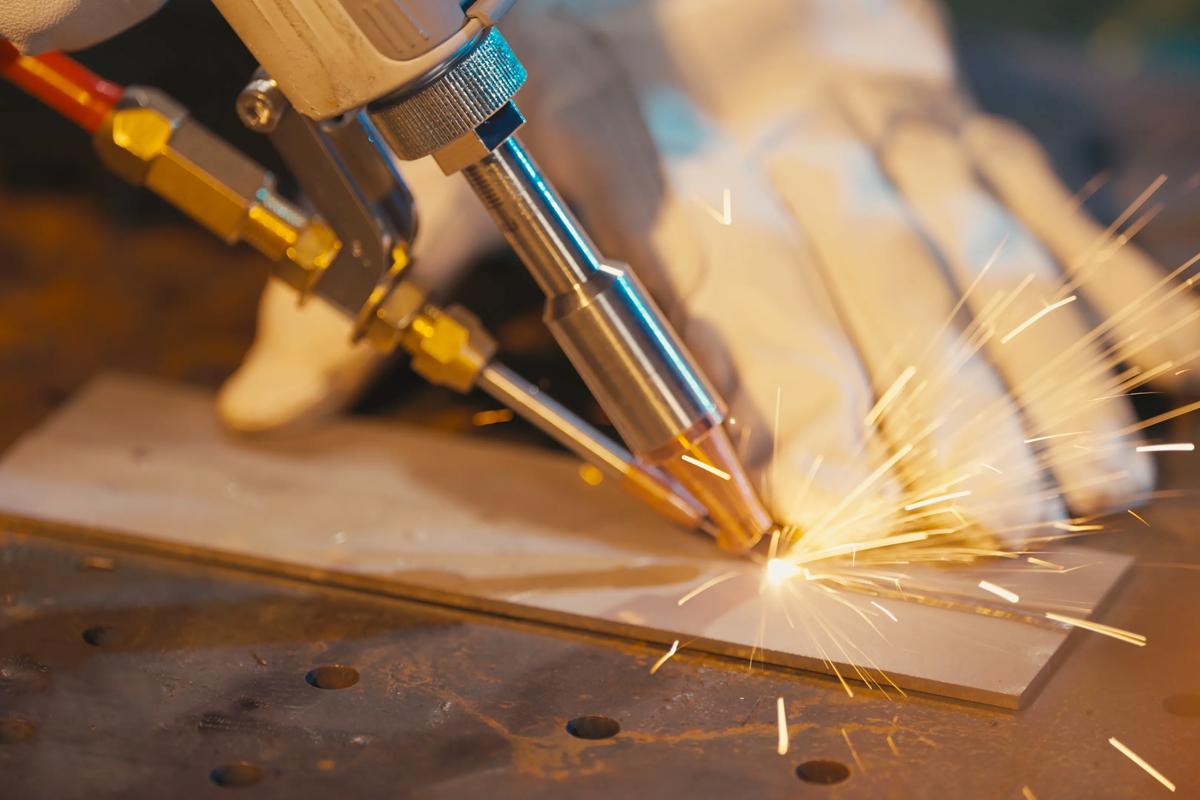
What Laser Welding Is—and How It Works
Common Laser Types
Different laser sources bring unique advantages to the welding process:
- Fiber Lasers: Currently, the most widely used in industry. They deliver high beam quality, excellent focusability, and electrical efficiency above 30%. Their compact, solid-state design reduces maintenance, and their ability to couple with fiber optics makes them ideal for robotic or automated systems. Fiber lasers excel at welding thin to medium-thickness metals with high precision.
- CO2 Lasers: Once the workhorse for thick-section welding, CO2 lasers operate in the 10.6 μm wavelength range. They provide deep penetration but require complex mirror-based beam delivery, making them less flexible in automated setups. They are gradually being replaced by fiber lasers due to lower energy efficiency and higher operating costs.
- Nd:YAG Lasers: These operate at 1.06 μm wavelength and can be pulsed or continuous. Their ability to deliver through optical fibers provides versatility, especially for spot welding and repairs. However, they are less energy-efficient than fiber lasers and are increasingly niche.
Beam Delivery and Optics
The precision of laser welding depends heavily on how the beam is delivered and focused.
- Optical fibers are used with fiber and Nd:YAG lasers, offering flexibility in robotic integration and multi-station setups.
- Mirrors and lenses are necessary for CO2 lasers, which limit maneuverability and make system alignment more complex.
Shielding Gas
Shielding gas plays multiple roles in laser welding. It prevents oxidation of the molten pool, protects optics from spatter, stabilizes the plasma plume, and can even influence weld penetration.
- Argon is common for reactive metals like titanium and aluminum, providing an inert protective atmosphere.
- Helium offers a higher ionization potential, improving penetration depth and weld stability, though it is more expensive.
- Nitrogen is sometimes used for stainless steels, where it can improve weld strength through alloying effects.
Filler or No Filler
What TIG (GTAW) Welding Is—and How It Works
Current Modes and Polarities
TIG welding can operate with different electrical modes depending on the base metal:
- Direct Current Electrode Negative (DCEN): The most common setup. About 70% of heat is concentrated on the workpiece, providing deep penetration and stable arcs—ideal for steels, nickel alloys, and titanium.
- Direct Current Electrode Positive (DCEP): Puts more heat on the tungsten electrode. Rarely used alone because it risks overheating the electrode, but useful for cleaning oxide films on certain surfaces.
- Alternating Current (AC): Essential for welding aluminum and magnesium. The electrode-positive half of the cycle breaks up oxide layers, while the electrode-negative half penetrates the base material. Modern AC TIG power sources allow waveform control—such as balance adjustment and frequency tuning—for even more precision.
Torch and Control
Shielding, Backing, and Purge
Shielding is critical in TIG welding because the arc and molten pool must be completely isolated from the atmosphere to avoid contamination.
- Shielding Gas: Typically argon, though helium or argon-helium mixes may be used for deeper penetration or faster travel speeds. For reactive materials like titanium or zirconium, shielding gas coverage must be flawless.
- Backing Gas: For full-penetration welds, especially on stainless steel or nickel alloys, backing gas is introduced to the underside of the joint to protect the root from oxidation.
- Purge Systems: In tubular or enclosed components, purge chambers or purge dams ensure the entire weld zone is protected, preventing defects like “sugaring” (oxidation on the root side).
Core Differences at Glance
Speed
- Laser Welding: Laser welding is among the fastest fusion processes available. Travel speeds can reach 5–10 m/min on thin sections, depending on the material and laser type. The high power density melts metal almost instantaneously, which reduces cycle time and enables continuous production. This speed is why laser welding dominates in automotive body-in-white production, battery tab welding, and electronic components.
- TIG Welding: TIG is inherently slower, with typical travel speeds in the 0.1–0.5 m/min range for manual welding. Each joint requires careful control of arc length, travel angle, and filler feeding. The process is better suited for low-volume, specialized work rather than production speed.
Heat Input & Distortion
- Laser Welding: Produces very low overall heat input because the energy is concentrated in a small spot. This creates a narrow weld with a small heat-affected zone (HAZ), resulting in minimal distortion and residual stress. Components can be welded with tighter dimensional tolerances, reducing post-weld machining.
- TIG Welding: Generates higher overall heat input since the arc spreads energy over a wider area. This increases the risk of distortion, particularly on thin sheet metals. Skilled operators can mitigate this with intermittent welding, backstepping, or chill blocks, but distortion management is a constant challenge.
Fit-Up Tolerance
- Laser Welding: Requires precise fit-up and joint preparation. Gaps greater than 0.1–0.2 mm often lead to incomplete fusion, underfill, or porosity unless filler is added. This makes it less forgiving in repair work or field applications.
- TIG Welding: Much more tolerant of joint gaps because filler wire can bridge spaces and correct misalignment. This makes TIG the go-to choice for fabrication, prototyping, and repair, where components may not be manufactured to perfect tolerances.
Thickness Range
- Laser Welding: Best suited for thin to medium materials (0.1 mm–8 mm in a single pass). Using “keyhole welding,” lasers can penetrate thicker sections, but beyond 10 mm, multiple passes or hybrid methods (e.g., laser-MIG) are usually required.
- TIG Welding: Handles a much wider thickness range. Skilled welders can fuse foil-thin metals without burn-through or deposit thick welds on heavy plate (with multiple passes). The trade-off is slower productivity on thick sections.
Accessibility
- Laser Welding: Restricted by line-of-sight. The laser beam must directly reach the joint, and reflective surfaces (like aluminum) can complicate beam coupling. Complex geometries or obstructed welds may require redesign or alternate methods.
- TIG Welding: Highly adaptable in tight or complex areas. Operators can angle the torch, feed filler at different approaches, and even weld overhead or in confined spaces. This makes it extremely versatile in field service and custom fabrication.
Automation
- Laser Welding: Naturally suited to robotic automation. Once programmed, it delivers repeatable, high-speed welds with minimal variability. Integrated sensors can provide real-time monitoring and quality control, critical in mass production.
- TIG Welding: Can be mechanized (orbital TIG systems are common in pipelines), but full automation is complex due to the precise coordination needed between torch and filler. TIG remains largely a manual, skill-driven process.
Cosmetics
- Laser Welding: Produces smooth, narrow seams with minimal spatter and no need for post-grinding. Welds are often flush and nearly invisible, which is why laser welding is used on visible consumer products (e.g., medical tools, electronics housings).
- TIG Welding: Known for its “stack-of-dimes” appearance when performed by a skilled welder. The weld bead is slightly raised and visually distinctive, often considered a mark of craftsmanship. However, cosmetic quality is highly operator-dependent.
Metallurgy
- Laser Welding: High cooling rates can lead to hard microstructures in steels, which may reduce toughness unless carefully controlled. Alloy segregation, porosity, and cracking risks increase in some materials. Filler or preheating is sometimes necessary to stabilize welds.
- TIG Welding: Slower cooling produces more predictable metallurgy with lower residual stresses. Using filler rods matched to base metal provides excellent control over dilution, microstructure, and crack resistance. TIG is often preferred for critical alloys where weld integrity is non-negotiable.
Cost
- Laser Welding: Equipment cost is high: industrial fiber lasers and optics require significant investment. However, once installed, operating costs are relatively low due to fast cycle times, low filler use, and reduced rework. Economical for high-volume, repeatable production.
- TIG Welding: Equipment is relatively inexpensive, but labor costs are high. Skilled operators are essential, and deposition rates are low. More cost-effective for one-offs, prototypes, or repairs, but not competitive for large-scale production.
Heat, Metallurgy, and Mechanical Properties
Heat Input and Cooling Rates
- Laser Welding: Laser beams deliver extremely high energy density in a very localized spot, which means welds form quickly with low overall heat input. Cooling rates are correspondingly fast—often several hundred °C per second. This reduces distortion and shrinkage but can lead to hard or brittle microstructures in certain alloys if not controlled. In steels, for example, rapid cooling may produce martensite, increasing hardness but reducing toughness.
- TIG Welding: TIG arcs distribute heat over a wider area and require more time to form a weld pool. The result is higher total heat input and slower cooling rates. While this increases distortion risk, it also gives the microstructure more time to stabilize, often producing softer, more ductile welds with fewer cracking tendencies.
Heat-Affected Zone (HAZ) Behavior
- Laser Welding: The HAZ is very narrow and localized because the laser introduces minimal bulk heating. This is beneficial when dimensional control matters—thin-walled parts, precision assemblies, or components requiring post-weld machining. However, the steep thermal gradients can create residual stresses and microstructural inhomogeneities that must be considered in critical applications.
- TIG Welding: TIG welding creates a wider HAZ because of prolonged heating. This increases the risk of distortion and grain coarsening but reduces the severity of thermal gradients. The transition between weld metal, HAZ, and base metal tends to be smoother, which can improve toughness and fatigue resistance in certain alloys.
Mechanical Properties
- Laser Welding: The resulting welds are typically narrow, deep, and strong, with high hardness due to rapid solidification. However, toughness and ductility may be reduced unless parameters are optimized or filler is used. For critical components, post-weld heat treatment may be required to relieve residual stress and temper brittle structures.
- TIG Welding: Welds generally have balanced mechanical properties—good ductility, reasonable strength, and predictable performance. The ability to add filler material matched to the base metal gives operators control over weld chemistry, improving corrosion resistance, crack resistance, and fatigue behavior.
Joint Types and Design Choices
Butt Joints
- Laser Welding: Butt joints are the most common configuration for laser welding. When parts are tightly fitted with minimal gaps, lasers produce narrow, deep-penetration welds in a single pass. For thin sheets, this can result in almost invisible seams. However, joint gap tolerance is low (often <0.1 mm). If gaps are present, filler wire may be needed.
- TIG Welding: Butt joints are also standard for TIG welding. The process is far more forgiving of gaps because filler can be added manually. For thicker materials, multiple passes may be required, but TIG offers excellent control over root fusion and bead profile.
Lap Joints
- Laser Welding: Lap joints are frequently used in thin-gauge assemblies like automotive or battery tabs. The laser can penetrate both layers to form a strong bond with minimal overlap. However, lap weld strength is sensitive to penetration depth and beam positioning, requiring precise setup.
- TIG Welding: TIG can weld lap joints effectively, but higher heat input increases distortion risk on thin materials. For thicker overlaps, filler metal improves strength but adds time and cost. TIG excels when the cosmetic surface appearance of the top sheet is a priority.
Fillet Joints
- Laser Welding: Fillet joints can be welded with lasers, but access and alignment are critical. Because the laser beam must directly reach the corner, fixturing and part geometry play a big role. Fillets are less common in laser applications unless automated positioning systems are used.
- TIG Welding: TIG welding is highly versatile with fillet joints. Operators can manipulate torch angle and filler placement to achieve full penetration, smooth bead appearance, and good strength. This flexibility makes TIG the go-to choice for structural fillets in pipes, frames, and assemblies.
Edge, Corner, and Hermetic Seams
- Laser Welding: Lasers excel in edge and corner welds, especially where aesthetics or leak-tight seals are required. In electronics, sensors, and medical devices, hermetic seam welding is a major application, as the narrow welds create airtight enclosures without damaging delicate components nearby.
- TIG Welding: TIG can also perform edge and corner welds, but requires more heat and often filler to reinforce the joint. For hermetic applications, TIG is less efficient because of larger weld beads and greater distortion, but it’s still used when manual control and repairability are important.
Tolerances and Prep
- Laser Welding: Demands tight dimensional control and clean surfaces. Even small misalignments, gaps, or contaminants can compromise weld quality. Machining, precision cutting, or careful fixturing is often required before welding.
- TIG Welding: Much more tolerant of imperfect preparation. Welders can compensate for gaps, uneven edges, or surface contamination with filler metal and technique adjustments. This makes TIG well-suited for fieldwork, repair, and one-off fabrications.
Equipment, Setup, and Integration
Laser Welding System
A laser welding setup is a high-tech, modular system built around precision and automation. Its core elements include:
- Laser Source: Fiber lasers dominate today’s market due to their compact design, efficiency, and excellent beam quality. Older systems may use CO2 or Nd:YAG lasers. Power ratings range from a few hundred watts (for micro-welding) to several kilowatts (for automotive structures).
- Beam Delivery and Optics: Optical fibers or mirrors channel the laser to the weld head. Focusing lenses concentrate the beam to achieve the necessary spot size for either conduction-mode or keyhole-mode welding. Automated systems often include beam scanners for rapid positioning.
- Motion System and Fixturing: Most laser welding requires precision fixturing to hold parts in exact alignment. Robotic arms or CNC stages move the laser head or the workpiece with micron-level accuracy.
- Shielding and Assist Gas: Gas nozzles deliver argon, helium, or nitrogen to protect the weld pool and influence penetration. In high-speed systems, gas also helps remove metal vapor (plume control).
- Integration: Laser welding is often built into automated production cells with robotic handling, inline inspection, and quality monitoring. Once programmed, it provides consistent, repeatable results at high throughput.
TIG Welding System
TIG welding systems are comparatively simple, flexible, and operator-driven. Its main elements include:
- Power Source: TIG uses constant current (CC) power supplies with options for DCEN, DCEP, or AC. Advanced machines allow waveform control, pulse modes, and fine amperage adjustments.
- Torch Assembly: A hand-held or mechanized torch houses the tungsten electrode, shielding gas nozzle, and collet body. Torches can be air-cooled for light-duty work or water-cooled for high amperages.
- Shielding Gas Supply: Argon is the standard, though helium blends are used for deeper penetration or faster welding. Flow rates are controlled by a regulator and a flowmeter.
- Filler Metal: Unlike laser welding, filler rods are usually added manually by the welder, though wire feeders can be used in mechanized TIG. Filler choice allows precise control of weld chemistry and properties.
- Control Systems: Heat input is adjusted in real-time, often with a foot pedal, finger control, or panel settings. This makes TIG highly responsive to operator skill and technique.
- Integration: TIG can be mechanized (e.g., orbital TIG for pipe welding), but full robotic automation is less common due to complexity in handling filler addition. It remains heavily reliant on skilled operators.
Shielding Gases and Consumables
Laser Welding
- Shielding Gases: Laser welding typically uses argon, helium, or nitrogen. Each gas has specific effects:
- Argon: Most common, economical, and effective for protecting the molten pool. Its high density blankets the weld well but may increase plume formation, which can interfere with the laser beam.
- Helium: Preferred when deeper penetration or higher weld quality is required. It reduces plasma absorption of the laser beam and provides better heat transfer, though it is expensive.
- Nitrogen: Used selectively for stainless steels, where it can act as an alloying element and improve pitting corrosion resistance. However, in some materials, it may promote brittleness.
- Shielding also stabilizes the process and influences the cooling rate. In high-power applications, assist gases may be used to remove metal vapor and minimize contamination of optics.
- Consumables: Laser welding is relatively low-consumable compared to arc welding. When performed autogenously (without filler), no filler wire is required. However, if joint gaps are present or specific alloying adjustments are needed, filler wires may be introduced. Even then, usage is minimal compared to TIG. The most critical consumables are optical components—lenses, mirrors, and fiber ends—which must remain clean and aligned. Contaminated optics can degrade beam quality and weld consistency.
TIG Welding
- Shielding Gases: TIG welding almost exclusively uses argon for most applications, providing a stable arc and good shielding across a wide variety of metals. In certain cases:
- Helium or argon-helium mixes are used for deeper penetration and faster welding on thicker materials.
- Hydrogen mixtures (up to ~5%) may be used with stainless steels to improve arc stability and bead appearance, though they are unsuitable for materials prone to cracking.
- Shielding effectiveness is vital, as even slight exposure to air can cause oxidation, porosity, or a brittle weld bead. For root passes on stainless steel or titanium, backing gas or purge chambers are often required to protect the underside of the weld.
- Consumables: TIG welding uses a broader range of consumables:
- Tungsten Electrodes: Non-consumable, but tips degrade over time. Electrodes come in different types—pure tungsten, thoriated, ceriated, lanthanated—chosen based on current mode and material.
- Filler Rods/Wires: A major consumable in TIG welding. They allow welders to adjust chemistry, add reinforcement, and compensate for poor fit-up. The filler alloy must often be carefully matched to the base material for corrosion and mechanical performance.
- Gas Nozzles and Cups: Ceramic cups direct shielding gas over the weld zone. These wear over time and must be replaced.
Parameters and Control Strategies
Laser Parameters
Laser welding operates with tight process windows where small changes in parameters can greatly affect weld quality. The key variables include:
- Power Output: Determines penetration depth and weld speed. Low power produces conduction-mode welds (shallow, wide), while higher power enables keyhole welding (deep, narrow). Power stability is critical for consistent results.
- Beam Focus and Spot Size: A tightly focused spot increases energy density, improving penetration but also raising the risk of porosity or spatter. Defocused beams spread energy for surface welds or thin sheets.
- Travel Speed: Faster speeds reduce heat input and distortion, but risk incomplete fusion if too high. Slower speeds increase penetration but may widen the HAZ and introduce porosity.
- Pulse vs. Continuous Mode: Pulsed lasers allow precise control over heat input in micro-welding or thin sections, while continuous-wave lasers dominate in high-speed industrial production.
- Shielding Gas Flow: Flow rate and composition must be optimized. Too little gas leads to oxidation; too much can cause turbulence and instability.
- Joint Positioning and Tolerances: Because lasers are intolerant of misalignment, precise fixturing and part preparation are often as important as parameter control.
TIG Parameters
TIG welding allows for a wider process window but requires significant operator input. Key parameters include:
- Current Type and Polarity:
- DCEN (Direct Current Electrode Negative): Standard for steels, titanium, and nickel alloys. Provides deep penetration and stable arcs.
- DCEP (Direct Current Electrode Positive): Rarely used alone, but can help clean oxides on surfaces.
- AC (Alternating Current): Essential for aluminum and magnesium, where the electrode-positive half removes oxides and the electrode-negative half provides penetration. Waveform balance and frequency control in advanced machines allow fine-tuning for better results.
- Amperage and Heat Control: Amperage dictates penetration and weld pool size. TIG welders often adjust amperage dynamically with a foot pedal, finger switch, or remote control. Pulse modes (high/low current cycling) help control heat input, reduce distortion, and improve weld quality on thin sections.
- Arc Length and Torch Angle: Directly controlled by the operator. A shorter arc improves concentration and penetration, while angle affects bead shape and shielding gas coverage.
- Filler Addition: Timing, position, and quantity of filler metal are critical. Poor filler technique can cause porosity, lack of fusion, or excessive reinforcement.
- Shielding Gas Flow: Flow rate must be balanced for coverage without turbulence. In some applications, trailing shields or gas lenses are used for extended protection of reactive metals.
Automation and Robotics
Laser Welding
Laser welding is inherently suited to automation. Its precision, speed, and repeatability make it ideal for robotic and CNC-controlled systems.
- System Integration: Laser sources, optics, and delivery heads are commonly mounted on robotic arms or gantry systems. These can execute complex paths with micron-level accuracy, enabling welds in high-density assemblies such as automotive body structures, EV battery packs, and medical devices.
- Process Monitoring: Modern laser welding cells incorporate sensors and closed-loop controls (e.g., monitoring back-reflection, weld plume, or thermal signatures). These allow real-time parameter adjustments, reducing defect rates and ensuring consistency.
- High Throughput: Robots can operate at high speeds with minimal downtime, producing thousands of identical welds per shift. This makes laser welding one of the most productive automated processes available.
- Challenges: The main challenges are joint fit-up tolerance and initial investment cost. Parts must be precisely manufactured and fixtured, as robots cannot easily compensate for gaps or misalignment in the same way a human welder can.
TIG Welding
TIG welding can also be automated, but it is a more complex undertaking due to the nature of the process.
- Orbital TIG Systems: Automation is common in specialized fields like pipe and tube welding, where orbital TIG heads travel around the joint while maintaining perfect shielding gas coverage. These systems deliver exceptional quality but are expensive and highly specialized.
- Robotic TIG Welding: Robots can be equipped with TIG torches, but adding filler metal poses significant challenges. Unlike laser or MIG processes, TIG filler addition is often manual and highly variable, making robotic integration less straightforward. Some automated TIG cells use cold wire feeders, but precision filler placement requires advanced programming and careful calibration.
- Flexibility: TIG automation is less about mass production and more about reproducibility in critical applications—nuclear, aerospace, and pharmaceutical industries, where weld quality and traceability are more important than speed.
- Limitations: TIG welding remains slower and less tolerant to programming errors in robotic setups. It also demands complex fixturing and precise shielding strategies to avoid contamination.
Safety and Ergonomics
Laser Safety
Laser welding introduces unique hazards associated with the high-energy light beam and supporting system:
- Beam Hazards: Industrial lasers are typically Class 4 devices, meaning direct or reflected exposure to the beam can cause permanent eye damage or skin burns. Even diffuse reflections from shiny metals can be hazardous. Operators must use enclosed welding cells, interlocks, and laser-rated safety eyewear.
- Plume and Fumes: The high energy density can vaporize material, creating metallic fumes and plasma plumes. Effective fume extraction and shielding gas flow are essential.
- Electrical and Optical Safety: High-voltage laser sources and sensitive optics require careful handling. Misaligned or contaminated lenses can scatter the beam unpredictably, creating risks.
- Ergonomics: Once enclosed and automated, laser welding is ergonomically friendly. Operators typically oversee processes from a control panel rather than being physically exposed, reducing fatigue, repetitive stress, and long-term health risks.
TIG Safety
TIG welding carries the more traditional hazards associated with arc welding, requiring strict adherence to protective measures:
- Arc Radiation: TIG arcs emit intense UV and IR radiation, which can cause eye injuries (“arc eye”) and skin burns. Welders must use helmets with appropriate shade filters, gloves, and full protective clothing.
- Heat and Burns: TIG torches, filler rods, and workpieces get extremely hot. Contact burns and radiant heat exposure are common risks without proper PPE.
- Fumes and Gases: While TIG produces less fume than MIG or stick welding, it still generates ozone and metal oxides, especially when welding stainless steel, nickel, or titanium. Adequate ventilation is critical.
- Ergonomics: TIG welding is highly operator-intensive. Welders must maintain steady torch control, filler feeding, and precise positioning, often for extended periods. This can lead to musculoskeletal strain in the hands, wrists, shoulders, and back. The need to hold awkward positions in manual welding further increases fatigue.
- Electrical Safety: As with all arc processes, there’s a risk of electric shock, particularly in damp environments or when working inside conductive structures.
Common Defects and Troubleshooting
Laser Welding Defects
Laser welding operates with a very tight process window, making it sensitive to setup, alignment, and material conditions. Typical defects include:
- Porosity: Gas trapped in the molten pool can solidify as voids. This often results from excessive shielding gas turbulence, contaminants on the workpiece, or unstable keyhole collapse.
- Troubleshooting: Improve surface cleaning, optimize gas flow, and stabilize laser power. In some cases, adjust the beam focus to reduce turbulence.
- Cracking (Hot or Cold): Rapid cooling and high thermal gradients can cause solidification cracks, especially in alloys with wide solidification ranges (e.g., aluminum). Cold cracking may occur in hardened zones of steel.
- Troubleshooting: Use filler material to modify weld chemistry, preheat susceptible alloys, or adjust welding speed to control cooling rates.
- Lack of Fusion/Penetration: If the beam is misaligned, underpowered, or too fast, incomplete fusion occurs, weakening the joint.
- Troubleshooting: Increase laser power, reduce travel speed, ensure accurate beam focus, or improve joint fit-up.
- Spatter and Undercut: Excessive energy density or unstable keyholes can eject molten material, leaving surface defects or gouges.
- Troubleshooting: Lower power density, optimize shielding gas type/flow, and refine focus positioning.
TIG Welding Defects
TIG welding is more forgiving than laser welding, but it is highly dependent on operator skill. Common issues include:
- Porosity: Caused by inadequate shielding, moisture or oil contamination, or filler wire oxidation. Porosity is particularly common in aluminum TIG welds.
- Troubleshooting: Ensure clean base and filler metals, maintain proper gas flow, and avoid drafts that disturb shielding.
- Cracking: Hot cracking can occur in alloys like aluminum or stainless steel due to impurities or improper heat control. Crater cracking is another common issue when the arc is extinguished abruptly.
- Troubleshooting: Use appropriate filler alloys, taper off current at the weld end, and avoid excessive heat input.
- Incomplete Fusion or Lack of Penetration: Often the result of insufficient heat, poor joint preparation, or incorrect torch angle.
- Troubleshooting: Increase amperage, adjust arc length, and ensure proper edge preparation.
- Tungsten Inclusions: Unique to TIG welding, these occur when the tungsten electrode contaminates the weld pool, usually from improper torch handling or excessive current.
- Troubleshooting: Maintain correct arc length, avoid dipping tungsten into the pool, and use the correct electrode type for the material.
- Undercut or Excess Reinforcement: Results from poor filler addition technique or incorrect travel speed, affecting both strength and cosmetics.
- Troubleshooting: Adjust travel speed, maintain proper torch angle, and coordinate filler addition with pool dynamics.
Materials-Specific Notes
Carbon and Low-Alloy Steels
- Laser Welding: Performs well due to good absorptivity at laser wavelengths. Narrow welds with minimal distortion are achievable. However, rapid cooling can form martensite, leading to hardness and cracking in higher-carbon grades. Preheating or filler addition is often needed.
- TIG Welding: A well-established method for these steels. Slower cooling reduces hardness and cracking risk, and filler can be selected to fine-tune properties. TIG provides reliable, ductile welds, though distortion may be greater.
Stainless Steels
- Laser Welding: Produces smooth, clean welds with minimal discoloration. Fast cooling helps retain corrosion resistance but may increase susceptibility to hot cracking, especially in austenitic grades. Shielding gas (argon/helium) is critical to prevent oxidation.
- TIG Welding: Extremely common for stainless fabrication. Allows better metallurgical control, especially with filler addition to counter cracking or ferrite balance issues. Back purging with argon is often required to protect the root from oxidation (“sugaring”).
Aluminum Alloys
- Laser Welding: Challenging due to high reflectivity (especially with CO₂ lasers) and high thermal conductivity, which demands higher laser power. Porosity is common due to hydrogen solubility. Fiber lasers with filler wire and helium shielding improve results.
- TIG Welding: Very common for aluminum. AC cleans oxide layers while ensuring penetration. TIG provides excellent cosmetic welds but is slow. Careful heat management is required to avoid distortion or burn-through in thin sections.
Nickel Alloys (Inconel, Hastelloy, etc.)
- Laser Welding: Possible, but alloys are crack-sensitive due to rapid solidification. Autogenous laser welds can suffer from microfissures. Preheating, optimized parameters, and filler wire are often required.
- TIG Welding: Preferred for critical nickel-alloy components. Slower cooling reduces cracking risk. Wide filler selection allows weld chemistry optimization. TIG is common in aerospace, petrochemical, and nuclear applications where reliability is non-negotiable.
Copper and Copper Alloys
- Laser Welding: Difficult due to high reflectivity and high thermal conductivity. Requires very high power density and precise focus. Fiber lasers with short wavelengths (~1 μm) are more effective than CO2. Once melted, welds can be sound, but process control is challenging.
- TIG Welding: Possible, but requires very high amperage due to copper’s thermal conductivity. Preheating is often necessary. TIG allows good control but is slow and energy-intensive.
Titanium
- Laser Welding: Excellent candidate for laser welding due to good absorptivity and low thermal conductivity. Produces precise welds with minimal distortion. However, titanium is extremely reactive with oxygen and nitrogen, so shielding gas coverage must be flawless, often requiring trailing shields or glove boxes.
- TIG Welding: The traditional method for titanium welding. With proper shielding (argon purge, trailing gas), TIG welds are strong, ductile, and corrosion-resistant. However, operator skill is crucial, and even slight contamination can ruin a weld.
Economic Comparison
Capital vs Operating Costs
- Laser Welding:
- Capital Costs: Very high. Industrial laser systems—including the source, optics, fixturing, motion systems, shielding, and enclosures—can cost hundreds of thousands to millions of dollars. This upfront cost often includes integration with robotics or CNC systems.
- Operating Costs: Relatively low per part. Lasers require minimal consumables (mainly shielding gas and occasional filler wire). Energy efficiency is high, and automation reduces labor costs. Maintenance is focused on optics and alignment rather than electrodes or filler. Over time, operating costs are far lower than manual arc processes.
- TIG Welding:
- Capital Costs: Low to moderate. A quality TIG power source, torch, and shielding setup is inexpensive compared to a laser system. Even advanced AC/DC TIG machines are a fraction of the cost of laser equipment.
- Operating Costs: High. TIG consumes filler rods, tungsten electrodes, gas cups, and large volumes of shielding gas. Most importantly, it is labor-intensive, with deposition rates much lower than MIG or laser welding. Skilled welders command high wages, and labor often dominates the cost structure.
Where the Break-Even Lies
- Laser Welding: The break-even point comes in high-volume, high-precision production. The huge upfront cost only makes sense if the system runs continuously, producing thousands or millions of parts with minimal rework. Industries like automotive, electronics, and medical devices justify laser systems because throughput, repeatability, and minimal distortion save money at scale.
- TIG Welding: Break-even favors low-volume, custom, or repair work. For small batches, one-off prototypes, or parts requiring metallurgical flexibility, TIG is cheaper and more practical. It doesn’t require the fixturing precision or upfront capital of a laser cell, and its adaptability makes it invaluable in job shops and fieldwork.
Environmental and Operational Footprint
Energy Efficiency
- Laser Welding: Modern fiber lasers are among the most energy-efficient welding sources available, with wall-plug efficiencies of 25–35%. Because they deliver heat in a concentrated beam, the overall energy input per weld is low. Welds are completed faster, which further reduces per-part energy demand. Less rework and distortion correction also minimizes hidden energy costs.
- TIG Welding: TIG power sources are less efficient, and the process itself consumes more energy per unit length of weld because of slower travel speeds and higher overall heat input. Extended arc times, multiple passes on thicker sections, and post-weld finishing all add to energy use.
Fume and Noise
- Laser Welding: Produces fewer fumes compared to arc welding, since the heat-affected volume is small. However, high-intensity laser-material interaction can generate metal vapor and plasma plumes, especially in keyhole mode. These must be managed with localized extraction and proper shielding gas flow. Noise levels are minimal, making laser welding a relatively quiet process once enclosed in automated cells.
- TIG Welding: Known for being one of the cleaner arc welding methods, but it still generates fumes containing ozone, metal oxides, and nitrogen oxides, particularly with stainless steels and reactive alloys. Adequate ventilation or fume extraction is mandatory. TIG arcs are generally quieter than MIG or stick processes, but high-frequency AC starts can generate noticeable noise and electromagnetic interference.
Gas Consumption
- Laser Welding: Shielding gas is essential, but consumption is typically lower per weld because of fast travel speeds and smaller weld pools. Helium is sometimes required to stabilize the plume and improve penetration, but its high cost increases operational footprint. Gas optimization (e.g., nozzle design, flow rate control) directly affects both cost and sustainability.
- TIG Welding: More gas-intensive, especially for reactive metals like titanium or stainless steel, where backing gas and purging may be required to protect the root side of welds. Shielding flow rates are higher than in laser welding, and consumables like gas lenses or trailing shields further increase usage. Overall, TIG has a larger gas consumption footprint per part.
Decision Framework
Production Volume and Takt Time
- Laser Welding: Laser systems shine in mass production environments where every second matters. A properly configured laser cell can complete welds in fractions of the time needed for TIG—sometimes 10x faster. Takt times in automotive and electronics demand this kind of throughput. The ability to run continuously with minimal operator intervention also means high uptime and predictable output.
- TIG Welding: TIG cannot compete in raw speed. Travel rates are typically 0.1–0.5 m/min, compared to meters per minute for lasers. However, TIG welding excels in short-run, low-volume, or repair jobs, where takt time is secondary to flexibility and weld reliability.
Fit-Up Capability
- Laser Welding: Requires precision machining and fixturing. Gaps larger than ~0.1–0.2 mm often lead to porosity, underfill, or lack of fusion unless filler is added. For manufacturers with precision-cut parts and automated clamping systems, lasers perform flawlessly. Without those controls, rejection rates can be high.
- TIG Welding: Far more forgiving. A skilled welder can manipulate filler rod, torch angle, and travel speed to compensate for gaps, misalignments, or edge irregularities. This makes TIG ideal for field repairs, retrofits, or parts where tolerance stack-ups cannot be avoided.
Material and Thickness
- Laser Welding: Best suited for thin to medium sections (0.1–8 mm in a single pass). Fiber lasers, operating at ~1 µm wavelength, work well on steels, stainless steel, and titanium, but reflectivity limits their efficiency on copper and aluminum unless special measures are taken. For thick sections (>10 mm), hybrid processes (laser + MIG/TIG) or multiple passes are required.
- TIG Welding: Handles a wider range—from foil-like sheets to thick plate. TIG welders can manage delicate welds on aerospace foils as well as multipass welds on heavy equipment. For aluminum and nickel alloys, TIG remains the standard because of its ability to handle oxide cleaning (AC mode) and filler control.
Metallurgical Risks
- Laser Welding: Rapid cooling produces fine but sometimes brittle microstructures. Martensite formation in steels or hot cracking in aluminum and nickel alloys are risks. Without filler or preheat, weld toughness may suffer. Metallurgical performance depends heavily on parameter optimization and, in some cases, post-weld heat treatment.
- TIG Welding: Slower thermal cycles produce more predictable metallurgy. Welders can select filler rods that fine-tune chemistry (e.g., controlling ferrite content in stainless steels, or adding ductility to nickel alloys). For safety-critical industries like aerospace and nuclear, TIG is trusted because its metallurgy is easier to control and certify.
Automation Infrastructure
- Laser Welding: Designed for robotic and CNC integration. A laser head mounted on a robot arm can weld complex geometries with micron precision, guided by sensors and closed-loop controls. However, this requires upfront investment in fixturing, robotics, and quality monitoring systems. Companies with existing automation see lasers as a natural fit.
- TIG Welding: Automation is possible, but niche. Orbital TIG welding is widely used for pipes in aerospace, semiconductor, and pharmaceutical industries. However, robotic TIG welding with filler is complex and expensive. In most cases, TIG remains a manual or semi-automated craft, relying on human dexterity.
Quality Requirements
- Laser Welding: Produces narrow, smooth, nearly invisible seams. Ideal for hermetic seals (e.g., sensors, medical implants, electronics housings) and for visible surfaces in consumer or aerospace products. Dimensional distortion is minimal, so post-weld machining is reduced.
- TIG Welding: Renowned for its cosmetic “stack-of-dimes” weld bead and high structural integrity. Filler metal enables welds with excellent corrosion resistance and toughness. TIG is often specified in industries where aesthetics and proven metallurgy carry as much weight as strength.
Safety and Facility Limits
- Laser Welding: Requires Class 4 laser safety controls: enclosures, interlocks, curtains, and trained operators. Open-beam operation is unsafe. Lasers are also sensitive to reflective surfaces, which may redirect hazardous beams. This confines them to controlled shop-floor environments with proper infrastructure.
- TIG Welding: Requires PPE (helmet, gloves, protective clothing) and fume extraction, but is far more portable and adaptable. TIG can be performed in workshops, shipyards, construction sites, or remote repair jobs, making it a more flexible choice for varied environments.
How to Choose: Laser Welding or TIG Welding
Choose Laser Welding If
- You produce at high volume, and speed matters. Laser welding excels in mass production environments like automotive, electronics, and medical device manufacturing. Travel speeds can be 5–10 times faster than TIG, reducing takt time and per-part costs.
- Your parts require minimal distortion and high precision. With its concentrated energy input, laser welding minimizes heat-affected zones and reduces post-weld machining. This is especially valuable in precision assemblies, sensors, and aerospace components where tolerances are tight.
- Your parts are well-prepared with tight tolerances. Laser welding requires exact fit-up and clean surfaces. If your production line already uses precision machining and reliable fixturing, laser welding integrates seamlessly.
- You have or plan to invest in automation. Laser welding is designed for robotic integration and CNC systems. Automated cells can produce consistent, repeatable welds with in-line quality monitoring—ideal for scaling production.
- Cosmetics and sealing are critical. Laser welds are smooth, narrow, and often nearly invisible. They are widely used for hermetic seams and for consumer-facing parts where weld appearance must be flawless.
- You’re ready for high capital investment. Laser systems require a substantial upfront spend, but deliver low long-term operating costs in high-throughput settings.
Choose TIG Welding If
- You work with low-volume, custom, or repair jobs. TIG welding thrives in one-off projects, prototypes, and field repairs, where flexibility and adaptability matter more than speed.
- Your parts don’t always fit perfectly. Unlike lasers, TIG welders can compensate for gaps, misalignments, and inconsistent preparation by manipulating filler and torch technique. This makes it suitable for fabrication shops and maintenance work.
- You weld challenging alloys. TIG is more forgiving with aluminum, nickel alloys, stainless steels, and dissimilar metals, thanks to slower cooling and filler options. Metallurgical risks like cracking or brittleness are easier to manage.
- Operator skill adds value. TIG welding is a craft. Skilled welders can tailor heat input, filler chemistry, and bead placement in real time, producing welds that are both strong and aesthetically distinctive.
- You need portability. TIG welding setups are relatively compact and can be deployed in the field—shipyards, construction sites, or remote facilities—where laser systems are impractical.
- You want a lower capital cost. TIG equipment is far less expensive than laser systems. While operating costs (labor, filler, gas) are higher, TIG is more cost-effective for small runs and maintenance work.
Summary
Get Laser Welding Solutions
Drawing upon years of deep expertise in industrial laser cutting, welding, marking, and cleaning, this article presents information based on practical experience and the latest industry insights. By providing clear and technically sound guidance, it helps readers select the right machines, understand process trade-offs, and optimize workflows.
My goal is to help engineers, shop floor managers, and production decision-makers make informed choices that perfectly combine innovation, quality, and operational efficiency.
Drawing upon years of deep expertise in industrial laser cutting, welding, marking, and cleaning, this article presents information based on practical experience and the latest industry insights. By providing clear and technically sound guidance, it helps readers select the right machines, understand process trade-offs, and optimize workflows.
My goal is to help engineers, shop floor managers, and production decision-makers make informed choices that perfectly combine innovation, quality, and operational efficiency.