
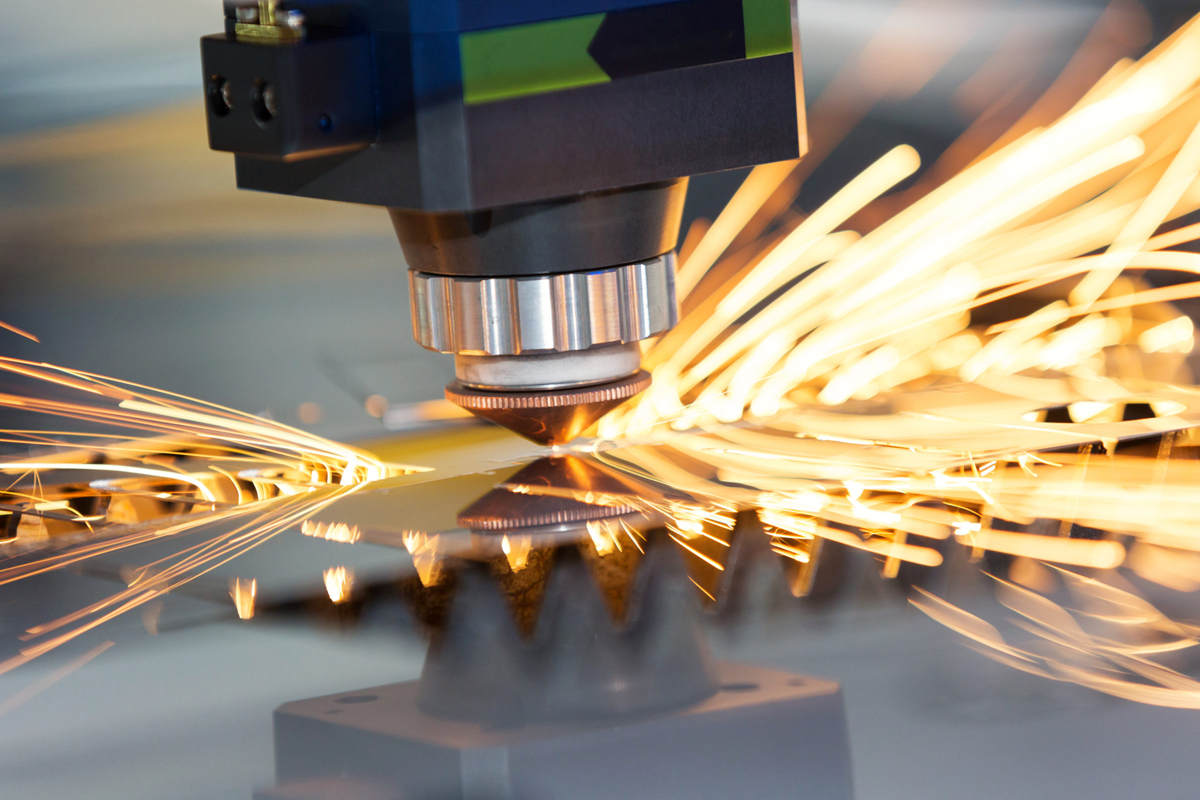
How Each Process Works
Laser Cutting
Plasma Cutting
Materials and Thickness Ranges
Laser Cutting
Laser cutting is highly versatile and can process both metals and non-metals. Commonly cut materials include:
- Metals: stainless steel, carbon steel, aluminum, copper, brass.
- Non-metals: plastics, wood, ceramics, paper, textiles, composites.
Thickness capacity:
- Most industrial lasers handle metals up to 20–25 mm, depending on machine power (6–12 kW systems are standard, with some ultra-high-power fiber lasers exceeding 30 mm).
- Sweet spot is thin to medium sheets (<12 mm), where cut quality is highest and edge finishing is minimal.
- Fiber lasers are especially effective on reflective metals (aluminum, brass, copper), overcoming limitations of older CO2 lasers.
Plasma Cutting
Plasma cutting is limited to electrically conductive metals, but within that category, it dominates in heavy plate applications. Materials commonly cut include:
- Ferrous metals: carbon steel, stainless steel.
- Non-ferrous metals: aluminum, copper, brass.
Thickness capacity:
- Standard plasma machines cut up to 50 mm (2 inches) efficiently.
- High-definition plasma systems can reach 75 mm (3 inches) with acceptable quality.
- Heavy-duty industrial plasma torches can handle over 150 mm (6 inches), though cut quality decreases at extreme thicknesses.
- The best productivity range is 6–50 mm, where plasma is faster and more cost-effective than lasers.
Cut Quality, Tolerances, and Edge Condition
Edge Roughness and Heat-Affected Zone (HAZ)
- Laser Cutting: Produces smooth, almost glassy edges with minimal burr or slag. The beam’s extremely narrow kerf and controlled heat input result in a very small HAZ—often less than 0.3–0.5 mm. This means the material near the cut retains its original properties, and distortion is negligible. In many thin-sheet applications, the edge is “assembly-ready” straight off the machine.
- Plasma Cutting: Edges are rougher, with more dross and noticeable striations, especially as thickness increases. The plasma jet’s broader profile and higher thermal load create a larger HAZ—commonly 1–3 mm—which can slightly harden the edge or cause warping in thinner sections. Cleanup with grinding or machining is standard in precision work.
Accuracy and Feature Fidelity
- Laser Cutting: Offers extremely tight tolerances, typically ±0.05–0.1 mm, with kerf widths as narrow as 0.1–0.3 mm depending on material thickness. Small holes, sharp corners, and intricate cutouts maintain definition, making laser cutting the tool of choice for aerospace, medical devices, and other industries where micrometer-level accuracy matters.
- Plasma Cutting: Standard tolerance is broader, around ±0.3–0.5 mm, with kerf widths closer to 1.5–3 mm. This makes fine features less accurate, and small holes may taper or lose roundness. High-definition plasma narrows this gap considerably, sometimes approaching ±0.2 mm, but lasers still hold the edge in fine-detail reliability.
Bevel and Weld Prep
- Laser Cutting: Produces edges that are nearly perfectly perpendicular, usually within 1° of vertical. For applications requiring weld bevels, modern 5-axis laser systems can cut precise angles directly, reducing or eliminating manual grinding. This is a huge advantage for parts that move straight into fabrication.
- Plasma Cutting: The plasma arc naturally produces a conical kerf, which often leaves edges with a slight bevel angle of 1–3°. For many structural applications, this is acceptable and may even aid weld penetration. However, for high-spec welds, additional beveling or machining is often needed. Bevel-capable plasma heads exist, but don’t achieve the same consistency as lasers.
Speed, Piercing, and Productivity
Cutting Speed
- Laser Cutting: On thin to medium sheets (under ~12 mm), lasers—especially modern fiber lasers—are unmatched in speed. For instance, a 6 kW fiber laser can cut 3 mm stainless steel several times faster than plasma, while producing smoother edges. As thickness increases, however, laser speed drops sharply. Beyond ~20–25 mm, plasma usually takes the lead.
- Plasma Cutting: Designed for high-speed work on thicker materials. Plasma torches can cut through 25 mm carbon steel in a single pass faster than a laser, and industrial systems can tackle plates up to 50 mm at production speed. While plasma can cut a thin sheet, quality issues (dross, wider kerf) reduce its advantage there.
Piercing Performance
- Laser Cutting: Piercing time is negligible on thin materials but increases significantly with thickness. A 20 mm steel plate can take several seconds to pierce, slowing cycle time on jobs with many holes or internal features. High-pressure assist gases and advanced piercing cycles reduce delays but don’t eliminate them.
- Plasma Cutting: Excels at piercing, even on thick plate. The plasma arc blasts through quickly, often in under a second for moderate thicknesses. This rapid piercing gives plasma an edge on heavy jobs requiring hundreds of holes or frequent start/stop cycles.
Overall Productivity
- Laser Cutting: Best suited for production runs where precision, part complexity, and minimal post-processing matter. Lasers pair well with automation—such as material handling systems, load/unload stations, and nesting software—maximizing uptime. However, productivity declines on very thick materials due to slower speeds and longer pierce times.
- Plasma Cutting: Shines in heavy fabrication where throughput is measured by tons of steel per shift rather than fine detail. Plasma tables handle large plate sizes, rugged materials, and thick cuts efficiently. While edges may need cleanup, the overall throughput is hard to match when cutting thick steel at volume.
Consumables, Maintenance, and Operating Culture
Laser Consumables and Care
- Consumables: Lasers require relatively few consumables. The main items are nozzles, lenses, protective windows, and assist gases (oxygen, nitrogen, compressed air). Consumables last longer than plasma parts but must be kept clean and properly aligned to maintain beam quality.
- Maintenance Culture: Laser cutting demands a precision mindset. Operators must monitor optical components for contamination, maintain a dust-free environment, and regularly check gas purity. A dirty lens or misaligned beam can quickly degrade cut quality. Maintenance tasks are less frequent but more exacting, often requiring skilled technicians.
- Operating Costs: While assist gases (especially nitrogen) can be expensive, other consumable costs are relatively low. A well-maintained laser cutting system can run with high consistency and predictable expenses.
Plasma Consumables and Care
- Consumables: Plasma torches consume electrodes, nozzles, shields, and swirl rings—parts that endure extreme heat and wear quickly. Lifespan depends on cutting amperage, gas quality, and operator skill, but consumables are replaced regularly, sometimes daily in heavy production.
- Maintenance Culture: Plasma cutting demands a production mindset. Operators are expected to monitor arc quality and swap consumables proactively. While individual consumables are inexpensive compared to laser optics, frequent changes add to operating costs and require hands-on oversight. Maintaining proper gas flow and cooling is also critical to extending consumable life.
- Operating Costs: Consumables represent a significant portion of plasma’s running expenses, especially in high-volume shops. However, the lower capital cost of plasma cutting machines offsets this for many users.
Power, Energy, and Infrastructure
Laser Cutting
- Electrical Demand: Fiber lasers are far more energy-efficient than older CO2 laser cutting systems, often converting 30–40% of electrical input into cutting power. Typical machines require 20–50 kW of connected load, depending on wattage.
- Gas Supply: Assisted gases (oxygen, nitrogen, or compressed air) are critical. High-purity nitrogen in particular can be costly, requiring either bulk tanks or onsite generation.
- Cooling: Lasers need precise thermal management. Most systems use external chillers to keep optics and laser sources within tight temperature ranges.
- Ventilation: Because lasers can cut metals and non-metals, fume extraction systems must be tailored to capture fine particulates and vapors without disturbing the beam path.
- Infrastructure Culture: A laser setup demands a clean, controlled environment with stable power and gas quality. Infrastructure investment is higher upfront but supports consistent, precision operation.
Plasma Cutting
- Electrical Demand: Plasma cutting is less energy-efficient than lasers. A system rated at 400 amps can require 60–100 kW of connected load, especially for a thick plate. Energy costs rise with amperage and duty cycle.
- Gas Supply: Plasma torches rely on compressed air or gases such as oxygen, nitrogen, or argon-hydrogen mixes. Air compressors must be sized to deliver steady, high-volume flow at pressure, and gas quality directly affects consumable life.
- Cooling: Smaller plasma units are air-cooled, but high-powered industrial cutting systems use liquid cooling to manage electrode and nozzle heat.
- Ventilation: Plasma produces significant fumes, molten spatter, and UV radiation, requiring robust extraction and protective systems. In large plate shops, downdraft tables or water tables are standard for dust and smoke control.
- Infrastructure Culture: Plasma cutting systems are rugged and less sensitive to environmental conditions, but demand large power feeds and robust ventilation to keep up with heavy-duty cutting.
Training, Workflows, and the Human Factor
Laser Cutting
- Training Needs: Operators must understand CAD/CAM software, nesting strategies, and the interplay between cutting parameters (power, focus, gas type, gas pressure). Training often emphasizes programming skills and machine calibration rather than manual torch control.
- Workflow Discipline: Lasers perform best in clean, organized environments with consistent material input. Workflow often involves automation—automatic loaders, unloaders, and conveyors—where operators shift from “manual cutting” to overseeing processes and troubleshooting.
- Human Factor: Precision makes lasers less forgiving of mistakes. Incorrect gas selection, dirty optics, or poor parameter settings can lead to costly downtime. Operators need a detail-oriented mindset, treating the machine more like lab equipment than a shop tool.
Plasma Cutting
- Training Needs: Plasma operators require strong hands-on skills in torch setup, consumable selection, and recognizing wear. Programming is simpler than for lasers, but experience matters in adjusting parameters for thickness and material type.
- Workflow Discipline: Plasma shops typically emphasize throughput and robustness. Material may be less uniform, and handling is more manual, especially with large, heavy plates. Workflows are built for speed and adaptability rather than surgical precision.
- Human Factor: Plasma tolerates more variation in operator technique, but it rewards attentiveness. Consumables wear quickly, and ignoring arc quality or gas pressure can dramatically shorten lifespan. Plasma operators often develop an intuitive “feel” for the machine, catching issues before they affect cut quality.
Safety Considerations
Laser Cutting
- Radiation Risk: Industrial lasers operate at wavelengths invisible to the human eye (typically infrared). Direct exposure, even for milliseconds, can cause permanent retinal damage. This makes beam containment and interlock systems critical.
- Fume Extraction: Cutting metals and plastics with lasers can release fine particulates and toxic fumes. Proper fume extraction and filtration are mandatory to maintain air quality.
- Fire Risk: Because lasers can ignite combustible materials, fire suppression systems and material monitoring are part of standard safety setups.
- Operating Culture: Lasers are usually enclosed in protective housings with access interlocks, making them safer for operators in day-to-day use. However, safety depends heavily on infrastructure discipline—well-maintained optics, clean environments, and reliable enclosures.
Plasma Cutting
- Arc and UV Exposure: Plasma arcs produce intense UV and visible light that can cause “arc eye” or skin burns. Operators require welding-grade PPE, including helmets, shields, and protective clothing.
- Heat and Spatter: Plasma cutting ejects molten metal at high speed, presenting burn and fire hazards. Work areas must be clear of flammables, and operators must wear flame-resistant gear.
- Noise and Vibration: Plasma cutting systems generate noise levels above 90 dB, requiring hearing protection. The arc and compressed air also create vibration, adding to operator fatigue.
- Fume Generation: Plasma cutting produces significant fumes and metallic particulates, especially when cutting galvanized or coated steels. Downdraft or water tables are standard for capturing contaminants at the source.
- Operating Culture: Plasma cutting is typically run in open tables, requiring more reliance on operator PPE and awareness compared to lasers’ enclosed systems. It’s rugged but less contained, meaning human protection plays a bigger role.
Environmental and Regulatory Considerations
Laser Cutting
- Emissions and Air Quality: Laser cutting produces fine particulates and vapors, especially when processing coated or plastic-backed metals. However, compared to plasma, emission volumes are generally lower because of the narrow kerf and efficient energy use. High-efficiency fume extraction and filtration systems (HEPA or activated carbon) are required to meet OSHA/NIOSH exposure limits and EPA air quality standards.
- Energy Efficiency: Fiber lasers are relatively energy-efficient, converting up to 30–40% of input power into cutting energy. This translates to lower greenhouse gas emissions per cut, especially when paired with renewable electricity sources.
- Gas Usage: The main environmental burden comes from assist gases. Oxygen and nitrogen must be produced, stored, and transported, which carries a carbon footprint. Bulk tanks or on-site nitrogen generators are common in high-volume shops, but regulators may require safe handling protocols for compressed gases.
- Regulatory Culture: Lasers often fit neatly into clean manufacturing environments, but operators must comply with laser safety standards (ANSI Z136, IEC 60825), ensuring beam containment and labeling. Environmental focus is usually on fume management and gas efficiency.
Plasma Cutting
- Emissions and Air Quality: Plasma cutting generates higher volumes of fumes, ozone, and metal particulates than lasers due to its higher thermal load and wider kerf. Cutting galvanized, painted, or coated steel releases toxic byproducts (zinc oxide, lead, VOCs). This makes robust local exhaust ventilation—such as downdraft tables or water tables—essential for compliance with occupational health standards.
- Energy Consumption: Plasma cutting is less energy-efficient, converting less of its electrical input into cutting power. Heavy-duty cutting systems can draw 60–100 kW or more, increasing both operational cost and environmental footprint.
- Noise Pollution: Plasma cutting is much noisier than laser cutting, often exceeding 90–100 dB, requiring hearing protection and compliance with workplace noise regulations.
- Regulatory Culture: Plasma shops must manage fume capture, noise exposure, and electrical load carefully to comply with OSHA, EPA, and local environmental agencies. Water tables also raise disposal concerns, as contaminated water must be treated before discharge.
Maintenance and Reliability
Laser Cutting
- Key Maintenance Tasks: Regular cleaning and replacement of lenses, protective windows, and nozzles; monitoring and maintaining assist gas purity; servicing the chiller and fume extraction units. Fiber lasers require less maintenance than older CO2 laser cutting systems (no resonator mirrors or turbine blowers), but optical cleanliness remains critical.
- Frequency: Intervals are generally longer. Optics may need weekly inspection, while gas systems and chillers require scheduled service every few months. Preventive maintenance contracts are common in precision shops.
- Reliability Profile: Lasers are highly reliable when operated in clean, controlled environments. Machine uptime is predictable, and performance consistency is excellent, but small oversights (like a dirty lens) can sharply degrade cut quality.
- Operator Culture: Precision-oriented—operators must follow strict cleaning routines and handle consumables carefully. With discipline, lasers deliver stable output over years of operation.
Plasma Cutting
- Key Maintenance Tasks: Frequent replacement of electrodes, nozzles, shields, and swirl rings, often daily or weekly, depending on usage. Checking torch alignment, gas flow, and cooling systems is routine.
- Frequency: High. Consumable turnover is the main maintenance burden, and ignoring wear leads to poor cut quality, wasted material, and higher costs. Downdraft or water tables also require regular cleaning to handle slag buildup.
- Reliability Profile: Plasma machines are robust and continue running in harsher environments than lasers. Reliability depends on consumable quality and operator attentiveness—skilled operators can maximize torch life, while poor habits shorten it. Even so, downtime for consumable changes is built into daily workflows.
- Operator Culture: Production-oriented—operators are trained to “feel” when consumables are wearing out and swap them quickly to minimize downtime. Plasma reliability is about ruggedness and recoverability rather than precision.
Software, Automation, and Line Integration
CAD/CAM and Nesting
- Laser Cutting: CAD/CAM software drives precision, optimizing cut paths for minimal heat buildup and distortion. Nesting software is critical to maximize material use when cutting thin sheets, where scrap reduction has a direct cost impact. Laser cutting also allows integration with ERP/MES systems for digital part tracking and scheduling.
- Plasma Cutting: Plasma cutting relies on simpler nesting strategies but benefits from high-speed path optimization to reduce arc-on time and consumable wear. Nesting precision is less critical than with lasers since tolerances are wider, but for a thick plate, efficient layout reduces crane and plate-handling movements.
Height Control and Focus
- Laser Cutting: Dynamic autofocus systems adjust focal length in real time, ensuring consistent kerf width and edge quality even on warped or uneven material. Capacitive sensors monitor standoff distance with micron-level accuracy. This is crucial in high-precision cutting where tolerance stacks matter.
- Plasma Cutting: Torch height control systems maintain optimal arc length above the workpiece. These systems are rugged and fast, designed to handle warped plates and thicker materials. While less precise than laser focus control, they are essential for consumable life and consistent cut quality.
Sensors and Analytics
- Laser Cutting: Modern lasers are packed with sensors—beam monitoring, pierce detection, nozzle wear sensors, and even real-time cut diagnostics. These feed into analytics platforms for predictive maintenance and process optimization, aligning with Industry 4.0 initiatives.
- Plasma Cutting: Plasma machines also use sensors, particularly for arc voltage, gas flow, and consumable condition. While analytics are less advanced than lasers, high-definition plasma cutting systems increasingly integrate with monitoring platforms to improve uptime and consumable tracking.
Material Handling
- Laser Cutting: Often paired with automated sheet loaders/unloaders, conveyors, and part sorting systems. Integration is common in lights-out manufacturing cells where one operator can oversee multiple machines. Material handling minimizes downtime between sheets and maximizes throughput in precision production.
- Plasma Cutting: Material handling is more manual due to the size and weight of the plates. Overhead cranes or forklifts are common. However, large plasma cutting tables are designed to handle heavy plates quickly, and automation can be added in high-volume shipbuilding or structural steel applications.
Downstream Processes
- Laser Cutting: Produces parts that often move directly into bending, welding, or finishing with little or no secondary work. Precision and clean edges simplify downstream workflows, reducing overall process time.
- Plasma Cutting: Edges usually need grinding, machining, or cleaning before welding or finishing. This adds steps but is accepted in industries where the throughput of thick materials is the priority. Plasma’s strength lies in moving heavy parts quickly to fabrication, not in eliminating finishing steps.
Troubleshooting Common Cut Defects
Dross (Top / Bottom)
Laser Cutting
- Likely Causes:
- Bottom dross: cutting too slowly, low gas pressure, and focusing too deeply.
- Top dross: assist gas pressure too high, nozzle misalignment, poor gas flow.
- Material-related: reflective surfaces (aluminum, brass) worsen dross if optics aren’t optimized.
- Corrective Actions:
- Raise cutting speed slightly to reduce melt buildup.
- Adjust focus closer to the surface (too deep increases bottom dross).
- Optimize assist gas type/pressure (e.g., nitrogen for stainless to avoid oxidized edges).
- Replace or realign nozzles.
- Prevention: Keep optics clean, use consistent material surfaces, and maintain gas purity.
Plasma Cutting
- Likely Causes:
- Bottom dross: travel speed too slow, arc voltage too low.
- Top dross: cutting too fast, torch standoff too high.
- Consumables: worn electrodes/nozzles degrade arc stability.
- Corrective Actions:
- Adjust speed depending on defect type.
- Verify arc voltage settings and automatic height control.
- Replace consumables proactively.
- Prevention: Use high-quality consumables, keep the gas supply dry/clean, and calibrate height control regularly.
Angularity / Taper
Laser Cutting
- Likely Causes: Beam divergence, incorrect focal point, or low beam quality (poor mode).
- Corrective Actions:
- Recalibrate focus height.
- Clean optics; dirty lenses/mirrors scatter the beam.
- Use higher wattage or improved beam quality for thicker plates.
- Prevention: Regular beam path checks, proper nozzle size selection, and preventive lens/window cleaning.
Plasma Cutting
- Likely Causes: Plasma arc’s natural conical shape; worsened by worn nozzles, wrong gas swirl, and incorrect standoff height.
- Corrective Actions:
- Replace nozzles/electrodes.
- Fine-tune torch-to-work distance using height control.
- Select the correct amperage/gas combination for plate thickness.
- Prevention: Invest in high-definition plasma (better arc constriction reduces taper), maintain gas swirl rings, and monitor arc voltage.
Rough Edge / Striations
Laser Cutting
- Likely Causes: Low laser power for thickness, dirty/misaligned optics, nozzle turbulence, or cutting too fast/slow.
- Corrective Actions:
- Increase power or reduce speed to balance melting/vaporization.
- Clean/replace lenses, protective windows, or nozzles.
- Check gas flow for leaks or turbulence.
- Prevention: Keep optics clean, use proper nozzles for thickness, and run periodic cut-quality tests.
Plasma Cutting
- Likely Causes: Excessive travel speed, poor gas pressure/quality (e.g., moisture in air), worn consumables.
- Corrective Actions:
- Slow speed slightly to allow full penetration.
- Inspect compressors/dryers; contaminants in gas create unstable arcs.
- Replace consumables before arc performance declines.
- Prevention: Maintain a clean, dry gas supply; monitor arc voltage regularly; use recommended consumable sets for specific thickness ranges.
Poor Holes / Out-of-Round
Laser Cutting
- Likely Causes: Poor pierce cycle control, misaligned beam path, low beam quality, or incorrect lead-in programming.
- Corrective Actions:
- Use spiral or ramped pierce cycles for a thick plate.
- Align nozzle/beam; check for lens contamination.
- Optimize CAM lead-in/out settings.
- Prevention: Regular optical alignment, consistent gas pressure, and periodic calibration cuts for hole quality.
Plasma Cutting
- Likely Causes: Natural taper due to arc shape; exaggerated if hole diameter <1.5–2× material thickness. Incorrect torch height or lead-ins worsen defects.
- Corrective Actions:
- Reduce torch height, optimize travel speed.
- Use hole-cutting routines available in high-definition plasma systems (specialized lead-ins, dwell times).
- Avoid cutting small-diameter holes in thick plate when possible.
- Prevention: Program parts with hole diameter ≥2× plate thickness, use high-definition consumables, and regularly calibrate height control.
While laser cutting machines and plasma cutting machines share defect categories, the root causes and fixes are technology-specific:
- Laser Cutting: Sensitive to optics, gas flow, and precision parameter control. Most issues are solved by recalibrating, cleaning, or adjusting focus/speed.
- Plasma Cutting: Sensitive to consumable wear, torch height, and gas quality. Most issues are solved by replacing consumables, maintaining gas supply, or fine-tuning the torch setup.
Cost
Capital Expenditure (Capex)
Laser Cutting
- Machines typically cost $20,000–$1,000,000+, depending on wattage and table size.
- Automation (load/unload towers, pallet changers) can add $100,000–$500,000.
- Requires climate control, chillers, and high-pressure gas systems.
- ROI depends on automation, precision, and reduced downstream finishing.
Plasma Cutting
- Machines range $5,000–$250,000, with high-definition models at the upper end.
- Infrastructure needs are lighter—rugged environments are acceptable.
- Attractive for small shops or heavy fabrication where budget constraints are tight.
Operating Expenditure (Opex)
Laser Cutting
- Consumables: Few (nozzles, optics, protective windows), but sensitive to dirt and damage.
- Assist gases: A major cost driver—nitrogen bills can reach $1,000–$3,000/month.
- Energy: Fiber lasers convert 30–40% of power into cutting energy; more efficient than plasma.
- Labor: Automation reduces operator time per part.
- Maintenance: Scheduled service contracts typically $15,000–$30,000/year.
Plasma Cutting
- Consumables: Electrodes, nozzles, and shields are replaced frequently; annual costs $20,000–$50,000 in busy shops.
- Gases: Compressed air or oxygen/nitrogen blends—cheaper than laser gases.
- Energy: Heavy power draw (60–100 kW) on thick plate cutting.
- Labor: Higher—consumables require monitoring and swapping; plate handling is more manual.
- Maintenance: Frequent, hands-on, but simple to perform.
Total Cost of Partnership (TCP)
Laser Cutting
- Predictable operating costs and minimal rework reduce lifecycle expenses.
- Strong fit with digital workflows (CAD/CAM, ERP, MES) and automation.
- Suppliers often provide predictive maintenance and remote support.
- Best ROI in industries where precision saves downstream labor (aerospace, medical, automotive).
Plasma Cutting
- Rugged systems thrive in tough environments with less sensitivity.
- Lower upfront spend spreads risk for smaller shops.
- Consumables and energy bills accumulate, often narrowing the Capex advantage over 5–10 years.
- Best ROI in industries where throughput > perfection (shipbuilding, construction, heavy equipment).
Choosing the Right Process
Primary Thickness Range and Format
The thickness of your typical material and the size of your workpieces are the most immediate decision drivers. Each technology has a “sweet spot” where it outperforms the other.
- Laser Cutting: Best for thin-to-medium sheets (<20–25 mm) and mixed-material runs. Optimized for standard sheet sizes with automated loading/unloading.
- Plasma Cutting: Best for medium-to-thick plate (>25 mm), and better equipped for oversized plate formats. Rugged plasma tables handle crane-loaded steel efficiently.
Tolerances and Feature Size
Precision requirements often determine whether a laser or plasma is viable. If your customers demand tight tolerances or complex geometries, the differences are stark.
- Laser Cutting: Delivers ±0.05–0.1 mm tolerances with narrow kerf widths (~0.1–0.3 mm). Ideal for sharp corners, fine holes, and parts requiring an exact fit.
- Plasma Cutting: Typical tolerances are ±0.3–0.5 mm (±0.2 mm with high-definition). Adequate for structural or heavy-fabrication work, but not suitable for fine detail.
Edge Condition and Downstream Steps
The quality of the cut edge impacts what happens next—whether parts go straight into assembly or require grinding and prep.
- Laser Cutting: Produces smooth, perpendicular, weld-ready edges with minimal burr. Little or no secondary finishing required.
- Plasma Cutting: Produces rougher edges, bevel angles (1–3°), and more dross. Grinding or machining is usually required before welding or coating.
Throughput Economics
Cutting speed and productivity vary depending on thickness. The real question is: which technology cuts faster in your material range, and how does that translate into throughput?
- Laser Cutting: Faster on thin-to-medium sheets (<12 mm). Slows down significantly on a thick plate. Shines in automated, lights-out environments.
- Plasma Cutting: Faster on thick plate (>20 mm). Pierces quickly and sustains high productivity for large-volume heavy steel jobs.
Budget and Scalability
Upfront investment and growth strategy strongly influence the choice. Lasers scale with automation; plasma scales with additional machines.
- Laser Cutting: High Capex ($20k–$1M+ with automation). Scales via material towers, pallet changers, and smart integration.
- Plasma Cutting: Low Capex ($5k–$250k). Scales more easily by adding additional tables, but with higher operator labor.
Long-Term OPEX
Running costs—consumables, gases, energy, and labor—define the economics over years of use. Predictability vs variability is a major difference.
- Laser Cutting: Fewer consumables, but expensive gases (nitrogen, oxygen). Energy-efficient (30–40% conversion). Predictable OPEX and lower labor due to automation.
- Plasma Cutting: High consumable turnover ($20k–$50k/year in busy shops). Lower gas cost (compressed air/oxygen blends). Higher electricity draw and more operator involvement.
Future Mix
A machine should serve today’s workload but also tomorrow’s. Future product diversification vs specialization often determines the smarter choice.
- Laser Cutting: Flexible—handles metals and non-metals, can also engrave/etch. Industry 4.0-ready with strong automation and software integration.
- Plasma Cutting: Specialized—limited to conductive metals, excels in heavy plate. Best for shops confident their future lies in thick, rugged steel fabrication.
- Laser Cutting: Precision, flexibility, automation, and predictable downstream savings. Best for thin-to-medium materials with tight tolerances and evolving product lines.
- Plasma Cutting: Throughput, ruggedness, affordability, and speed on thick plate. Best for heavy-duty industries where volume and cost per ton matter more than perfect edges.
How to Choose: Laser Cutting or Plasma Cutting
Choose Laser Cutting If
- Extreme Precision and Fine Detail are Required: Laser cutting is the ideal choice when you need high precision and intricate designs. The laser beam is extremely focused, allowing for detailed cuts with very tight tolerances, as small as 0.1 mm. This makes it the best option for applications requiring fine patterns, small holes, or complex geometries that demand precision.
- Thin Materials or Very Lightweight Parts: If you are working with thin materials, laser cutting provides clean, sharp edges without significant heat distortion. It’s particularly effective for materials up to 20 mm thick. Laser cutting can achieve higher cutting speeds and better quality on these materials than plasma cutting, making it a superior choice for delicate or lightweight parts.
- Non-Metal or Reflective Materials: Laser cutting can easily handle non-metal materials like plastics, wood, glass, and ceramics. It’s also an excellent choice for reflective materials, such as aluminum or copper, which can be problematic for plasma cutting unless specialized equipment is used. The versatility of laser cutting across materials makes it a great option when cutting a variety of material types is necessary.
- Parts Require Little to No Post-Processing: Laser cutting produces smooth, clean edges with minimal burrs or dross. Because of this, parts cut with lasers often require little to no additional finishing work, which can save both time and money on post-processing steps like sanding, grinding, or deburring.
- High Volume Production of Small/Medium Parts: When producing a high volume of small to medium-sized parts, laser cutting is efficient and ideal due to its precision, speed, and consistency. The system can be easily automated with CNC machines for continuous, high-volume production, making it a reliable option for mass production.
- Available Budget for Investment: While the initial investment in a laser cutting system is typically higher than plasma cutting, it may be justified if your operations require the precision and versatility that laser cutting offers. If you have the available budget for equipment and are looking for long-term productivity, laser cutting systems provide excellent ROI in the right circumstances.
- Minimal Heat Affected Zone (HAZ) or Distortion Allowed: If minimizing heat-affected zones (HAZ) and material distortion is critical to the integrity of the part, laser cutting is a better option. The focused laser minimizes the thermal effect on the surrounding material, reducing the risk of warping or dimensional changes, especially on thin metals and intricate parts.
Choose Plasma Cutting If
- Thick Materials are the Norm: Plasma cutting excels at cutting thicker materials, particularly for plates over 10 mm thick, and it can cut through materials up to 150 mm or more, depending on the plasma system. For projects involving thicker metals like structural steel, plasma cutting offers high-speed cutting capabilities, making it more efficient than laser cutting for heavy-duty material.
- Ultimate Edge Quality is Not Critical: Plasma cutting is an excellent option when edge quality is less critical. While it provides fast and effective cuts, the edges can sometimes be rough, with a wider kerf and dross formation. If post-processing (such as grinding or sanding) is acceptable, plasma cutting can still deliver good results at a lower cost.
- Cost Sensitivity / Budget Constraints: If budget is a major consideration and the cutting application doesn’t require the ultra-high precision of laser cutting, plasma cutting is more affordable. Plasma systems typically have a lower initial investment and operating costs, offering a more cost-effective solution for businesses with limited budgets, especially for heavy-duty applications.
- Cutting Primarily Common Metals with Moderate Precision: Plasma cutting is ideal for cutting ferrous metals (like carbon steel) and non-ferrous metals (like aluminum and copper) when moderate precision is sufficient. It’s well-suited for applications where the highest level of detail and finish is not critical but where speed and efficiency are more important.
- Large Part Profiles or Low Batch Counts: Plasma cutting is well-suited for large part profiles or when you need to cut larger sheets of material quickly. If you are working with low batch counts or need to cut fewer parts with a quick turnaround time, plasma cutting provides high throughput without the investment needed for complex, high-precision laser systems.
- Portability and On-Site Work: Plasma cutting systems are typically more portable than laser systems, making them an excellent choice for on-site cutting or mobile applications. Whether in construction, shipbuilding, or other industrial settings, plasma cutters can be easily moved to different locations for cutting large pieces of material.
- Ease of Maintenance and Use: Plasma cutting systems are generally easier to maintain and operate than laser systems. They have fewer components that require regular maintenance, and many modern plasma cutters are user-friendly, making them more suitable for environments where simplicity and quick setup are priorities. For those who need to minimize downtime and maintain high productivity, plasma systems offer ease of use with low maintenance costs.
Summary
Get Laser Cutting Solutions
Drawing upon years of deep expertise in industrial laser cutting, welding, marking, and cleaning, this article presents information based on practical experience and the latest industry insights. By providing clear and technically sound guidance, it helps readers select the right machines, understand process trade-offs, and optimize workflows.
My goal is to help engineers, shop floor managers, and production decision-makers make informed choices that perfectly combine innovation, quality, and operational efficiency.
Drawing upon years of deep expertise in industrial laser cutting, welding, marking, and cleaning, this article presents information based on practical experience and the latest industry insights. By providing clear and technically sound guidance, it helps readers select the right machines, understand process trade-offs, and optimize workflows.
My goal is to help engineers, shop floor managers, and production decision-makers make informed choices that perfectly combine innovation, quality, and operational efficiency.